The Physical Layer That Comes After the Fiber
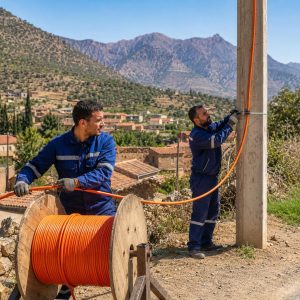
Algeria has spent five years pouring capital into the physical layer of the internet — fiber to the home, new submarine landings, and upgraded backbone capacity. The fiber milestone is real and measurable: TechAfrica News reported that Algeria crossed 3 million FTTH households in February 2026, and TelecomLead put the precise figure at 3.1 million FTTH subscribers by that month — a fiber base that has doubled within two years, heading toward a 7-million-household target by 2027.
That demand is not theoretical. National annual data consumption now exceeds 3.3 billion gigabytes, up from roughly 379.7 million GB in Q2 2020 — close to a 9x rise in five years. The baseline FTTH tier moved from 60 Mbps to 100 Mbps in April 2026 at no extra cost, and median download speeds reached 53.1 Mbps in Q2 2026, up from around 10 Mbps in 2023. Every one of those gigabytes has to be served from somewhere.
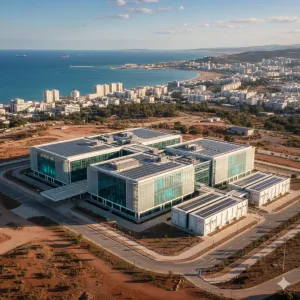
Here is the opportunity. A large share of that traffic is still fetched from servers and caches sitting in Europe. When an Algerian user loads a video, a software update, or a popular app, the bytes often travel from Marseille or Valencia and back. That round trip adds latency and means ISPs keep buying international transit capacity in hard currency. The fiber is the road; the next thing Algeria can build is the warehouse beside the road — a place to store and serve the content locally. That warehouse is a carrier-neutral data center.
What “Carrier-Neutral” Actually Means
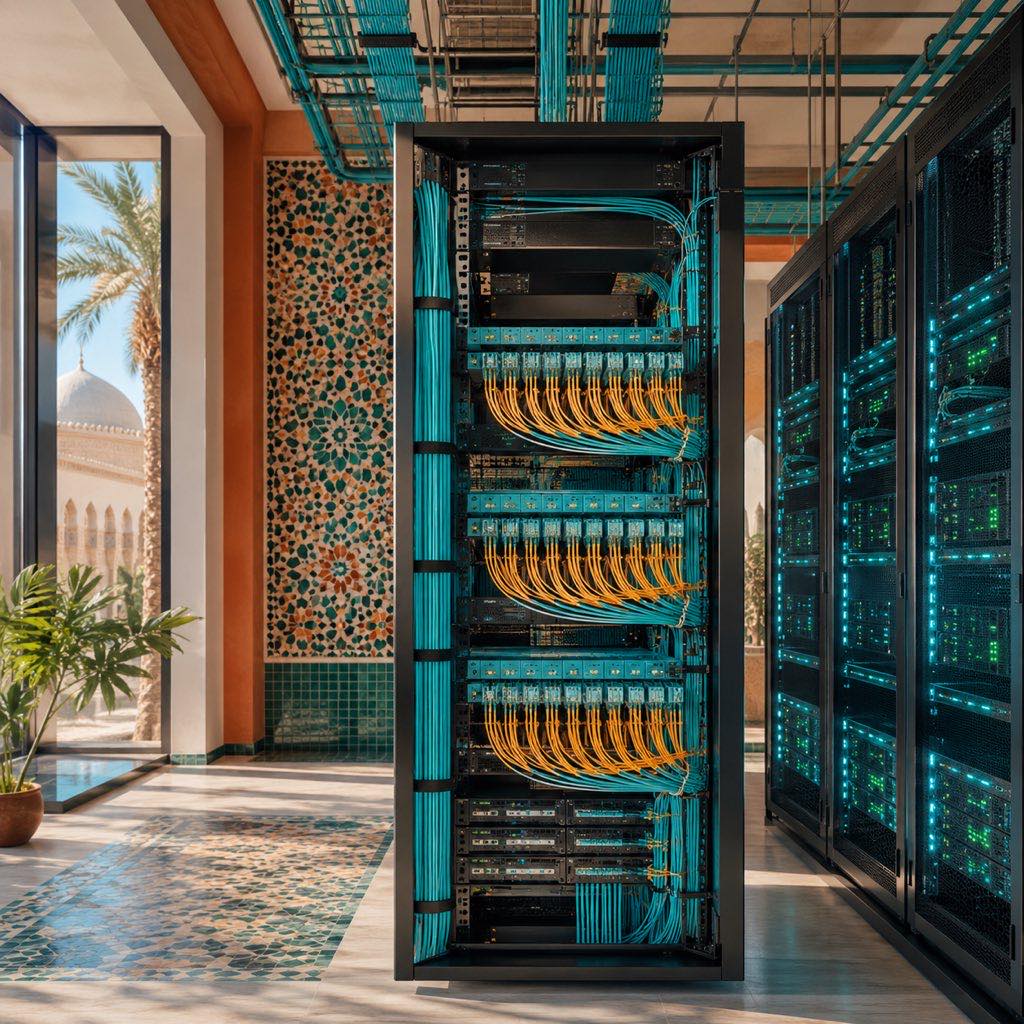
Most existing Algerian data center capacity is operator-owned: a telecom or ISP builds a facility primarily for its own services. A carrier-neutral facility is different by design. It belongs to none of the networks that plug into it, so every ISP, every hosting company, and every global content provider can colocate equipment on equal terms and interconnect with each other inside the same building. DataCenterMap currently lists six facilities from five operators in Algeria, including ICOSNET’s Tier III data center in Cheraga, Algiers — a strong base of cloud and colocation capacity to build a neutral interconnection layer on top of.
Neutrality is what unlocks the network effect. Once enough networks share one roof, it becomes economically rational for a global CDN — Cloudflare already runs points of presence in Algiers, Annaba, and Constantine — to place a caching server inside that building. From there, the most-requested 60-80% of internet content (video, app stores, software updates, social media assets) is served from inside Algeria instead of across the Mediterranean. The same logic powers the internet exchange point opportunity: neutral colocation is the room where the IXP fabric and the CDN caches physically live.
The market is moving in this direction. Statista’s forecast has Algeria’s data center market growing about 5.07% a year to US$519.5 million by 2029, and Algeria’s position between Europe and Africa — reinforced by the neutral Medusa submarine cable, whose first phase completes in 2026 at up to 20 Tbps per fiber pair — makes the country a natural interconnection point rather than just an endpoint.
Advertisement
What Algerian telecom operators and hosting providers should do
1. Designate or build at least one genuinely carrier-neutral facility
The single highest-leverage move is to establish a facility whose commercial model is interconnection, not retail hosting. That means transparent cross-connect pricing, open membership for any licensed ISP, and a governance structure that no single network controls. Operators can start by carving out neutral meet-me space inside existing Tier III capacity — ICOSNET’s Cheraga site and similar facilities already have the power, cooling, and security to host a neutral interconnection room without greenfield construction.
2. Recruit global CDN caches with hard-currency math, not just goodwill
CDN operators decide where to place caches based on traffic volume and cost-per-bit. Algeria’s 3.3-billion-GB annual consumption is now large enough to justify on-shore caching. Operators should package the business case explicitly: present aggregated, anonymized traffic demand to Cloudflare, Google, and other cache-fill programs, and quantify the international transit currently bought in hard currency to serve that same content. Every gigabyte cached locally is a gigabyte that no longer needs a paid trip across the sea.
3. Make local hosting economically competitive, then market it
Today many “Algerian” hosting brands resell capacity physically located in France or Germany. A neutral, well-connected local facility flips that equation — local hosting becomes faster (lower latency to Algerian users), cheaper to operate (no cross-border transit on every request), and easier to keep compliant with data-residency expectations. Providers should move flagship workloads — government portals, e-commerce platforms, fintech apps, streaming services — onto on-shore infrastructure and use the latency and sovereignty advantages as a selling point to enterprise customers.
4. Treat the colocation layer as shared national infrastructure
No single operator captures the full value of a neutral facility, which is exactly why it tends to be under-built — the returns are distributed across the whole ecosystem. Public and private actors can coordinate so that the facility is governed as shared infrastructure: predictable pricing, published interconnection policies, and capacity planning tied to the 7-million-household fiber target. The reference points are clear — Nigeria’s IXPN ecosystem went from under 1 Tbps to over 2 Tbps of peak domestic traffic in roughly 11 months once carrier-neutral colocation and CDN caches were in place.
Where This Fits in Algeria’s 2026 Infrastructure Story
The fiber rollout and the colocation layer are two halves of the same project, sequenced in the right order. First you build the roads so the bytes can move; then you build the warehouses so the bytes have somewhere local to live. Algeria has finished the hard, capital-intensive first half — 3.1 million homes on fiber, more than 10.2 Tbps of international capacity, and a new neutral submarine cable arriving in 2026. The second half is comparatively cheap and fast, because the power, the cooling, and the Tier III shells already exist.
What ties it together is the economics of keeping value at home. Every cache placed locally, every hosting workload repatriated, and every domestic peering session established converts hard-currency transit spending into a domestic content economy — Algerian developers building on Algerian infrastructure, serving Algerian users at single-digit-millisecond latency. The fiber proved the country can execute a national infrastructure program at scale. The carrier-neutral colocation layer is the next, smaller, higher-return step that makes all that fiber pay off.
Frequently Asked Questions
What is a carrier-neutral data center and how does it differ from a normal one?
A carrier-neutral data center is owned by an operator that is not itself one of the networks using it, so any ISP, hosting company, or content provider can colocate equipment and interconnect on equal terms. A normal operator-owned facility is built mainly to serve its owner’s own customers. Neutrality is what lets many networks share one roof and exchange traffic directly, which is the precondition for local CDN caching and peering.
How much could on-shore colocation save Algeria in transit costs?
The exact figure depends on traffic mix, but the mechanism is clear: a large share of Algeria’s 3.3-billion-GB annual data consumption is currently served from Europe, and every one of those gigabytes requires international transit capacity paid for in hard currency. Caching the most-requested 60-80% of content locally removes that recurring cross-border cost for the bulk of everyday traffic, while also cutting latency for users.
Does Algeria already have the data centers to do this?
Yes — DataCenterMap lists six facilities from five operators, including a Tier III site in Cheraga, Algiers. The opportunity is not to build from scratch but to add a genuinely neutral interconnection layer on top of existing capacity, since the power, cooling, and security infrastructure are already in place. That is what makes this a months-not-years initiative.
Sources & Further Reading
- Algeria Reaches Milestone as 3 Million Households Connect to Fibre Broadband — TechAfrica News
- Best ISPs in Algeria 2026: FTTH Expansion Drives Algeria Toward Africa’s First Gigabit Society — TelecomLead
- Algeria Data Centers — 6 Facilities from 5 Operators — DataCenterMap
- Data Center — Algeria Market Forecast — Statista
- Algeria’s Internet Exchange Point Opportunity: How Local Peering Can Unlock a Domestic Content Economy — ALGERIATECH
🔗 Related Intelligence
Mapping the Gaps: How Algeria Télécom’s Fiber Survey Will Unlock Rural Cloud Access

Algeria’s Internet Exchange Point Opportunity: How Local Peering Can Unlock a Domestic Content Economy

Trans-Saharan Fiber Backbone: Algeria’s Path to Becoming the Sahel’s Digital Gateway

African Digital Summit: Algeria’s Infrastructure Bet