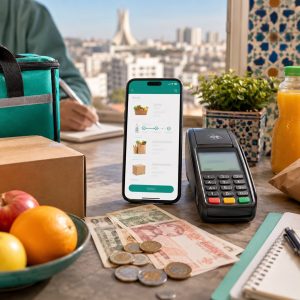
Why Global Platforms Fall Short in Algeria
Internet penetration in Algeria has surpassed 77%, according to Ecommaps’ 2026 research, and mobile commerce is the dominant shopping modality. Yet merchants who attempt to build on Shopify alone quickly encounter a wall: no native Stripe support, no PayPal for buyers, and a COD-dominant payment culture that global checkout flows are not designed to handle.
The gap between Algeria’s growing consumer demand and the availability of adapted digital tools has been the market’s central tension since at least 2020. What changed in 2024–2026 is that local players filled it. Three categories of tools now form a coherent stack: storefronts and catalog management, payment processing, and logistics and order management. Together they give an Algerian merchant an end-to-end digital commerce infrastructure built for local realities.
Understanding what each layer does — and which tool fits each stage of merchant scale — is the operational intelligence that separates successful Algerian e-commerce businesses from merchants who stall at 20 orders per day.
The Three-Layer Stack: What Algerian Merchants Need
Layer 1: Storefronts — Building a Compliant, Conversion-Optimized Shop
Ecommaps is the most complete local storefront and commerce platform operating in Algeria in 2026. Its product suite covers the full merchant journey:
- ecoBuilder — a drag-and-drop storefront design tool that produces Arabic-RTL and French-bilingual storefronts without custom development
- ecoTheme — multi-page e-commerce templates pre-optimized for Algerian mobile commerce
- EcoPOS — a cloud point-of-sale system with real-time inventory synchronization across online and offline channels
- EcoPay — built-in cash-on-delivery and logistics automation
The critical advantage Ecommaps provides over self-hosted Shopify or WooCommerce is compliance integration: invoicing is aligned with Algerian tax requirements, and the platform hosts on local infrastructure with SATIM payment acceptance baked in. For a merchant who needs to issue compliant invoices and accept local card payments without engineering resources, Ecommaps compresses months of integration work into a single platform.
Layer 2: Payment Processing — Serving CIB, Edahabia, and the Unbanked
Chargily Pay has established itself as Algeria’s most widely adopted local payment gateway. Its technical architecture accepts CIB bank cards, Edahabia (Algeria Post’s debit card, held by an estimated 10+ million Algerians), and digital wallets in a single API integration.
The Edahabia integration is particularly significant. Edahabia is not a bank account — it’s Algeria Post’s electronic payment card, widely used by public-sector workers and students who receive salaries and stipends directly into their postal account. This is a substantial population segment that global payment gateways cannot serve but that Chargily Pay reaches natively.
CartDNA’s 2026 Shopify payment guide for Algeria identifies Chargily Pay alongside CIB, Edahabia, and Tamayyuz Epay as the available local solutions. The guide emphasizes that COD remains essential — but that merchants who add card options capture a growing card-willing buyer segment without replacing their COD flow.
DZMobPay operates in the mobile payment segment, targeting buyers who use telecom operator wallets. Its integration is lighter-weight than Chargily Pay and best suited for merchants whose primary audience is mobile-first buyers with telecom credit rather than bank cards.
Layer 3: Logistics and Order Intelligence — Closing the COD Loop
The logistics layer is where Algerian e-commerce operational sophistication has grown most visibly. Yalidine, Maystro, and ZR Express each offer API integrations that connect directly to storefront and order management platforms, enabling automated dispatch once an order is confirmed.
Ecommaps’ EcoPay module integrates directly with major carriers, making multi-carrier dispatch configuration available to merchants without custom logistics engineering. For merchants above 100 orders per day, CODRocket adds an order-intelligence layer — phone-based order confirmation before dispatch — that meaningfully reduces return-to-origin rates.
Advertisement
What This Means for Algerian Merchants at Different Scales
The right stack configuration depends on where a merchant is in their growth arc.
1. Launch Phase (0–20 orders/day): Start with Ecommaps + Yalidine
A merchant launching in 2026 should start on Ecommaps rather than attempting Shopify customization. The platform handles compliance invoicing, local payment acceptance via SATIM, and carrier integration out of the box. Yalidine’s 160+ branch network provides nationwide coverage from day one, and its J+1 COD reimbursement model keeps cash flowing even at low order volumes.
2. Growth Phase (20–100 orders/day): Add Chargily Pay to Capture Card Buyers
At this scale, adding Chargily Pay to accept CIB and Edahabia orders is high-ROI: card orders carry zero RTO risk, and the integration cost is a one-time engineering task. Merchants who add card payment at this stage typically see 5–15% of orders shift from COD to card — improving blended margins and reducing logistics complexity for those orders.
3. Scale Phase (100+ orders/day): Invest in Order Intelligence and Multi-Carrier Routing
Above 100 daily orders, the limiting factor is confirmation quality and carrier routing efficiency. At this scale, CODRocket’s confirmation system (automated WhatsApp + phone team) and multi-carrier routing based on per-wilaya performance data become operational necessities, not optional add-ons.
Where This Fits in Algeria’s 2026 Digital Commerce Moment
Algeria’s local e-commerce stack in 2026 is meaningfully more complete than it was 24 months ago. The gap between what a merchant needs and what local tools provide has narrowed to a point where a serious e-commerce business can be built entirely on domestic infrastructure.
The remaining gaps are known: Shopify’s official Algerian presence is limited, international payment acceptance for foreign buyers remains constrained, and shipping to certain southern wilayat still has coverage challenges. But for the core Algerian domestic merchant targeting Algerian buyers — which is the real market for 90% of operators — the stack is functional.
Merchants who build on Ecommaps for their storefront, Chargily Pay for card acceptance, and Yalidine for logistics will find themselves better positioned than those who attempt to adapt global platforms to a market those platforms were not designed for. The local-first stack is the competitive advantage in Algeria’s e-commerce market in 2026.
Compliance Is No Longer Optional
One dimension that separates experienced Algerian e-commerce operators from newcomers is the handling of compliance infrastructure. Law 18-05 requires merchants to issue compliant invoices, display tax identification, and route payments through Bank of Algeria-authorised channels. Ecommaps’ native invoice engine is pre-aligned with DGI requirements — it generates invoices in the format Algerian tax authorities recognise and stores transaction records in a format ready for inspection.
Merchants who built their stores on Instagram DM or Facebook group listings before 2024 face retroactive compliance exposure as enforcement intensity rises. Migrating to Ecommaps is not just an operational improvement — it is a compliance upgrade that reduces the risk of fines under the Ministry of Internal Trade’s accelerating formalisation drive. The platform’s SATIM payment integration also ensures that card transactions route through Bank of Algeria-approved infrastructure, satisfying the payment-channel requirements that informal checkout solutions do not meet.
The Data Advantage of Integrated Stacks
A secondary benefit of building on an integrated local stack is the quality of operational data it generates. Merchants who run storefronts, payments, and logistics through separate, disconnected tools typically have fragmented visibility: their payment data lives in one system, their delivery data in another, and their customer profiles in neither. This fragmentation makes it impossible to calculate true per-order margin, identify which wilayas are profitable versus loss-making, or understand which product categories drive the highest return rates.
Ecommaps’ EcoPOS and EcoPay modules share a unified data layer. When a merchant routes orders through Ecommaps and connects Yalidine via the platform’s carrier API, delivery outcomes feed back into the order management system — giving the merchant a real-time view of which orders were delivered, which were returned, and what the per-wilaya delivery success rate looks like. This data infrastructure is the foundation for the scale-phase optimisation that separates merchants who grow from merchants who stall at their first 1,000 monthly orders.
Frequently Asked Questions
Is Shopify a viable platform for Algerian e-commerce merchants?
Shopify can be used in Algeria, but with significant limitations: Stripe (Shopify’s default payment processor) is not available in Algeria, and connecting local payment gateways like Chargily Pay requires custom integration work. Ecommaps, built specifically for Algeria with SATIM payment integration and bilingual Arabic/French storefronts, is generally the more practical starting point for merchants without engineering teams.
What payment methods do Algerian online buyers actually use?
Over 85% of transactions still use cash-on-delivery (COD), according to Ecommaps’ 2026 research. Among digital payment holders, Edahabia (Algeria Post’s debit card, held by 10+ million Algerians) is the most widely held card, followed by CIB bank cards. Chargily Pay accepts both in a single integration. Telecom wallet payments (DZMobPay) serve mobile-first segments without bank accounts.
Which logistics provider is best for Algerian merchants starting out?
Yalidine is the largest provider with 160+ branches across 1,469 municipalities and offers daily (J+1) COD reimbursement — ideal for cash-flow management. Maystro is popular among social commerce sellers. The right choice depends on the target wilayat: merchants should test two carriers in parallel and optimize by region based on delivery success rates, not just unit price per shipment.
Sources & Further Reading
🔗 Related Intelligence

AfCFTA Digital Trade: How Algerian E-Commerce Merchants Can Reach African Markets

Algeria’s E-Commerce Pivot: From COD Dominance to Digital Payment Adoption

Algeria’s E-Commerce Boom: 92% Annual Growth and What Comes Next for Digital Merchants

Algeria E-Commerce Fulfillment: The Warehouse Gap Holding Back a $7 Billion Market