The 939 Billion Dinars That Changed the Narrative
For years, Algeria’s digital payment story was characterised by potential deferred. The country had the population, the smartphone penetration, and the policy intent — but the transaction data told a different story. That inflection point arrived in 2025.
According to figures published in April 2026, total electronic payment value in Algeria reached 939 billion DZD in 2025, up from 643.8 billion DZD the previous year — a 46% growth rate that outpaced every optimistic projection made at the start of the Fintech Strategy 2024-2030 cycle. Online payments specifically surged 179%, reaching 145 billion DZD across more than 27 million transactions. In December 2025 alone, the peak month, 3.6 million online transactions worth 65.27 billion DZD were processed — more than the entire country processed online in any quarter just three years ago.
These are not soft metrics. The numbers cover real-money flows across Algeria’s interbank switch (SATIM), the national CCP/BaridiMob ecosystem, and the growing cohort of private payment gateways. They reflect a genuine acceleration in merchant acceptance, consumer behaviour change, and infrastructure buildout — all happening simultaneously.
What the figures also reveal is that the gap between Algeria’s cashless aspiration and its operational reality is narrowing faster than most observers expected. The question now is whether the fintech and retail ecosystem can capitalise on the infrastructure moment before the next policy cycle.
What the Terminal and Merchant Data Actually Show
1. The POS terminal rollout is real but still thin relative to population size
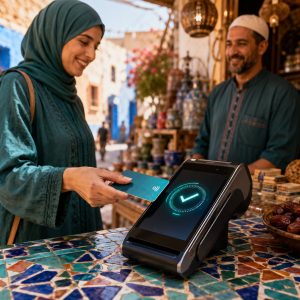
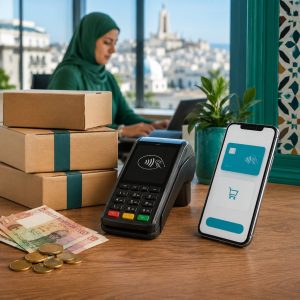
At 78,774 POS terminals by end-2025 — up 15.61% from 68,140 in December 2024 — Algeria’s acceptance network is growing. The average transaction value at POS also rose sharply, from 6,000 DZD in 2020 to over 9,000 DZD in 2025, indicating that card users are increasingly comfortable making larger purchases electronically.
However, context matters. Algeria has a population of approximately 47 million people and an estimated 1.2 million registered formal commercial entities. At 78,774 terminals, the acceptance density is roughly 1 terminal per 597 people, and the coverage of formal businesses remains well below comparable MENA markets. Egypt, with a larger informal sector, reached 1 million POS terminals in 2022. Morocco crossed 500,000. Algeria’s trajectory is upward, but the distance to coverage saturation is still significant — which is precisely where the opportunity lies for payment hardware distributors, SoftPOS app providers, and fintech startups building merchant-facing products.
The growth in POS transaction value (POS volumes doubled to 89.5 billion DZD) demonstrates that where terminals exist, they are being used more intensively. That is the critical signal: latent demand is converting into real transaction volume once acceptance infrastructure is in place.
2. Online merchant integration grew 26% — but 644 is a market still in its first chapter
The count of integrated online merchants stood at 644 by end-2025, representing 134 new integrations during the year — a 26.27% increase. The total cumulative online transactions since the system’s 2016 origin reached 84 million, with half of them completed in just the last two years.
That half-life compression is the real story. It took nine years to reach the first 42 million online transactions. The next 42 million came in roughly twenty-four months. The infrastructure has crossed a threshold where positive feedback loops are driving adoption: more merchants attract more consumers, which makes the investment in integration worthwhile for more merchants.
For fintech founders, the 644 figure should be read as an early-mover market, not a saturated one. Comparable North African markets with similar population sizes support 10,000–25,000 active online merchants. Algeria’s addressable runway before market saturation is substantial.
3. Mobile payments and QR codes are gaining genuine transaction volume
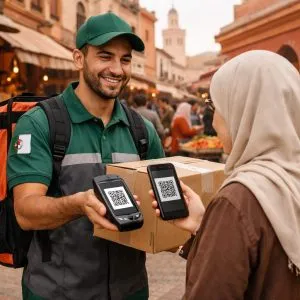
QR code payments reached 69.3 million operations in 2025, up 19% year-on-year, representing 57.3 billion DZD in value. P2P transfers via mobile climbed to 47.5 million transactions totalling 647.4 billion DZD — a 31% increase that signals growing comfort with non-cash settlement for larger personal transactions.
The DZ Mob Pay interbank service, launched in 2025, added 95,014 personal accounts and 14,283 merchant accounts in its first year of operation, with early QR code volumes of 12,682 transactions. These numbers are modest by global standards, but the month-on-month curves in the data show rapid compounding: DZ Mob Pay added more merchant accounts in Q4 2025 than in Q2 and Q3 combined.
Advertisement
What This Means for Algerian Fintech Founders and Retailers
1. Treat 2026 as the merchant acquisition window, not the product-building window
The infrastructure is now functional enough that merchant onboarding is a distribution problem, not a technical problem. The merchants who integrate payment acceptance in 2026 will capture the first cohort of digitised consumers in their category. In Brazil’s Pix rollout, merchants who onboarded in the first twelve months retained a structural advantage in customer payment preference for years afterward. Algeria’s QR and BaridiMob ecosystem is at a structurally similar early-mover stage. The competitive moat is not technology — it is being first in your merchant vertical.
2. Average ticket size growth changes the unit economics of payment processing
The rise in average POS transaction value from 6,000 DZD to over 9,000 DZD between 2020 and 2025 has a direct implication for payment processors and embedded finance providers: higher ticket sizes mean the same number of transactions generate more revenue per unit, and the business case for merchant credit (lending against transaction history) improves materially. Fintechs building merchant cash advance products in Algeria now have a five-year transaction history baseline to underwrite from.
3. Build for the online merchant integration backlog, not the already-integrated
Of Algeria’s estimated 1.2 million formal commercial entities, 644 have integrated online payments. That is an integration rate of approximately 0.05%. Even accounting for the fact that many businesses have no e-commerce use case, the total addressable market for payment gateway integrations is at minimum 50,000–80,000 entities in retail, services, and B2B trade. The winning product for the next wave of Algerian fintech will not be another consumer-facing wallet — it will be the SME payment infrastructure layer: low-friction gateway integration, instant settlement, and working capital access tied to transaction history.
The Structural Lesson: Infrastructure Matures in S-Curves
Algeria’s 46% growth in electronic payments did not arrive from a single event. It is the compound effect of years of regulatory groundwork: the 2019 interoperability mandate, the 2021 BaridiMob expansion, the 2023 QR code standard, and the 2025 Finance Law’s tax incentives for electronic payments (stamp duty exemptions, VAT and customs duty waivers on POS assembly kits through December 2027).
Payment adoption in any market follows an S-curve: slow uptake during infrastructure build, an inflection point when critical mass is achieved, then rapid diffusion. Algeria’s data suggests the country entered the steep part of that curve in 2024–2025. The 179% growth in online payments and the halving of the time to reach cumulative transaction milestones are inflection-point signatures, not outlier years.
For regional fintech investors and product builders, the pattern is familiar from Egypt (2018–2020), Morocco (2019–2021), and Kenya’s non-Pesa payment rails (2022–2024). Algeria is approximately 24–36 months behind those inflection points in aggregate — but its 947-billion-dinar market, oil-revenue-backed policy stability, and 47 million-person population make the compounding opportunity proportionally larger.
The ATM withdrawal data provides one final calibrating signal: Algerians still withdrew 4,397 billion DZD in cash in 2025, across 235 million ATM operations. Cash remains dominant in absolute terms. But the direction of travel — 46% electronic payment growth against 19% ATM growth — shows that the gap is narrowing, and narrowing faster with each passing year.
Frequently Asked Questions
What does the jump from 53,000 to 78,774 POS terminals mean for the average Algerian retailer?
The 46% increase in POS terminals means that digital payment acceptance is transitioning from a premium feature (associated with large retailers and hotels) to a baseline expectation for most commercial establishments. For the average retailer, this creates a practical competitive pressure: consumers who encounter cash-only merchants increasingly choose the competitor who accepts CIB or BaridiMob payment. The terminal rollout has been fastest in major urban centers (Algiers, Oran, Constantine) but is spreading to secondary cities in 2026.
Why did online merchant integrations only reach 644 when e-payment values are nearly 1 trillion DZD?
The 644 figure represents merchants formally integrated into Satim’s certified e-payment infrastructure for online sales. It excludes: informal peer-to-peer transfers (BaridiMob) used for e-commerce; merchants using non-certified payment workarounds; and the large informal cash-on-delivery market that still dominates Algerian e-commerce. The 939 billion DZD total includes POS terminal transactions, ATM withdrawals, and all electronic transfer types — not just e-commerce. The 644 certified online merchant figure is the legally compliant e-commerce segment, which is growing fastest in 2026.
What infrastructure or regulatory changes would accelerate the terminal and merchant growth rate beyond the current 46% pace?
Three factors would significantly accelerate adoption: first, reducing the bank processing time for merchant account applications (currently 4-8 weeks) to under 2 weeks; second, introducing merchant-side incentives (tax deductions for terminal acquisition) similar to those used in Egypt and Morocco to drive rapid POS deployment; third, expanding BaridiMob’s merchant payment capabilities to include QR-code-based checkout for online purchases, enabling the 5.4 million registered BaridiMob users to pay at any merchant without a physical terminal.
Sources & Further Reading
- Electronic Payments in Algeria Surge by 46% in 2025 — DzairTube
- Algeria’s Payment Rails & How They Work – SATIM, E-Payments & the Path to Digital Banking — Transfi
- Algeria Instant Payments: Rails, Fees — Lightspark
- Algeria Unveils Strategy to Boost Digital Economy with 500+ Projects — Techpression
- The Digitization of E-Commerce in Algeria: Challenges, Government Efforts — Ecommaps Blog
- —