The Number That Redrew the Global Payment Map
For the better part of six decades, Visa and Mastercard have defined what a global payment network looks like: a private, card-based, interchange-funded system built on Western banking infrastructure and exported to the world by commercial imperative. That model produced enormous efficiency and reach, but also significant costs — interchange fees averaging 1.5–2.5% per transaction, exclusion of the unbanked, and dependency on card issuance infrastructure that many emerging markets lack.
In December 2025, UPI processed 21.63 billion transactions — an average of 698 million per day, up 29% year-on-year — with a total monthly value of approximately ₹27.97 trillion ($336 billion). Visa, by comparison, processes approximately 640 million transactions daily across more than 200 countries. UPI’s volume milestone — achieved in a single country, at near-zero transaction cost, within nine years of launch — represents the most significant structural challenge to the Western-card-network model in payment history.
The milestone is not merely statistical. It signals that a government-built, open-architecture, mobile-first payment rail can achieve greater transaction volume than the world’s dominant private card network. And NPCI (National Payments Corporation of India) is not keeping the blueprint to itself.
The Architecture That Made 698 Million Daily Transactions Possible
1. Open rails with federated competition above the infrastructure layer
UPI’s design separated the payment infrastructure (the rails) from the payment applications (the apps). The NPCI built and maintains the interoperability infrastructure; private companies — Google Pay (37% market share), PhonePe (48.3%), and hundreds of smaller apps — compete ferociously for users on top of those rails. The infrastructure is a public utility. The competition happens at the product layer.
This design choice produced an outcome that Western payment economists initially considered paradoxical: by making the infrastructure free and interoperable, NPCI created the conditions for vigorous private-sector competition that drove adoption faster than any single operator could have done. PhonePe and Google Pay collectively control over 85% of UPI usage, but they are volume competitors building on shared rails — not proprietary network effects that create lock-in at the infrastructure level.
The federated competition model is the key design lesson. Countries attempting to build national digital payment systems by creating a single state-operated wallet (a common approach in sub-Saharan Africa and the Middle East) consistently produce lower adoption rates than open-rail models where private competition drives user experience improvement. UPI’s architecture is the template that NPCI is actively exporting.
2. The merchant penetration problem — and how QR codes solved it
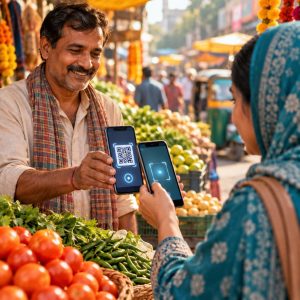
A payment system that consumers adopt but merchants do not accept is a social payments app, not an economic one. UPI solved the merchant acceptance problem through QR codes — a merchant acceptance format that costs approximately $0 to deploy (a printed QR code on a counter), requires no POS hardware, and settles funds in near-real-time. The combination of zero deployment cost and instant settlement proved compelling in a market where formal banking infrastructure was thin and working capital cycles are tight.
As of 2025, UPI’s P2M (person to merchant) transactions account for 63% of volume versus 37% peer-to-peer transfers — meaning the majority of UPI usage is now commercial, not social. Rural adoption has reached 38% preference among rural merchants who have accepted digital payments. The QR code approach has been directly adopted by Singapore (PayNow), Thailand (PromptPay), Brazil (Pix), and multiple African payment systems — a model diffusion that predates NPCI’s explicit international expansion programme.
3. Global expansion as sovereign diplomacy, not commercial expansion
NPCI’s international arm is pursuing UPI deployment through a combination of bilateral government agreements and partnerships with local payment networks. As of April 2026, UPI is live in 8 countries: Singapore, UAE, Bhutan, Nepal, Sri Lanka, Mauritius, Qatar, and France. A further 30+ countries are in active discussion phases, with Kenya, Rwanda, Mozambique, and Malaysia in various stages of finalisation.
The expansion model is explicitly diplomatic — each new UPI country was announced alongside prime ministerial or ministerial-level bilateral agreements, positioning payment infrastructure as a tool of Indian soft power and South-South cooperation. This differs structurally from how Visa and Mastercard expanded (commercial bank partnerships) and from how Chinese payment systems (Alipay, WeChat Pay) have expanded (following Chinese tourist and merchant flows). NPCI is positioning UPI as infrastructure that sovereign nations adopt, not a commercial product they purchase.
The strategic implication for receiving countries is significant: adopting UPI means importing India’s interoperability model and connecting to a network that processes more transactions than Visa, without paying interchange fees to a private card network.
Advertisement
What This Means for Payment System Designers and Fintech Founders
1. The open-rail architecture is the one design decision that cannot be reversed
Countries that build national payment systems as closed proprietary networks — where a single operator controls both infrastructure and application — consistently face adoption ceilings. The Philippines’ InstaPay, launched in 2018, processed approximately 12 million transactions monthly in 2024 despite mandatory participation. Brazil’s Pix, launched in 2020 using an open-rail model, processed over 5 billion transactions monthly in 2024. The adoption differential is not primarily about regulation or incentives — it is about architecture. Fintech founders and central bank payment architects reviewing national payment system design in 2026 should treat the open-rail model as a resolved question, not an open one.
2. QR-code merchant acceptance is the fastest path to P2M volume in any market
Every market that has achieved significant digital payment adoption at the merchant layer — UPI in India, Pix in Brazil, PromptPay in Thailand, GCash in the Philippines — has used QR code acceptance as the primary merchant onboarding mechanism. The zero-hardware-cost deployment model is not a compromise: it is the optimal design for markets where SME merchants lack the capital to invest in POS terminal infrastructure. Fintech founders building merchant payment products in any emerging market who are still leading with POS hardware should reconsider the go-to-market architecture.
3. UPI’s P2M milestone defines the maturity benchmark for any real-time payment system
A real-time payment system where peer-to-peer transfers dominate (>50% of volume) has not yet converted consumer adoption into economic activity. UPI crossed the P2M-dominant threshold — 63% of volume in commercial transactions — approximately seven years after launch, after resolving the merchant acceptance density problem through QR codes and cashback campaigns. Payment system builders should model their P2M crossover timeline explicitly and identify the specific merchant-acceptance friction points (hardware cost, settlement speed, fraud risk, integration complexity) that are delaying conversion.
Where UPI’s Global Expansion Goes From Here
UPI’s ambition — stated by NPCI — is 20+ country deployments by 2029 and 1 billion global users by late 2026. The second target (1 billion users) is aggressive: it requires approximately 370 million non-Indian users in addition to UPI’s current ~500 million Indian users, in markets where UPI is either newly launched or still in negotiation.
The more operationally significant milestone will be the first non-tourist use case at scale outside India: when a UPI deployment outside South Asia processes meaningful merchant transaction volume (not just Indian tourist payments at duty-free shops). France is the most likely candidate — it has a 1.5-million-strong Indian diaspora and UPI was launched there via the NIPL-Lyra partnership in 2023. If France P2M volume reaches material levels by 2026, it validates the sovereign-diaspora expansion model and creates a template for every country with a significant Indian diaspora community.
The network effect arithmetic, if it resolves in NPCI’s favour, produces a qualitatively different global payment topology by the end of the decade: not two Western card networks and a Chinese closed system, but a third open-rail network built on public infrastructure, operating at zero interchange cost, and governed by sovereign interoperability agreements. For the 1.4 billion adults worldwide who still lack access to formal financial services, that topology has material implications for the cost and accessibility of payments infrastructure.
Frequently Asked Questions
Why did UPI succeed where many other digital payment systems failed?
Three design choices were decisive: government mandate for interoperability (banks were required to participate, not invited); zero merchant discount rate (merchants paid nothing to accept UPI, removing the primary adoption barrier); and open API architecture allowing any licensed entity to build UPI-compatible apps. This created a competitive app ecosystem while keeping the rail itself neutral and free.
Which countries have adopted UPI and what does this mean for Algerian users traveling or sending remittances?
UPI is currently operational in 12 countries including France, UK, UAE, Singapore, and Mauritius — markets with significant Algerian diaspora populations. Algerians holding Indian bank accounts or using UPI-enabled services can make payments in these markets. The more significant implication is remittance: NPCI’s cross-border UPI framework enables real-time transfers at near-zero cost, a direct competitive challenge to Western Union-style remittance services used by the Algerian diaspora.
Can Algeria build its own UPI-equivalent or should it join the UPI network directly?
The most pragmatic path is hybrid: join UPI’s international network for cross-border use cases (diaspora remittances, travel), while building a domestic interoperable real-time rail that connects Satim, BaridiMob, CIB, and mobile operators. India itself did not join an existing global network — it built domestically first, then exported. Algeria’s domestic payment volume is insufficient for full export ambition, but domestic interoperability is achievable within 36 months with political will.
Sources & Further Reading
- UPI Statistics 2026: Insights and Trends — CoinLaw
- UPI Overtakes Visa to Become World’s Top Real-Time Payments System — IndBiz
- How India’s UPI Rose to Dominate Real-Time Payments — PaymentsJournal
- India’s UPI Goes Global: 20+ Countries to Adopt by FY29 — Vocal Media
- India’s Digital Payments Strategy Is Cutting Out Visa and Mastercard — TechCrunch
- —