Morocco Captures the Region’s Flagship Sovereign-AI Project
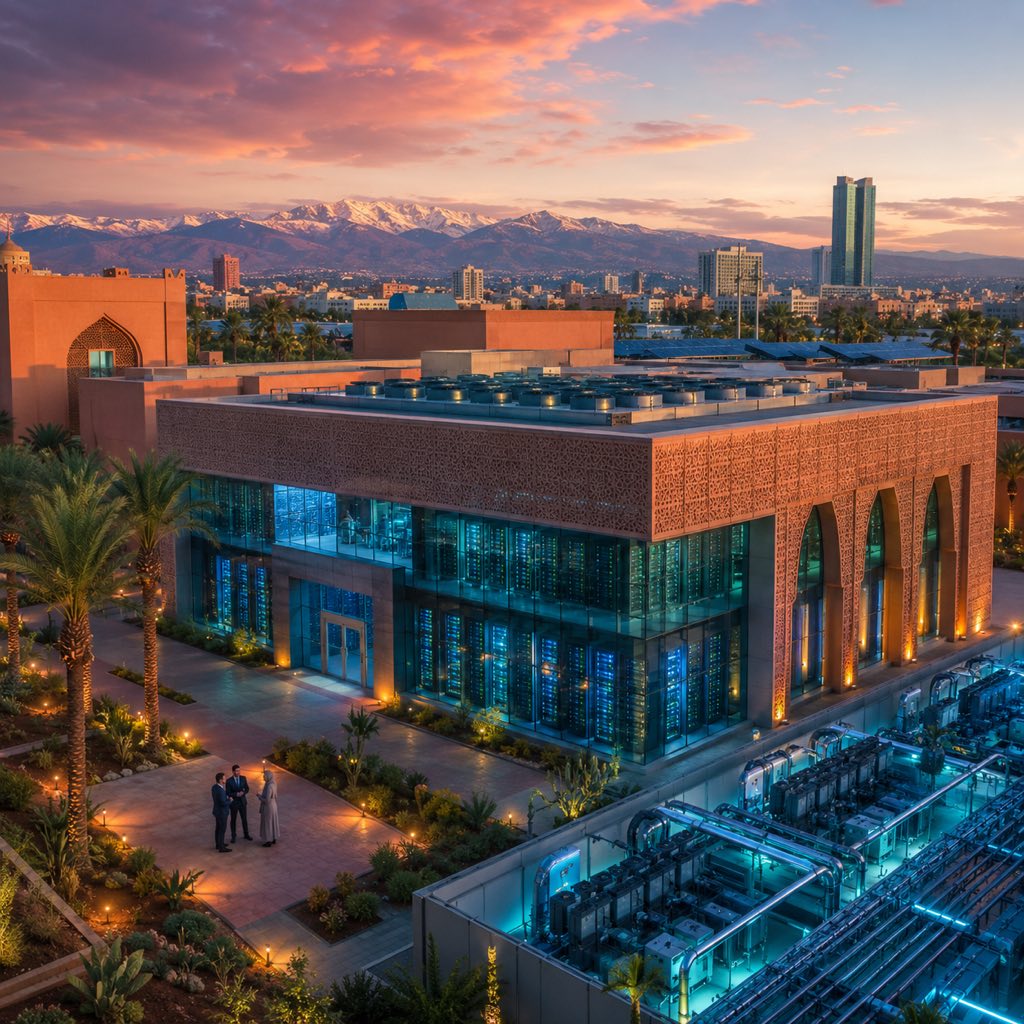
North Africa’s race to onshore artificial-intelligence capacity has a new frontrunner, and it is not a plan on paper. According to iAfrica’s report on the deal, a $1.2 billion AI data center — the “Nexus AI Factory” — will be built in the suburbs of Casablanca, and it is described as the first sovereign AI infrastructure platform of its kind in Africa, operating sovereign AI computing services across the Europe, Middle East and Africa region.
The backers are a serious international consortium. iAfrica lists the members as “U.S. AI infrastructure specialist Nexus Core Systems, Nvidia, South Korean cloud and AI company Naver and global investment firm Lloyd Capital.” The project was unveiled at GITEX Africa 2026 in Marrakech, and — crucially for the regional competition — Morocco was selected over South Africa and other African contenders, with investors citing the country’s “political stability, strategic location and existing infrastructure.”
That last detail is the one Algerian policymakers should sit with. This was a contested decision among African candidates, and Morocco won it on the strength of stability, location and existing digital infrastructure. The flagship sovereign-AI campus for an entire region went to a direct neighbor.
What the Facility Actually Is
The specifications matter because they define what “sovereign AI compute” means in practice at this scale. Per iAfrica, phase one will operate with “40 megawatts of AI supercomputing infrastructure powered by Nvidia’s latest Blackwell GB200 graphics processing units,” with potential expansion to 500 megawatts eventually. In other words, it starts as a substantial 40 MW installation and is architected to grow more than tenfold.
The power arrangement is as strategic as the compute. Middle East AI News reports the facility is a “500MW renewable energy-powered” project with a “40MW phase deploying NVIDIA’s latest Blackwell GB200 GPUs,” supplied under a “strategic renewable energy supply agreement” with TAQA, the UAE-headquartered power producer. The same report notes the operating partner, Naver Cloud, will deliver integrated AI services on the infrastructure, and that the project leverages Morocco’s proximity to Europe and its submarine fiber-optic cable connections.
Read together, the package is a template: frontier Nvidia silicon, a named cloud operator to run services on top, a dedicated renewable power supply, and Mediterranean connectivity to European markets. That combination — chips, operator, power and connectivity assembled into one sovereign offering — is precisely what makes it a benchmark rather than just a big building.
Part of a Broader North African Compute Race
Morocco’s win is not happening in isolation; it is the leading edge of a regional scramble to onshore AI and cloud capacity. In parallel, tech Africa News reported that Egypt approved a $400 million data center project on June 15, 2026, licensed to Hassan Allam Digital Infrastructure in partnership with A15 to “establish and operate data centers and provide cloud computing services” for governmental institutions, financial organizations and businesses.
Two of North Africa’s largest economies advancing sovereign compute projects within the same quarter is a signal, not a coincidence. The regional consensus is forming that hosting your own AI and cloud infrastructure — rather than renting it entirely from foreign hyperscalers — is now a strategic priority. The countries moving first are setting the terms, attracting the anchor operators, and building the specialized workforce that later entrants will have to compete against.
Advertisement
Why “Sovereign” Is the Operative Word
The framing of the Nexus project as “sovereign AI compute” is the strategic core of the story. Governments and regulated industries — banks, telecoms, public administration — increasingly face requirements that sensitive data and AI workloads run on infrastructure within their jurisdiction and control, not on a foreign hyperscaler’s cloud in another continent. A sovereign AI platform sited in the region, serving EMEA, positions Morocco to capture exactly those workloads: the government and enterprise AI demand that cannot legally or politically be sent offshore.
That is a durable, defensible market. It does not depend on out-competing global hyperscalers on raw scale or price; it depends on being the compliant, in-region option for data that must stay close. By landing the first such platform, Morocco is not just building a data center — it is claiming the position of default sovereign-AI host for a swath of Europe, the Middle East and Africa.
What This Means for Algeria
Morocco capturing the region’s flagship sovereign-AI campus sets a direct competitive benchmark — and a usable template — for Algeria’s own compute-sovereignty strategy. The response should be structural, not rhetorical.
1. Study the winning template and identify Algeria’s differentiated version
The Nexus package — Nvidia silicon, a named cloud operator, a dedicated renewable power supply, and Mediterranean connectivity — is a replicable blueprint. Algeria should map which of these it can match or beat, particularly on power (where its gas and Saharan solar capacity is substantial) and Mediterranean cable position, and assemble an equivalent consortium offer rather than pursuing a data center in isolation.
2. Lead with power and connectivity, the two inputs Algeria can genuinely compete on
Morocco won partly on existing infrastructure and location. Algeria’s credible differentiators are dispatchable energy capacity and its own Mediterranean cable landings. A sovereign-AI pitch anchored on guaranteed renewable-and-gas baseload plus European connectivity plays to real Algerian strengths rather than trying to out-stability or out-incentivize a first mover.
3. Secure an anchor operator and frontier-silicon partner early
The Nexus deal has Naver Cloud as operator and Nvidia as silicon partner — the elements that turn raw capacity into a sellable sovereign service. Algeria’s strategy should prioritize landing a comparable named cloud operator and a GPU supply commitment, because a data center without an operator and modern accelerators is not a sovereign-AI platform, just a shell.
The Competitive Reality
The Nexus AI Factory crystallizes a shift that Algeria cannot afford to watch passively. Sovereign AI compute is becoming a contested national asset across North Africa, and the first movers — Morocco with a $1.2 billion flagship, Egypt with a $400 million cloud build — are assembling the consortiums, operators and power deals that define the category. Morocco did not win on subsidies alone; it won by presenting a complete package of stability, location, infrastructure and international partners that a global consortium judged best in the region.
For Algeria, the benchmark is now concrete and next door. The country holds genuine cards — energy capacity and Mediterranean connectivity chief among them — but cards are not a strategy. Turning compute sovereignty from an aspiration into an anchor project requires doing what Morocco did: assembling the operator, the silicon, the power and the connectivity into a single credible offer, and moving before the region’s sovereign-AI demand is fully claimed by neighbors who started first.
Frequently Asked Questions
What is the Nexus AI Factory and who is building it?
The Nexus AI Factory is a $1.2 billion AI data center being built in the suburbs of Casablanca, described as Africa’s first sovereign AI infrastructure platform, serving the Europe, Middle East and Africa region. The consortium behind it comprises US infrastructure specialist Nexus Core Systems, Nvidia, South Korean cloud and AI company Naver, and investment firm Lloyd Capital. It was unveiled at GITEX Africa 2026 in Marrakech.
How large is the facility and how is it powered?
It launches with a 40-megawatt phase running Nvidia’s Blackwell GB200 GPUs, with planned expansion toward 500 megawatts. The facility is powered by renewable energy under a strategic supply agreement with TAQA, the UAE-headquartered power producer, and leverages Morocco’s proximity to Europe and its submarine fiber-optic cable connections. Naver Cloud is the operating partner delivering AI services on the infrastructure.
How does this compare to what other North African countries are doing?
Morocco’s project is the largest in a regional wave. Egypt approved a separate $400 million data center project on June 15, 2026, licensed to Hassan Allam Digital Infrastructure with A15 to provide cloud services for government, financial and business customers. Both moves, within the same quarter, reflect a regional consensus that hosting sovereign AI and cloud capacity is now a strategic priority rather than renting it entirely from foreign hyperscalers.
Sources & Further Reading
- Morocco Lands $1.2 Billion AI Data Center Project, Beating Out South Africa and Other African Rivals — iAfrica
- Naver, Nvidia Consortium Plans 500MW of AI Compute in Morocco — Middle East AI News
- Egypt Approves $400 Million Data Center Project to Boost Cloud Infrastructure — Tech Africa News
- Nexus Factory Launch at GITEX Africa Positions Morocco as a Future AI Gateway — Morocco World News
🔗 Related Intelligence

Consumer or Builder: Africa’s $1 Trillion AI Fork in the Road

Algeria’s First AI Supercomputing Center in Oran
AI Infrastructure: Algeria Breaks Ground on Its First Data Center in Oran

DjazairIA: Algeria’s First AI Incubator Connects Local Founders to Global Markets