What the April reopening actually changes
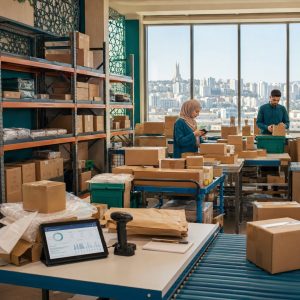
The Ministry of Foreign Trade and Export Promotion confirmed that the digital platform for raw material and equipment imports would be open from April 14 to April 30, 2026, applying to provisional import programs for the first half of the year. The announcement, relayed by APS and confirmed in coverage from Algeria Invest and Ecofin Agency, sets out four operational features: centralized handling of import requests, real-time tracking of operations, improved data reliability, and tighter alignment between authorized imports and the actual needs of national producers.
Access is restricted to firms registered under trade-register activity codes 01 and 07. Code 01 covers production activities, and code 07 covers production-adjacent operations. This restriction is deliberate. It excludes pure resellers and trading houses that historically captured a significant share of import quotas without adding industrial value. By limiting the platform window to producers, the Ministry is using digitization as a policy instrument, not just a workflow improvement.
The Ministry also indicated that two additional platforms are planned: one dedicated to monitoring service imports, and another focused on the resale of imported goods without processing. Combined with the customs digitization tracked by the Direction Generale des Douanes, the picture is of a phased trade-systems modernization rather than a single product launch.
Why operational predictability is economic value in this context
For producers and suppliers, uncertainty around import procedures translates directly into working-capital cost. A factory that cannot reliably predict when it will receive approval for a raw-material import has to over-stock, delay production, or absorb shipping premiums for expedited delivery. Each of those responses costs real money. The April 14-30 window is short, which means firms that miss it have to wait for the next reopening, and the predictability of that next window matters as much as the platform’s technical features.
The numbers behind the trade flow give the platform context. Algeria’s foreign trade was approximately $59 billion in 2024 according to OEC data, with hydrocarbons dominating exports and a wide range of capital equipment, vehicles, pharmaceuticals, and food products on the import side. Production-input imports, the specific category covered by the April platform, are concentrated in metals, plastics, chemicals, and machinery. Centralizing requests through one digital channel can reduce the back-and-forth that has historically slowed industrial supply chains.
The Ministry has framed the platform as a tool to shorten processing times, improve traceability, and strengthen governance in a sector considered strategic to the economy. Each of those phrases is a policy commitment that creates a measurable test. Processing time can be benchmarked against pre-platform baselines. Traceability can be audited via the platform’s logs. Governance improvements should show up in fewer disputes, fewer ad-hoc exemptions, and clearer criteria for approval and rejection.
How the platform fits into the wider digital-administration push
The imports platform is not a stand-alone initiative. The Ministry of Industry has reported via APS that the investor digital platform now lists more than 1,670 land areas available for industrial investment since launch. The Ministry of Public Works, under Minister Sayoud, has framed digitization as the cornerstone of modern administrative practice. Algeria has also advanced consular service digitization through cooperation agreements with international partners, and customs has continued its own modernization track at the Direction Generale des Douanes.
What this collection of initiatives sets up — and what the April 2026 reopening pressures the system to deliver next — is integration. A producer applying for raw-material imports often also needs to update customs declarations, secure foreign-exchange allocations, and align with industrial-zone permits. As each platform connects, firms benefit from a single integrated workflow. The next test of trade digitization is whether the imports platform exposes data to and consumes data from the adjacent customs, finance, and industry systems.
For e-commerce and consumer-facing digital services, this back-office trade infrastructure is invisible but consequential. Algerian e-commerce platforms depend on imported inventory, packaging, payment-terminal hardware, and logistics equipment. Smoother production-input imports translate, indirectly, into more predictable consumer offers. The connection between trade digitization and the wider digital economy is closer than the press releases usually suggest.
Advertisement
What firms should do during the April 14-30 window and after
For firms eligible under codes 01 and 07, three actions are worth taking now. First, prepare complete documentation before the window closes: bank statements, supplier invoices, intended-use justification, and trade-register extracts should be ready in digital form to avoid resubmission. Second, log every interaction with the platform: response times, error messages, and resolution paths give firms data to negotiate with operators if disputes arise later. Third, plan the next window: if the Ministry maintains a semi-annual cadence, firms should already be preparing the second-half submission package while H1 requests are processed.
For the wider economy, the test of whether the platform becomes routine infrastructure has three signals. Window predictability: if the second-half opening is announced with a clear timeline, firms can plan procurement cycles around it. Service-level transparency: if the Ministry publishes aggregate statistics on requests, approvals, processing times, and rejections, the platform stops being a black box. System integration: if the imports platform exchanges data with customs, finance, and industrial-zone systems, the cumulative friction on producers drops in a way that pure platform improvements cannot deliver. The April reopening is a useful step. The next twelve months will determine whether trade digitization becomes part of Algeria’s operating environment or a recurring announcement cycle.
A Three-Pillar Platform Maturity Framework for Producers and Officials
The difference between a platform that is used once and a platform that becomes operating infrastructure is whether it matures across three dimensions. Producers registered under codes 01 and 07 should evaluate the Ministry’s imports platform against these pillars at each reopening; officials should use them as a public commitment checklist.
Pillar 1: Window Predictability — Publish H2 Dates Before H1 Closes
The April 14-30 window was announced with sufficient lead time for large producers to prepare, but smaller firms reported difficulty gathering documentation in time. The Ministry should publish the H2 reopening date before the H1 window closes — ideally by May 15, 2026 — so that firms can begin preparing their second-half package while H1 requests are still being processed. Singapore’s TradeNet platform, the benchmark for integrated trade digitization in small economies, operates on a rolling calendar that allows importers to plan procurement cycles six months in advance. Predictable windows reduce emergency orders, lower logistics premiums, and allow smaller manufacturers to schedule raw-material purchases rather than react to late announcements.
Pillar 2: Service-Level Transparency — Publish Aggregate Processing Statistics
A platform without published service-level data is a black box. The Ministry of Foreign Trade should publish, after each window closes, the aggregate count of requests received, approved, rejected, and pending; the median processing time; and the most common rejection reasons. This data does not expose any individual firm’s commercial position, but it creates accountability pressure that improves response times over multiple cycles. Morocco’s digital customs administration publishes monthly clearance statistics as part of its trade facilitation commitments under the WTO’s Trade Facilitation Agreement. Algeria’s platform should meet the same standard. Transparency also reduces the incentive for firms to seek informal resolution of slow or ambiguous requests, which is where governance risks accumulate.
Pillar 3: System Integration — Connect the Platform to Customs and Finance
The most valuable upgrade to the imports platform is not a UI improvement — it is API connectivity to adjacent systems: the Direction Générale des Douanes for customs pre-clearance, the Bank of Algeria for foreign-exchange allocation status, and the Ministry of Industry’s industrial-zone permit system. A producer applying for production-input imports currently has to interact with each of these systems separately, often with duplicate documentation. An integrated workflow that allows a single digital dossier to flow across all four authorities reduces the end-to-end processing time by days, not hours. The United Nations Economic Commission for Africa’s 2024 Trade Facilitation Report estimates that African countries with integrated single-window trade systems reduce import processing time by 44% on average — Algeria’s phased approach provides the architecture; the API connections are the missing layer.
The Correction Scenario
The optimistic reading of the April 14-30 imports platform window is that it marks the beginning of a permanent operational improvement: predictable schedules, published service-level data, and eventual integration with customs and finance. That reading is plausible and worth pursuing. The correction scenario is equally plausible and worth naming.
Platforms that launch as periodic windows without evolving into always-on infrastructure tend to calcify around the administrative convenience of the issuing ministry rather than around the operational needs of users. The two-week reopening cadence creates a predictable political deliverable — the Ministry can announce each window as evidence of progress — without creating the measurement pressure that a permanent live system would generate. Firms that miss a window wait in silence. Rejections accumulate without published reasons. The informal resolution paths that the platform was supposed to replace quietly return because they are faster than waiting for the next cycle. The United Nations Economic Commission for Africa’s 2024 Trade Facilitation Report documents exactly this failure mode in three North African digital customs implementations that launched as periodic windows and never graduated to continuous operation.
The corrective action is not to slow down the platform — it is to attach measurable commitments to each reopening: an H2 date published before H1 closes, aggregate statistics released within 30 days of each window, and a named integration milestone with customs. Without those commitments visible in official communications, the correction scenario is the more likely outcome.
Frequently Asked Questions
Why does an imports platform belong in the digital economy?
Trade workflows determine how firms access the raw materials and equipment they need to produce. Algeria’s foreign trade ran at roughly $59 billion in 2024, and production-input imports concentrate in metals, plastics, chemicals, and machinery. Centralizing those workflows through a digital platform reduces uncertainty around timing and documentation, which translates directly into working-capital efficiency for producers. That makes back-office trade systems part of the same digital economy as consumer-facing apps.
What changed with the April 2026 reopening?
The Ministry of Foreign Trade and Export Promotion reopened the digital platform from April 14 to April 30, 2026, restricted to firms registered under trade-register activity codes 01 and 07 (production and production-adjacent activities). The platform offers centralized request handling, real-time operation tracking, and improved data reliability. The Ministry has also signaled two additional platforms in the pipeline, one for service imports and one for resale of imported goods without processing.
What should Algeria improve after this reopening?
Three signals will show whether the platform becomes routine infrastructure. Window predictability: if the H2 reopening is announced early with a clear timeline, firms can plan procurement around it. Service-level transparency: if the Ministry publishes aggregate request, approval, and processing-time statistics, accountability improves. System integration: if the imports platform exchanges data with customs, finance, and industrial-zone systems, cumulative friction on producers drops faster than any single platform improvement could deliver.
Sources & Further Reading
- Digital platform to reopen April 14-30 — APS
- Algeria Digitizes Import Tracking to Tighten Oversight of Strategic Materials — Ecofin Agency
- Importation of raw materials: launch of a digital platform — Algeria Invest
- Over 1,670 land areas listed on investor digital platform since its launch — APS
- Algeria foreign trade profile — OEC