
From One Node to a National Fabric
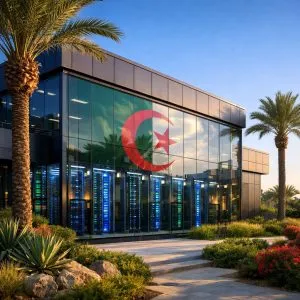
For most of Algeria’s enterprise IT history, “cloud” meant one of two things: a server room in Algiers or a foreign VPS in Europe. That calculus is shifting. Algérie Télécom inaugurated its Constantine data center in February 2023, adding the country’s east to a nascent national cloud fabric. The facility runs a cloud platform designed for enterprise data collection, processing, and storage, and was constructed entirely by Algérie Télécom’s own engineering teams — a point the company highlighted explicitly as evidence of internal capability development.
More significantly, Algérie Télécom announced plans to establish additional data centers across different Algerian regions, framing the Constantine node as the template rather than the terminus. Constantine was a logical second node: it hosts strong engineering universities, a growing startup layer, and sits at the geographic midpoint between the Algiers coast and the Saharan south.
The timing aligns with the broader infrastructure buildout. Algérie Télécom’s 400G WDM national backbone — delivered in partnership with Huawei and commissioned in 2025 — connects Algiers and Oran with high-speed optical capacity and extends toward Constantine. That backbone is what makes a multi-city enterprise PaaS meaningful: without low-latency, high-bandwidth internode connectivity, a distributed cloud architecture is just a collection of isolated servers with slow pipes between them.
Law 18-07 adds the regulatory dimension. Applications handling personal or financial data must host on Algerian infrastructure. As that law is increasingly enforced, the question for enterprise IT directors is no longer “should we host locally?” but “which local infrastructure is production-ready?”
The Enterprise PaaS Readiness Question
PaaS — Platform-as-a-Service — is the layer between raw compute and application code: managed databases, container orchestration, object storage, message queues, CI/CD pipelines. It is the layer that determines whether a development team of 10 can operate like one of 50. Most Algerian enterprises are today at the IaaS (Infrastructure-as-a-Service) layer at best: renting virtual machines from Algérie Télécom, ISSAL NET, or Symloop, and managing the entire software stack themselves.
A genuine PaaS offering would abstract that complexity — managed Kubernetes, managed PostgreSQL, auto-scaling application containers — so enterprise teams can focus on business logic. None of Algeria’s current local providers publicly document a full PaaS tier comparable to AWS Elastic Beanstalk or Google App Engine. What exists is IaaS with managed backup and monitoring add-ons. The Constantine data center’s cloud platform description — “data collection, processing, and storage” — does not yet map to PaaS primitives.
This is both a gap and an opportunity. The infrastructure prerequisite (local nodes, national backbone, legal mandate) now exists. The service layer above it does not. For Algerian enterprises, this means the next 12 to 24 months will determine whether local providers can close the PaaS gap — or whether enterprises continue routing workloads to AWS Bahrain or Azure UAE (the closest hyperscaler regions) in a grey zone of partial Law 18-07 compliance.
Advertisement
What Algerian Enterprise IT Directors Should Do About It
1. Map Your Application Portfolio Against the Law 18-07 Data Classification
Before committing to any cloud architecture, classify your application data by sensitivity tier: personal data (Tier 1 — must stay in Algeria per Law 18-07), financial transaction records (Tier 1), business analytics and reporting (Tier 2 — hybrid acceptable), and publicly-facing content (Tier 3 — CDN and foreign hosting are fine). Most enterprise portfolios have all three tiers running on the same infrastructure because nobody has done the classification.
This classification exercise typically takes two to four weeks for a mid-size enterprise, and the output directly informs which workloads must move to local hosting. Tier 1 workloads are the ones that either have to move to Algérie Télécom, ISSAL, or Symloop today — or be flagged for compliance risk. The Constantine data center is the right physical destination for Tier 1 east-Algeria workloads; Algiers nodes for west-Algeria deployments.
2. Evaluate Local Providers on Uptime SLA, Not Just Price
The common failure mode for Algerian enterprise cloud migrations is selecting a local provider on price alone — DZD pricing is attractive versus USD-denominated hyperscaler bills — then discovering that SLA terms are loose, support response times are measured in days rather than hours, and redundancy is single-site rather than multi-region. ISSAL NET publishes a 99.777% uptime SLA, which equates to approximately 19.7 hours of allowed downtime per year. For banking and logistics, that number should be 99.9% (8.7 hours/year) minimum.
Request from any prospective local provider: their last 12 months of uptime data, their incident response SLA (time to acknowledge, time to resolve), their backup frequency and recovery time objective, and their physical redundancy architecture (single-room, single-building, or multi-site). Providers that cannot or will not supply these numbers are not ready for enterprise-grade workloads. Algérie Télécom’s Constantine facility was described as equipped with “the latest technology” and “optimal security levels,” but independent audits and tier certifications are not yet publicly documented.
3. Architect for Hybrid From Day One — Not as an Afterthought
The pragmatic enterprise architecture for Algeria in 2026 is hybrid: Tier 1 data on Algerian local infrastructure, Tier 2 and Tier 3 workloads on the nearest hyperscaler region (AWS Bahrain — approximately 4,000 km, Azure UAE North — approximately 3,800 km), with a VPN or private connectivity layer (MPLS from Algérie Télécom) bridging the two environments. This is not a compromise — it is the correct architecture given the current local PaaS maturity level.
Symloop’s model — AWS, Azure, and Google Cloud partnerships combined with local hosting for data sovereignty — represents the current best practice for Algerian enterprises that need both compliance and modern PaaS capabilities. Designing the hybrid architecture now, before the Law 18-07 enforcement intensifies, prevents the expensive re-architecture that enterprises who waited until an audit letter arrived have had to undertake.
4. Engage Algérie Télécom on Roadmap Visibility
Algérie Télécom is the dominant infrastructure provider for this emerging multi-city fabric, and its roadmap — which regional nodes come next after Constantine, what services are planned on top of IaaS, when managed database or container services become available — directly affects enterprise investment decisions. Enterprises that engage Algérie Télécom’s enterprise sales unit now, rather than waiting for public announcements, gain advance visibility that informs three-year infrastructure planning cycles.
Ask specifically about: the planned timeline for additional regional data centers (which cities are next — Oran, Annaba, Ouargla?), any PaaS-tier services in development, and whether the 400G backbone capacity extension to eastern and southern Algeria is on a confirmed timeline. These conversations also signal enterprise demand that can shape which services get prioritized.
What Comes Next
Algeria’s cloud infrastructure story in 2026 is a story of necessary prerequisites being assembled — but the service layer that turns infrastructure into enterprise productivity remains incomplete. The Constantine data center is real and operational. The national backbone connecting it is real and fast. The legal mandate driving enterprise adoption is real and increasingly enforced.
What is not yet real is a local managed PaaS tier that lets an Algerian development team deploy containerized applications, consume managed databases, and auto-scale under load without managing every layer of the stack themselves. Until that layer exists, the multi-city infrastructure buildout will be used primarily for data residency compliance — storing regulated data locally while routing all actual compute to AWS or Azure.
The transition from “compliance data sink” to “genuine cloud platform” is the defining challenge for Algerian cloud providers over the next 24 months. Enterprises that understand this distinction will make better infrastructure decisions today — investing in the local data layer while retaining hyperscaler agility for the compute layer, rather than treating the two as an either/or.
Frequently Asked Questions
How should Algerian enterprises evaluate whether to build on-premise infrastructure or leverage cloud services?
The build-vs-buy decision in infrastructure should be driven by data sovereignty requirements, workload characteristics, and total cost of ownership over a 5-year horizon. For most Algerian enterprises, a hybrid approach — retaining sensitive data on-premise while using cloud for scalable, non-sensitive workloads — offers the best balance. The frameworks described provide evaluation criteria that apply to the Algerian context with minimal adaptation.
What is the realistic timeline for Algeria to close the infrastructure gap with regional peers like Morocco and Singapore?
Current investment trajectory suggests a 5-7 year timeline for Algeria to reach comparable enterprise cloud service availability, assuming continued investment in submarine cable connectivity, domestic data center capacity, and cloud provider market entry. The timeline could compress to 3-4 years with accelerated public-private investment in digital infrastructure as part of the national digital transformation strategy.
Which infrastructure technologies described here can be adopted immediately by Algerian organizations versus which require long lead times?
Software-defined networking, containerization, and cloud-native application architectures can be adopted immediately with existing talent and current cloud service availability. Hyperscale data center build-out, advanced edge computing networks, and submarine cable infrastructure require multi-year planning and significant capital investment. Algerian organizations should focus adoption efforts on the software and tooling layers where they can move quickly.
Sources & Further Reading
- Algeria Telecom Launches New Data Center in Constantine — Data Center Dynamics
- Algérie Télécom Inaugure son Data Center à Constantine — Algérie Éco
- ISSAL NET — Algerian Cloud Service Provider
- Cloud Infrastructure Server Solutions Algeria — Symloop
- Algeria Data Centers Facility Map — DatacenterMap
- Oran Rising: Algeria’s Second Tech Hub Takes Shape — ALGERIATECH
🔗 Related Intelligence

AT Cloud PaaS Tier: Algeria’s Enterprise Bridge While Hyperscalers Stay Away

Constantine’s Data Centers: Expanding Enterprise Cloud Beyond Algiers
Algeria’s Sovereign Cloud: How the Mohammedia-Blida Data Centers Reshape Digital Control

Algeria Cloud Market: How Djezzy, Algérie Télécom, and Local Providers Are Reshaping Enterprise Hosting