The $60 Billion Commitment Demands a Technology Upgrade
Sonatrach’s upstream investment plan through 2030 is the largest capital commitment in the company’s history. Energies Media’s reporting on the $60 billion programme confirms that approximately 80% of the investment is allocated to hydrocarbon exploration and production, with CEO Rachid Hachichi identifying a broader $80 billion target by the end of 2030. Eight hydrocarbon contracts were signed in 2025, and new exploration blocks are planned for Q1–Q2 2026.
At that capital scale, the question is not whether Sonatrach can deploy the investment — it has done so before. The question is whether it can deploy it efficiently, in a geological and operational environment that has become increasingly complex. Algeria’s most productive fields, including Hassi Messaoud, are mature assets with declining conventional recovery rates. The $60 billion programme includes significant spending on “improved recovery from mature assets and modernisation of infrastructure,” which is executive language for a specific technical challenge: extracting remaining hydrocarbons from reservoirs that have already been extensively produced requires subsurface intelligence that conventional seismic interpretation cannot provide accurately enough.
This is where AI-enabled seismic interpretation becomes a capital question, not a technology question. Every percentage point improvement in subsurface accuracy translates directly into reduced dry-well probability and better-targeted drilling — at Sonatrach’s scale, that arithmetic produces savings in the hundreds of millions of dirhams annually.
What AI-Enabled Seismic Actually Does Differently
Conventional seismic interpretation requires geoscientists to manually analyse acoustic reflection data to infer subsurface geology. The process is skilled, time-consuming, and subject to the interpretive variance between individual analysts — two geoscientists working from the same seismic data set will frequently produce different reservoir models.
The Sonatrach-GNPC R&D agreement announced in January 2026 frames AI-enabled seismic interpretation as the core shared technology domain: the memorandum specifically covers “artificial intelligence-enabled interpretation” and 4D seismic technology alongside real-time reservoir modelling and digital subsurface analysis. The agreement was established under the auspices of the African Petroleum Producers Organisation, which signals an intent to develop shared capabilities across African national oil companies rather than licensing proprietary Western algorithms at premium cost.
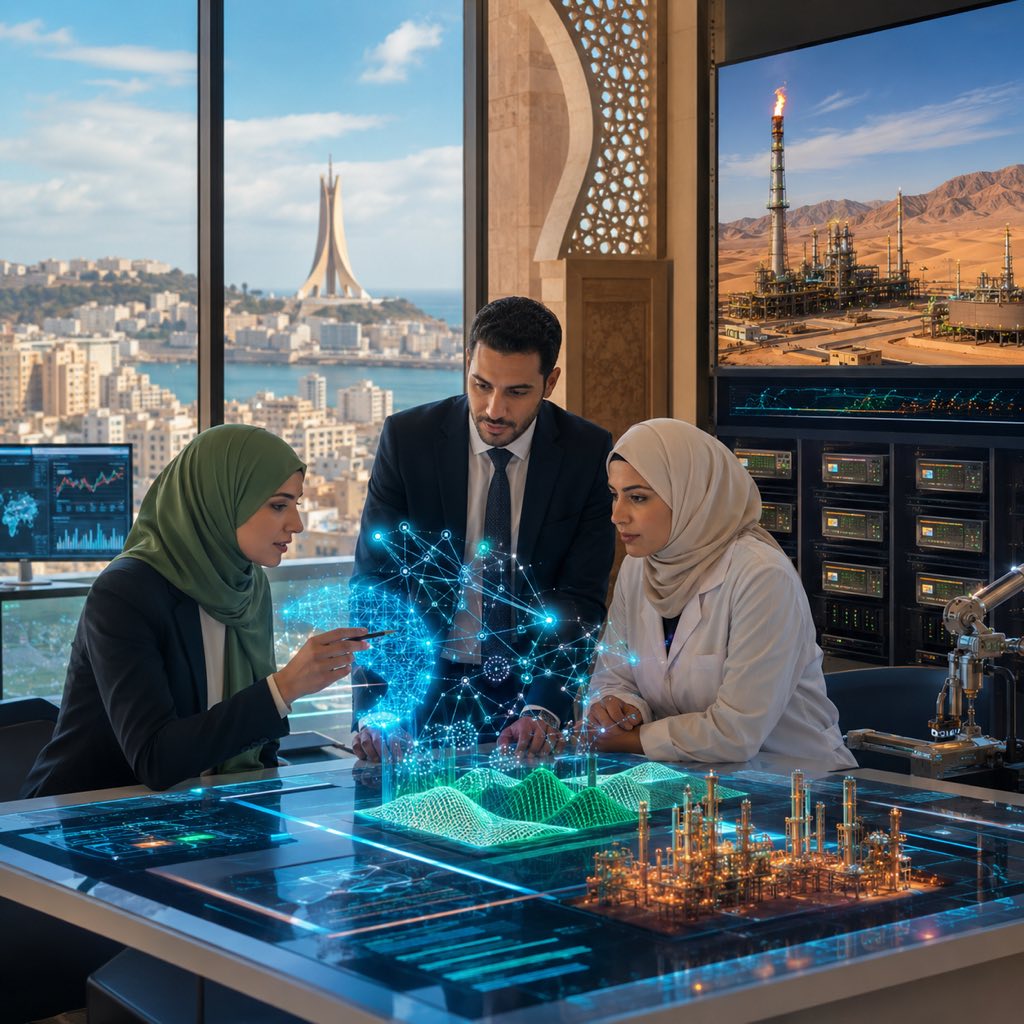
What the AI layer adds is three-fold. First, automated pattern recognition across large seismic volumes that would take human interpreters months can be completed in days, compressing the exploration cycle. Second, uncertainty quantification — AI models can be trained to output not just a “most likely” reservoir geometry but a probability distribution across multiple plausible geometries, which transforms drilling decisions from binary bets into risk-managed portfolio choices. Third, 4D seismic comparison: by running AI comparison between time-separated seismic surveys over the same field, Sonatrach can track reservoir depletion in near-real-time and redirect injection programmes for enhanced recovery without waiting for the next well to confirm the subsurface change.
Emerson, which the AEC Week reporting on Algeria’s unconventional resources strategy identifies as a key operational partner, is actively collaborating with Sonatrach to support production optimisation, operational cost management, and safety systems across Algerian operations. That partnership already embeds digital automation at the field level — the AI seismic layer extends that capability upstream into the exploration and appraisal phases where the most expensive decisions are made.
Advertisement
Algeria’s Unconventional Resource Dimension
The $60 billion programme is not limited to conventional fields. Algeria holds over 700 trillion cubic feet of un-risked shale gas resources — the third-largest globally — and significant unconventional plays that will require the full AI seismic toolkit to characterise accurately. Unconventional reservoirs, by definition, cannot be understood through conventional seismic analysis: their heterogeneity, pressure variation, and fracture networks require machine-learning models trained on analogous plays and capable of incorporating regional geomechanical data.
The SLB North Africa Managing Director, quoted in the AEC Week analysis, explicitly frames “automation and digital solutions in optimising production” as central to the unconventional development strategy. For shale gas resources of Algeria’s scale, AI-enabled interpretation is not an optional enhancement — it is the difference between commercially characterised resources and un-risked estimates that cannot underpin investment decisions.
What Sonatrach’s Digital Transition Means for Algerian Technology Professionals
Sonatrach’s upstream AI transformation is not happening in a vacuum. It is creating a specific and growing demand for Algerian technical professionals with a compound skill set that barely exists in the current talent pool.
1. Geoscientists Should Build Machine-Learning Competency Before the Recruitment Wave Hits
Sonatrach’s shift toward AI-enabled seismic interpretation will generate demand for geoscientists who can both read subsurface geology and design or validate machine-learning models for seismic pattern recognition. This dual competency is rare globally and almost absent from Algeria’s current geoscience graduate profile. Algerian geoscientists working in Sonatrach’s exploration or production divisions should begin self-directed training in Python-based geoscience libraries — particularly those used in the seismic industry such as Bruges, OpendTect, and SeiSee — in advance of formal training programmes. Sonatrach’s partnership infrastructure with GNPC and Emerson will eventually produce internal training modules, but the geoscientists who arrive at those modules with baseline competency will advance far faster than those who arrive without it.
2. Algerian ICT Integrators Should Develop O&G-Specific AI Offerings Before International Vendors Lock the Market
Western technology vendors — SLB, Emerson, Baker Hughes — have well-developed AI seismic offerings that they will pitch to Sonatrach as the investment programme scales. Algerian ICT companies that develop domain-specific AI competency in oil-and-gas data processing now, before those vendor contracts are signed, can position themselves as the local integration and customisation layer between Sonatrach’s operational data and the international vendors’ algorithms. The model is commercially proven: in mature oil-producing markets, national integrators that understand both the local geology and the vendor toolkits consistently capture integration and maintenance contracts worth 15–25% of the primary vendor contract. Algeria’s technology sector should be targeting those positions explicitly.
3. Engineering Universities Should Create Petroleum AI Specialisations Within Existing AI Programmes
Algeria’s 74 AI master’s programmes are currently focused on general-purpose machine learning, natural language processing, and computer vision. None of the publicly documented programmes has a petroleum-specific AI specialisation — a gap that will become increasingly visible as Sonatrach’s digital investment programme generates demand for domain-specific graduates. The Institut National Algérien du Pétrole (IAP) and the relevant engineering faculties at USTHB and the University of Boumerdès are the natural institutions to pilot a petroleum AI module — training AI practitioners specifically in seismic data interpretation, reservoir simulation, and production optimisation.
Where This Fits in Algeria’s 2026 Energy Landscape
Sonatrach’s AI bet is taking place at a moment when the entire global upstream oil-and-gas sector is undergoing a technology recalibration. The exploration phase is compressing from a typical seven-to-ten-year cycle to three-to-five years through AI-enabled seismic and drilling optimisation. Mature-field recovery rates are rising from historical averages of 30–35% of original oil in place to 40–50% in fields where AI-driven enhanced recovery is deployed systematically.
For Algeria, this technology shift lands differently than it does for a private-sector operator. Sonatrach is both the national oil company and the revenue engine of the Algerian state — its capex efficiency directly affects national budget capacity. A 200–300 million dollar annual saving in exploration costs, achievable through AI-enabled seismic accuracy, is not a technology-department metric. It is a national fiscal instrument.
The January 2026 GNPC R&D agreement should be read in this light: Sonatrach is not simply sharing knowledge with a peer African national oil company. It is building a joint capability that reduces its dependency on Western algorithm vendors at precisely the moment those vendors will begin premium-pricing their most advanced AI seismic tools. If the R&D partnership produces jointly owned algorithms trained on North African and West African geological data, Sonatrach will have created an asset that serves both its exploration programme and its long-term technology sovereignty.
Frequently Asked Questions
What is AI-enabled seismic interpretation and how does it improve oil exploration?
AI-enabled seismic interpretation uses machine-learning models to analyse acoustic reflection data from underground surveys faster and more accurately than conventional manual analysis. The AI can process volumes of seismic data in days rather than months, quantify uncertainty across multiple plausible reservoir geometries, and compare time-separated surveys to track reservoir depletion in near-real-time. These capabilities reduce dry-well probability and improve the targeting of drilling programmes — at Sonatrach’s scale, each percentage improvement in accuracy translates into hundreds of millions in avoided exploration costs.
What is the Sonatrach-GNPC R&D agreement and why does it matter?
In January 2026, Sonatrach and Ghana National Petroleum Corporation signed an R&D memorandum of understanding under the African Petroleum Producers Organisation, focused specifically on AI-enabled seismic interpretation, 4D seismic technology, real-time reservoir modelling, and enhanced oil recovery. The agreement is strategically significant because it represents an attempt by two African national oil companies to develop shared AI capabilities — potentially producing jointly owned algorithms trained on African geological data — rather than licensing expensive proprietary tools from Western vendors.
How does Sonatrach’s $60 billion upstream programme create opportunities for Algerian tech professionals?
The $60 billion programme generates demand for a specific compound skill set: professionals who combine geoscience domain knowledge with machine-learning competency. Algerian geoscientists who build Python-based seismic data skills now will be positioned for the recruitment wave before it arrives. Algerian ICT integrators who develop oil-and-gas-specific AI offerings can compete for integration and maintenance contracts worth 15–25% of Sonatrach’s primary vendor deals. Engineering universities that create petroleum AI specialisations will supply the first generation of graduates directly suited to the digital oilfield environment Sonatrach is building.
—
Sources & Further Reading
🔗 Related Intelligence

AI Seismic Monitoring: Algeria’s Earthquake Early Warning Revolution
AI in Algeria’s Oil and Gas Sector: How Sonatrach Is Betting on Machine Intelligence
Sonatrach’s AI Predictive Maintenance: The Highest-Value AI Use Case in Algeria’s Economy
Sonatrach and Baker Hughes: AI-Powered Predictive Maintenance Reshapes Algeria’s Oilfields