Where Algeria’s Skills Gap Meets Its Biggest Employer
Algeria’s technology skills gap has been documented across multiple dimensions — shortage of cloud engineers, AI practitioners, and cybersecurity specialists — but the diagnosis has consistently been easier to produce than the solution. Traditional university curricula lag industry timelines by three to five years. Private bootcamps have reached urban centers but rarely penetrate the professional workforce inside large institutions. Corporate training programs at Algerian enterprises have largely focused on vendor certifications rather than applied, hands-on skill-building.
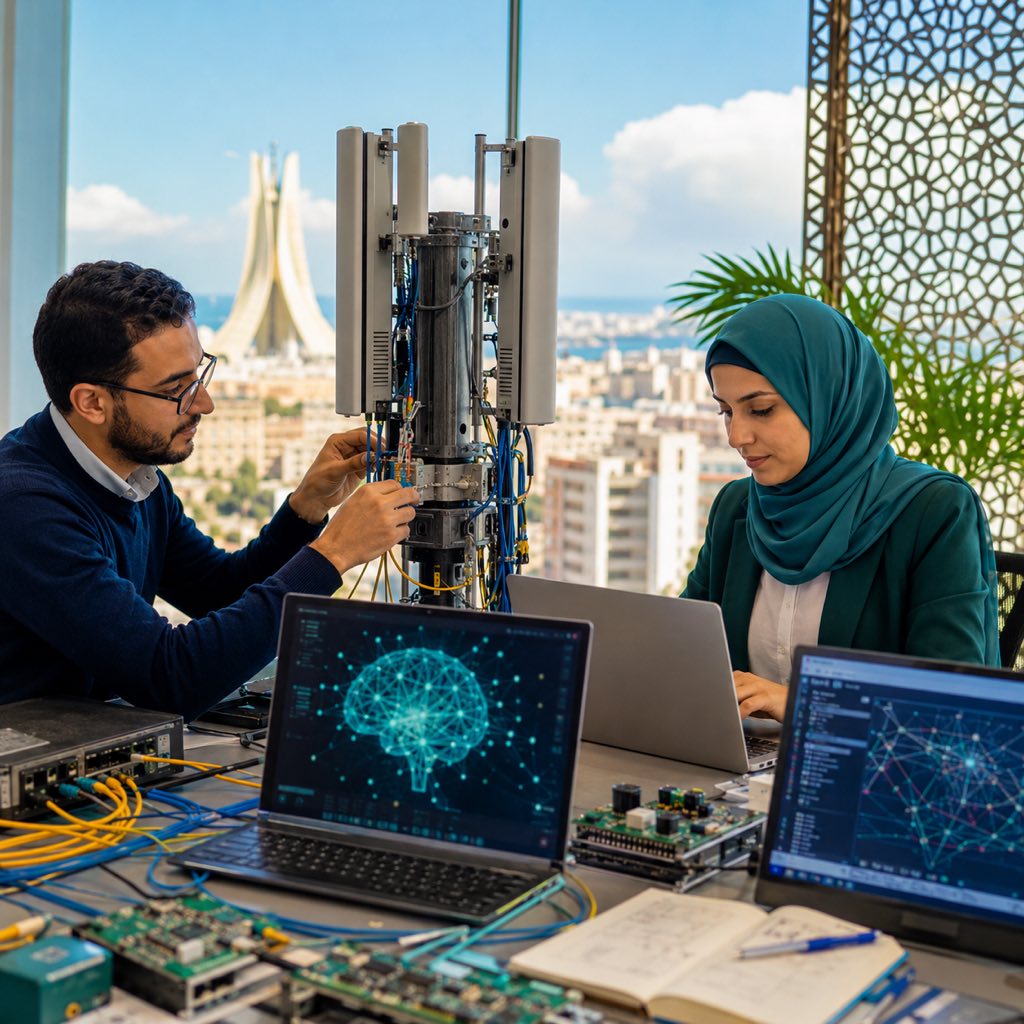
LabLabee was founded in 2021 by Samir Tahraoui and Mahfoud Sidi Ali Mebarek with an explicit thesis against this gap: the fastest route to upskilling a workforce is not classroom theory but configurable lab environments where engineers practice on realistic simulations of the networks and systems they will actually operate. The company’s platform delivers what it describes as “hands-on learning experiences in future network technologies” — covering 5G, cloud infrastructure (OpenStack, Docker, Kubernetes), IMS, and edge computing — through partnerships with telecom operators, vendors, and industrial firms.
In 2024, that thesis attracted institutional validation. LabLabee closed a $3.4 million seed round led by Reach Capital, a US-based education-focused VC fund. The round also included Classera, Brighteye Ventures, e& capital, and business angels Cedric Sellin and Mohammed Husamaddin. Empower Africa’s coverage of the round noted that LabLabee is one of very few Algerian startups to attract a US institutional lead investor with a domain-specific education thesis, rather than a generalist emerging-markets fund. For a Djazairi edtech startup to secure Reach Capital as lead investor is a signal that international investors with deep edtech domain expertise see LabLabee’s model as category-differentiated, not just locally relevant.
The Algérie Télécom Partnership: What It Actually Delivers
The partnership with Algérie Télécom, announced through LabLabee’s official channels in 2026, makes LabLabee’s training catalog available through Algérie Télécom’s platform to engineers and professionals across the operator’s workforce. The technical scope covers five categories: Telecommunications and Telco Cloud, Networking, Cybersecurity, Industry 4.0, and 5G/IoT network technologies.
The significance of Algérie Télécom as a partner is organizational scale. The state telecoms operator has a workforce that spans the country’s network infrastructure — engineers managing everything from fiber rollout to backbone routing to enterprise connectivity. This workforce needs to develop operational competency in 5G before Algérie Télécom’s planned Fixed Wireless Access (FWA) rollout targeted for early 2027. A hands-on lab environment that simulates 5G core configurations, cloud-native network functions, and edge compute deployments is directly applicable to the skills Algérie Télécom’s engineers will need to operate that infrastructure.
From LabLabee’s perspective, this is a B2G (business-to-government) distribution deal that bypasses the individual learner acquisition challenge — instead of marketing to thousands of engineers one-by-one, the company’s content is now accessible to an entire operator’s workforce through a single institutional channel. Samir Bennour, LabLabee’s Commercial Director for Algeria, described it as opening “an entirely new market” for the platform.
Advertisement
What This Model Means for Algeria’s EdTech Founders
1. The B2G Channel Is the Fastest Route to Algerian Workforce Scale
Individual consumer-facing edtech in Algeria faces a structural constraint: willingness to pay for professional training remains limited, and the market for individual course subscriptions is smaller than it appears. The B2G (and B2B) channel — selling directly to large institutional employers who then provide training to their employees — bypasses this constraint entirely. Algérie Télécom pays for access; engineers receive the training as an employer benefit; LabLabee receives enterprise-level contract economics.
For other Algerian edtech founders, the Algérie Télécom partnership is a model worth studying carefully. Identify which large Algerian institutions — Sonatrach, Sonelgaz, the banking sector, major healthcare systems — have a defined skills development obligation and an annual training budget. Approach those institutions with a B2G proposal rather than a consumer product. The selling cycle is longer, but the contract size and distribution scale are incomparably larger.
2. International EdTech VC Is Accessible for the Right Model
Reach Capital’s decision to lead LabLabee’s seed round is a data point for the broader Algerian startup ecosystem. International education-focused funds — Reach Capital, GSV Ventures, Owl Ventures — have thesis-driven investment mandates that look for scalable edtech models across emerging markets. Algeria’s combination of a large university-educated engineering population, an undersupplied professional training market, and major telecoms infrastructure expansion (5G FWA by 2027) maps onto a thesis that these funds recognize.
The implication for Algerian edtech founders seeking international capital: the pitch is not “Algeria-specific opportunity” but “the North Africa / MENA workforce training gap at scale, and here is why our model is the right vehicle.” LabLabee’s Reach Capital raise demonstrates this pitch can work. Prepare the supporting evidence — total addressable workforce, average enterprise training spend per employee, competitive moat in hands-on lab environments — and target funds whose portfolio already includes similar models in India, Southeast Asia, or Latin America.
3. Hands-On Technical Training Is the Defensible Category
The edtech landscape is flooded with content platforms, video lectures, and certification prep courses. What is significantly harder to replicate is a purpose-built lab environment that allows a practitioner to configure a 5G core node, test a cloud-native network function, or simulate a cybersecurity incident in a controlled, realistic environment. LabLabee’s defensibility comes from the lab infrastructure — the technical specificity of the environments, the ongoing investment required to keep them current as technology evolves, and the institutional partnerships (with vendors like those represented in LabLabee’s investor base through e& capital) that make the content authentic.
Algerian startup founders building in adjacent categories — industrial IoT, digital health, energy management — should assess whether a lab-based or simulation-based training component could differentiate their offer to B2B/B2G buyers who evaluate suppliers partly on their ability to upskill internal teams. This is not a feature add-on; it is a distribution and retention mechanism.
Where the Partnership Fits in Algeria’s 2026 Ecosystem
The LabLabee-Algérie Télécom deal lands at a specific structural moment. Algérie Télécom has publicly committed to a 5G FWA launch targeting early 2027. That commitment requires an engineering workforce that can configure, deploy, and operate cloud-native 5G network infrastructure — a skill set that did not exist in the country’s formal training system. LabLabee’s labs provide a route to that readiness that no traditional training provider was equipped to deliver at speed.
More broadly, this partnership is evidence that Algerian startups are finding their most powerful distribution through institutional partnerships rather than direct consumer growth. Yassir’s super-app growth was institutional in the sense that it was driven by deployment deals and logistics contracts. LabLabee’s next phase of growth runs through Algérie Télécom. This pattern — startup product, institutional distribution — is characteristic of how technology companies scale in markets where consumer behavior and payment infrastructure are still developing. Algeria’s founders who internalize this pattern will find shorter paths to the revenue and retention metrics that qualify them for the next round.
Frequently Asked Questions
What makes LabLabee different from certification prep or online course platforms?
LabLabee delivers configurable hands-on lab environments — actual technical simulations of 5G networks, cloud infrastructure, and cybersecurity scenarios — rather than video lectures or multiple-choice certification prep. This distinction matters to enterprise buyers like Algérie Télécom because engineers need to practice on realistic environments before deploying on live networks. Lab-based learning produces measurably faster skill transfer for technical infrastructure roles compared to passive content consumption.
Who are LabLabee’s investors and what does Reach Capital’s involvement signal?
LabLabee’s $3.4 million seed round was led by Reach Capital, a US-based VC fund focused on education technology. Co-investors include Classera, Brighteye Ventures, e& capital, and two business angels. Reach Capital’s involvement signals that LabLabee’s model has passed review by investors with deep domain expertise in edtech markets globally — they evaluate scalability and defensibility with the same rigor applied to their US portfolio. The participation of e& capital (the investment arm of UAE telecoms giant e&) adds a strategic dimension aligned with LabLabee’s telecoms training focus.
How does this partnership connect to Algeria’s broader 5G infrastructure roadmap?
Algérie Télécom has targeted early 2027 for a nationwide 5G Fixed Wireless Access (FWA) launch. Operating 5G network infrastructure — particularly cloud-native core networks and edge compute deployments — requires engineers with hands-on competency in technologies like OpenStack, Kubernetes, and 5G core configurations. The LabLabee partnership provides exactly these lab environments to Algérie Télécom’s workforce, giving the operator a structured skills development path aligned with its own deployment timeline.
Sources & Further Reading
- LabLabee × Algérie Télécom Partnership Announcement — LabLabee Official
- Algeria’s LabLabee Closes $3.4M Seed Round — TechPoint Africa
- Algerian EdTech LabLabee Raises $3.4M Seed Round Led by Reach Capital — Wamda
- Algerian EdTech LabLabee Raises $3.4 Million — Empower Africa
- 10 Algerian Startups to Watch in 2026 — MagStartup
🔗 Related Intelligence

LabLabee’s $3.4M Bet: How an Algerian EdTech Is Retraining the World’s Telecom Engineers

EdTech Startups in Algeria: LabLabee and the Race to Teach in Arabic

Algeria’s AI Trainer Pipeline: From Train-the-Trainers to Startup Lab Outcomes

Tech4Connect After the Awards: Can Algeria Turn Student AI Demos Into Startups?