A Procedural Change with Large Downstream Effects
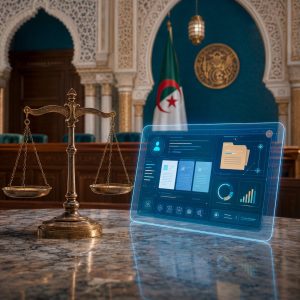
The ceremony at the Court of Biskra on 15 February 2026 looked administrative on the surface. Minister of Justice and Keeper of the Seals Lotfi Boudjemaa, accompanied by the Minister of the Interior and the Minister of Digitalization and Statistics, officially launched a new digital platform that enables lawyers to submit online requests for copies of judgments issued by ordinary and administrative courts — and to receive them electronically signed, containing a barcode for verification.
On paper, the platform replaces a clerical task: lawyers no longer have to travel to the registry to collect a paper copy. In practice, the change matters far more than that. For the first time at national scale, Algerian court decisions are being produced as authenticated digital documents through a government-operated channel. That is the foundational layer on which a modern legal-tech ecosystem — including the AI tools that are transforming legal work globally — actually gets built.
What the Platform Does Today
Access is through the Ministry of Justice website using credentials tied to each lawyer’s professional e-account, the same system already used for the digital exchange of pleadings and briefs in civil matters. Once logged in, a lawyer submits a request; the system processes it automatically and returns a PDF that is:
- Electronically signed by the issuing court
- Printable and legally valid
- Verifiable via a barcode tied back to the source record
A parallel platform, announced earlier by the Ministry, allows both lawyers and litigants to request certificates of non-opposition, non-appeal, and non-petition for review before the Court of Cassation — another piece of the paper-based-to-digital conversion. Together, these two platforms cover a significant share of the administrative correspondence that clogs Algerian courthouses.
The Data Infrastructure Story
For Algerian technologists, the interesting part is what the platform produces, not only what it removes. Every electronically signed judgment is a structured, timestamped, authenticated artifact. Over months and years, the platform will generate a growing corpus of machine-readable court decisions — the raw material that has driven the global wave of legal-AI tools for research, summarization, drafting, and predictive analysis.
For comparison: Nigeria is home to several Legal AI startups already, and TechCabal’s April 2026 Africa AI map counts 3 Legal AI companies in Nigeria alone, rooted in the country’s ability to mine digitized case law. Algeria did not have this input until recently. It does now.
Advertisement
The Policy and Compliance Context
The platform is part of the broader Ministry of Justice modernization programme, which has progressively introduced electronic filing for civil cases, online scheduling, and digital notification. It slots into the government’s SNTN-2030 digital strategy — the roadmap that targets 500+ digital projects across 2025-2026 and explicitly prioritizes public-service digitization.
From a legal-technology policy perspective, three things matter:
- Electronic signature legality. Algeria’s electronic signature framework, governed by Law 15-04 on electronic signature and certification, gives the outputs of this platform the same legal weight as physically signed documents. That is the base case any legal-AI product would need.
- Data governance. Court decisions are public records by nature, but their collection and use for AI training raise data protection questions under Algeria’s Law 18-07 on the protection of individuals regarding personal data. Any future AI use case will need to navigate anonymization rules, particularly around family-court and criminal judgments.
- Access terms. Whether bulk access to the judgment corpus becomes available — for research, academic work, or commercial legal-tech products — is a policy choice the Ministry has not yet signalled. That decision will shape whether Algeria’s legal-AI market stays tied to individual lawyer accounts or opens up for platform-scale applications.
Who This Matters To Now
Three audiences should be paying attention:
- Practicing lawyers: The immediate productivity gain is real. A task that consumed hours per week — travel, queueing, photocopying — now takes minutes. Firms that update their internal workflows to use the platform’s digital outputs (rather than converting them back to paper) will move faster on high-volume matters.
- Legal-tech and AI startups: A national corpus of authenticated, machine-readable judgments is the enabling condition for Algerian-built legal research tools, contract-analysis platforms, and case-prediction models. Early movers who build now — even while bulk access is limited — will be positioned when the Ministry opens additional APIs.
- Law schools and research centres: Universities with strong AI programmes (ENSIA, USTHB, Béjaïa) have a natural opening to study Algerian case law computationally. Partnerships with the Ministry of Justice on applied research — NLP on judicial Arabic and French, legal-argument mining — are the kind of projects that both the research sector and the Ministry’s modernization programme are positioned to fund.
What to Watch Next
The next inflection points will come from three directions. First, whether the Ministry extends the platform to criminal matters and the Court of Cassation’s own published decisions — the datasets that most matter for deep legal research. Second, whether Algeria moves, as several European justice systems have, toward structured publication of anonymized judgments (a practice that has catalyzed legal-tech ecosystems in France and Belgium). Third, whether any of Algeria’s emerging AI-startup cohort, supported by the $11M Algérie Télécom AI fund and the national venture studio programme, focuses on legal tech specifically.
The platform is one announcement in a long modernization arc. But it is the kind of announcement that, read against the broader global pattern, signals where an entire new vertical of Algerian technology may emerge over the next five years.
Frequently Asked Questions
What exactly did Algeria’s Ministry of Justice launch in February 2026?
On 15 February 2026, Algeria’s Minister of Justice Lotfi Boudjemaa launched a national digital platform that lets lawyers request and retrieve electronically signed copies of court judgments and decisions online. The documents are signed PDFs containing a verification barcode, accessed through each lawyer’s professional e-account on the Ministry of Justice website.
Are the PDFs legally valid in Algerian courts?
Yes. Algeria’s electronic signature framework (Law 15-04) gives digitally signed documents the same legal weight as physically signed ones. Each PDF issued by the platform is both legally valid and verifiable via its embedded barcode tied to the source record.
How does this help Algerian legal-AI startups?
Legal-AI products need structured, authenticated, machine-readable court decisions as inputs. The platform’s output is the first national-scale source of such documents in Algeria. Even with limited bulk access today, founders can build MVPs — search, summarization, case analytics — and position for broader API access as the Ministry’s modernization programme matures.
Sources & Further Reading
- Launch of a Digital Platform for Lawyers — Ministry of Justice of Algeria
- Digital Platform for Certificates of Non-Recours — Ministry of Justice of Algeria
- Modernisation of Justice — Ministry of Justice of Algeria
- Algeria Launches Digital Platform for Legal Professionals — DZWatch
- Africa’s AI Builders: 207 Startups — TechCabal
- Algeria Bets Big on AI Startups with New Investment Fund — Launch Base Africa