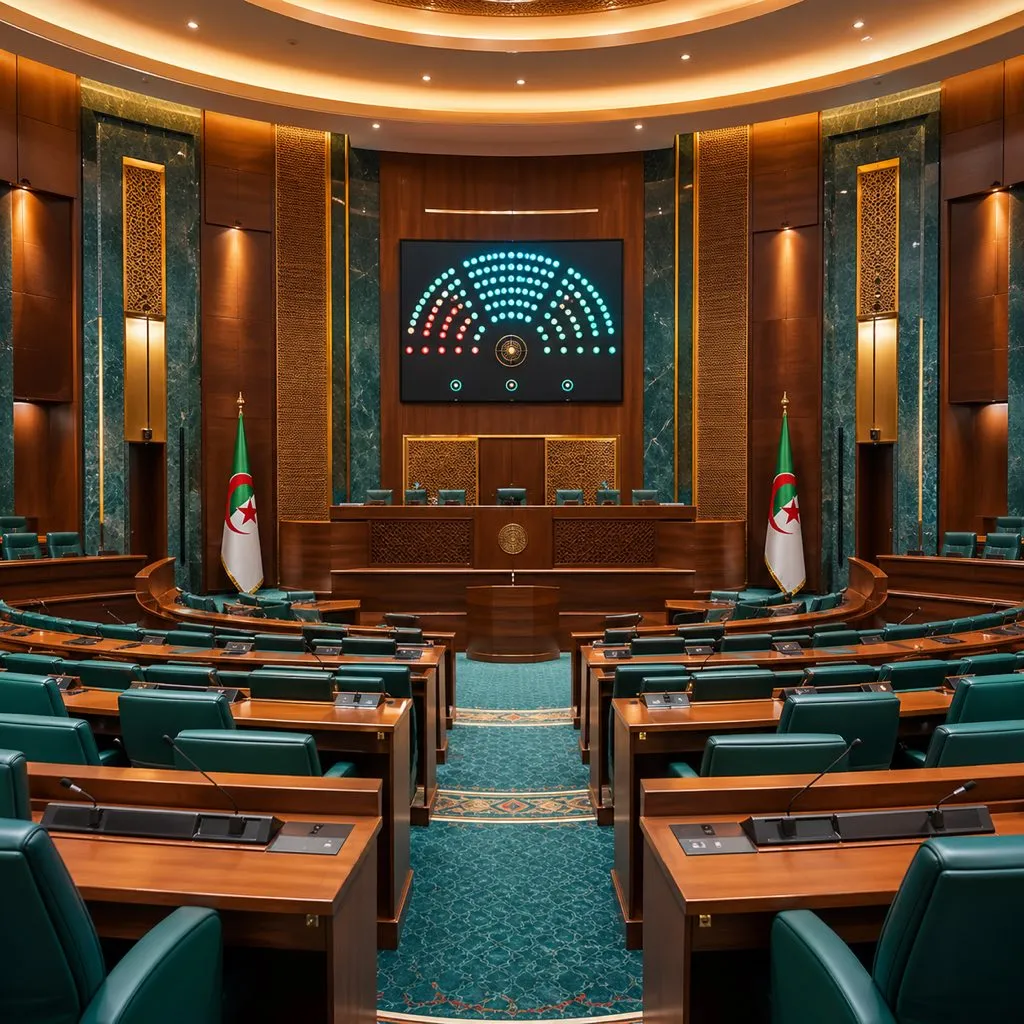
Two reforms, one digital-governance shift
Algeria passed two related legislative packages within five weeks. The political-parties law amendments were voted on in the APN on March 9, 2026, restructuring party governance around deliberative and executive bodies (articles 42 and 43), banning cash donations and mandating single-bank-account financial transparency, and requiring digital structures for party operations. The electoral system amendment was adopted by the APN on March 31, 2026, ratified by the Council of the Nation on April 2, and explicitly mandates “digital tools for the management of electoral rolls.” Together they modify well over one hundred articles of Algeria’s political-process law in under two months, and they hard-code digital workflows into the statutory text.
That hard-coding is the structural shift. Previous Algerian digitization moves — from the e-justice rollout to the Ministry of Knowledge Economy’s startup labels — sat as administrative practice on top of paper-era law. The April 2026 electoral reform reverses that order: the law itself now requires digital roll management, and the implementing decrees inherit legal force. Once a court can be asked to enforce a digital-governance provision, the design quality of the underlying systems becomes a regulatory question, not an IT preference.
The institutional architecture is also being redrawn
The reform reorganizes the National Independent Electoral Authority (ANIE) — created in 2019 with a mandate to remove elections from executive control — and returns logistical functions, voting material, and polling-station staffing to the Interior Ministry. The political-parties amendments give the Interior Minister authority to demand dissolution of any party that boycotts two consecutive elections. These are not purely administrative tweaks. They concentrate decision rights, and they do so at the same moment digital roll management is becoming the operational core of electoral administration.
For policy analysis, that combination is what makes “digital governance” the right frame. A digital electoral roll is not a neutral utility. Its access controls, audit logs, and modification rules encode who has effective authority over the voter base. When the Interior Ministry holds operational control and ANIE retains formal oversight, the precise division of digital permissions becomes the practical answer to the question of who governs the electoral process. International peers — France’s INSEE-managed electoral list with strict CNIL oversight, the UK’s Electoral Commission with statutory audit powers, Estonia’s published audit logs — all illustrate that the legal-technical interface is where legitimacy is built or contested.
Why this pattern will spread beyond elections
The election reforms are the most visible case, but they are not isolated. Algeria’s broader regulatory agenda — the 2025 Personal Data Protection Authority (ANPDP) operationalization, Law 18-07 enforcement, the e-government rollouts under the Ministry of Digitalization, and the digital-services updates flagged by Ecofin Agency in 2025 — points toward a generalized model where statutes embed digital workflows directly. Licensing, cadastral records, customs clearance, social-protection transfers, and judicial filings are all candidates for the same pattern.
That convergence creates four recurring policy questions. First, what audit trail is mandatory and who can read it? Second, how are dispute-resolution rights preserved when the underlying record is a database row rather than a paper file? Third, what data-protection authority has effective audit jurisdiction over the operational system? Fourth, how is implementation funded sustainably, given that the cost of an electoral-roll database is not the licenses but the security operations team that maintains it for the next decade?
Algeria already has answers in some areas. ANPDP exists and has authority. Law 18-07 covers personal data. The Cybersecurity National Authority published a critical-infrastructure framework in 2024. The gap is operational integration: do these institutions have inspection access to the new electoral-roll system before it goes live for the June 2026 parliamentary vote, or only after a complaint is filed?
Advertisement
What well-designed regulation actually looks like
Three specific moves would make the digital-governance shift robust. First, every law that mandates a digital workflow should include a published implementation timeline tied to a named technical authority — the absence of such a clause in the April 2026 electoral reform is the single largest gap. Second, audit access for ANPDP, the Court of Auditors, and accredited civil-society observers should be defined in the implementing decree, not negotiated later under pressure. Third, the legislature should include sunset and review clauses so digital-governance provisions are revisited every three to five years; technology cycles move faster than five-year electoral cycles, and statutes that cannot be updated will go stale.
The deeper implication for Algerian regulation is that legal drafting now requires technical literacy. A bill that mandates “digital tools” without specifying audit standards, dual-control rules, and inspection rights leaves the operational meaning of the law to whichever vendor builds the system. That is a legitimate concern raised by civil-society observers — the EU SEE alert published April 9, 2026 flagged “limited and non-inclusive public debate” on the same package. The technical content of the reform is not inherently wrong; it is under-specified.
Algeria’s election-law moment therefore has value beyond the ballot. It is the clearest case yet of digital governance moving from administrative practice into statute, and it surfaces the regulatory questions — audit, access, sunset, technical literacy in drafting — that will shape every subsequent reform of public services. The June 2026 parliamentary election will be the first stress test of whether the new model holds up under operational load.
What Algerian Public Administrators and Legal Technologists Should Do Now
The April 2026 reforms are in force. The implementation window is already open. For institutions involved in digital governance — ANPDP, ANIE, Interior Ministry IT teams, Court of Auditors, and public legal-services contractors — the following actions map directly to the gaps the reforms left unspecified.
1. Audit the Electoral Roll System Before It Goes Live for June 2026
The April 2, 2026 electoral reform mandates digital roll management but does not specify an inspection timeline. ANPDP — Algeria’s Personal Data Protection Authority — should invoke its authority under Law 18-07 to formally request read access to the electoral-roll database schema, access-log structure, and change-audit trail before the June 2026 parliamentary election, not after it. The French model — INSEE manages the electoral list under strict CNIL oversight — required a legally defined audit channel before any national election used the digital list. Estonia’s published audit logs are the benchmark for transparent post-election accountability. Algeria has the legal basis; the gap is exercising it proactively.
2. Publish the Technical Authority Named in Each Implementing Decree
The single largest specification gap in the April 2026 electoral reform is the absence of a named technical authority with a published implementation timeline. Every implementing decree that mandates a digital workflow should specify: which institution holds operational responsibility, what the deployment date is, which audit standard applies, and what the dispute-resolution path is when a record is challenged. The Ecofin Agency’s April 2025 reporting on Algeria’s digital-services law updates confirmed the same pattern across multiple reform packages. Closing this gap before the June 2026 vote is achievable in weeks; closing it after a disputed election result is politically costly.
3. Embed Sunset Clauses in All Digital-Workflow Legislation
The pattern that the election law introduced — statutes that embed digital workflows directly — will replicate across licensing, cadastral records, customs clearance, and judicial filings. Each such law should include a three-to-five-year review clause that forces legislative reconsideration on a technology cycle rather than an electoral cycle. The EU’s PSD3 revision process and India’s Account Aggregator framework both include mandatory review periods. For Algeria’s legislature, the practical mechanism is straightforward: a single boilerplate clause in any bill that mandates digital tools, requiring the competent ministry to report to the APN on technical performance and access disputes by a named date.
4. Build Technical Literacy Into the Legislative Drafting Process
The April 2026 reform was critiqued by EU SEE observers for “limited and non-inclusive public debate.” The deeper issue is that a bill mandating “digital tools” without specifying audit standards, dual-control rules, and inspection rights leaves the operational meaning of the law to the vendor who builds the system. The Ministry of Justice and the Secrétariat Général du Gouvernement should pilot a technical-review gate for any draft bill that mandates digital workflows: before parliamentary submission, the bill must show that audit access, data-protection compliance, and operational oversight roles have been defined. France’s Conseil d’État added a comparable digital-impact assessment requirement in 2023; Singapore’s PDPC runs a similar pre-legislative consultation. The capability exists within ANPDP and the cybersecurity authority; it needs to be formally attached to the drafting pipeline.
The Structural Lesson
Algeria’s April 2026 electoral reform is not primarily a story about voting. It is the clearest case yet of a broader structural shift: digital workflows moving from administrative preference into statutory obligation. That shift has a predictable consequence — the quality of implementation becomes legally contestable, not just operationally inconvenient. When a court can be asked to enforce a digital-governance provision, every gap in audit access, technical authority, and oversight jurisdiction becomes a potential litigation point rather than a deferred IT problem.
The structural lesson for every subsequent reform that follows this model — and the pattern will spread to licensing, cadastral records, customs clearance, judicial filings, and social protection — is that legal drafting and technical specification cannot be separated. A statute that mandates “digital tools” without defining the audit standard, the named authority, and the inspection rights leaves operational meaning to the vendor who builds the system. The EU SEE alert about “limited and non-inclusive public debate” on the April 2026 package pointed at exactly this gap. The problem was not digital adoption; it was under-specification.
Algeria’s June 2026 parliamentary election will be the first stress test of whether the electoral-roll system holds up under load. The result — whether it runs smoothly, produces disputed records, or surfaces access-control questions — will set the precedent for how the legislature approaches digital-governance mandates in every sector that follows.
Frequently Asked Questions
Why is digital governance now central in Algeria’s election-law reform?
The April 2, 2026 electoral system amendment modifies 85 articles and explicitly mandates digital tools for managing electoral rolls. Combined with the March 9, 2026 political-parties law revisions, more than one hundred legal articles now embed digital workflows directly, making system design a regulatory question rather than an IT preference.
What risks appear when electoral systems become more digital?
The main risks are unclear accountability, uneven audit access, and concentration of decision rights when the Interior Ministry holds operational control over digital roll management. International peers — France’s INSEE/CNIL split, the UK Electoral Commission, Estonia’s published audit logs — show that the legal-technical interface is where legitimacy is built.
How can Algeria improve trust in digitized election processes?
Three concrete moves: published implementation timelines with a named technical authority, audit access for ANPDP and accredited observers defined in the implementing decree, and sunset clauses so digital provisions can be updated faster than the five-year electoral cycle. Each has working precedent in EU and OECD jurisdictions.