The Dethroning of Data Center Alley
For more than two decades, Northern Virginia has held an uncontested claim to the title of data center capital of the world. Ashburn, Virginia, and the surrounding communities of Loudoun County host the largest concentration of data center capacity on the planet — approximately 8 gigawatts of total capacity, with roughly 4 GW more under construction. The region’s dominance was built on a foundation of abundant fiber connectivity, proximity to federal agencies and financial institutions, favorable local policies, and a self-reinforcing ecosystem of data center operators, service providers, and skilled workers.
That dominance is now under serious threat. Texas, driven by a confluence of power availability, business-friendly regulation, vast land, and the insatiable energy demands of AI infrastructure, is rapidly emerging as the primary destination for new hyperscale data center development. According to JLL’s North America Data Center Report (year-end 2025), Texas could surpass Northern Virginia in total data center capacity and become the world’s largest data center market by 2030.
The numbers are striking. Texas currently has approximately 6.5 gigawatts of data center capacity under construction or in advanced development stages. The state already operates 375 data centers across Austin, Houston, Dallas, and San Antonio, with another 70 currently under construction. Across all of North America, the total construction pipeline exceeds 24 gigawatts. Texas alone accounts for roughly one-quarter of the continent’s data center development pipeline, a share that has grown dramatically over the past two years.
This geographic shift isn’t a story about one state getting lucky. It’s a structural realignment driven by the physics and economics of AI-era data center infrastructure, and it has implications for power markets, real estate, workforce development, and the competitive positioning of regions around the world.
Why Virginia Is Hitting Its Ceiling
Northern Virginia’s data center dominance was built in an era when data centers consumed tens of megawatts each and the primary location factors were connectivity, proximity to end users, and access to a skilled workforce. The region excelled on all three counts, and its early ecosystem advantages created a virtuous cycle: more data centers attracted more fiber, more fiber attracted more data centers.
But the AI era has changed the equation. The primary constraint for new data center development is no longer connectivity or talent — it’s power. AI training clusters consume hundreds of megawatts. Hyperscale AI campuses require gigawatts. And Northern Virginia’s power infrastructure, despite enormous investment, is struggling to keep pace.
Dominion Energy, the primary utility serving Northern Virginia’s data center corridor, faces a supply-demand imbalance that has been building for years. Between July 2023 and July 2025, the total contracted capacity between Dominion and its data center customers increased by 185 percent. The utility’s distribution and transmission infrastructure was designed for a region of suburban homes and office parks, not one of the most power-hungry industrial concentrations on Earth. Dominion has announced plans to invest $50.1 billion in capital projects — including transmission lines, substations, and generation resources — between 2025 and 2029, but the timeline for new infrastructure extends years into the future.
The result is a power queue. New data center developments in Northern Virginia face wait times of three to five years for utility power connections. For hyperscalers racing to deploy AI infrastructure, those timelines are unacceptable. Some developers have resorted to building temporary on-site power generation to bridge the gap, but this adds cost and complexity.
In November 2025, Virginia’s State Corporation Commission approved Dominion’s request to create a new GS-5 rate class for the largest electricity users — including data centers consuming over 25 megawatts — set to take effect in January 2027. The move signals a regulatory environment that is increasingly treating data centers as a distinct industrial class with its own cost structure.
Land constraints compound the power problem. Loudoun County, the heart of Data Center Alley, currently hosts 199 data centers with another 117 in development. Zoning restrictions, community opposition, and the simple reality of a suburban county approaching build-out have pushed new development further west into Prince William County, Fauquier County, and beyond — areas with less fiber infrastructure and longer power interconnection timelines.
The Texas Advantage: Power, Land, and Speed
Texas offers a fundamentally different proposition for data center developers. The state’s advantages are structural, not incidental, and they align precisely with the requirements of AI-era infrastructure.
Power Abundance and Market Structure
Texas operates its own electric grid through the Electric Reliability Council of Texas (ERCOT), independent of the two major interconnections that serve the rest of the continental United States. ERCOT’s deregulated market structure allows large consumers to contract directly with generators, negotiate favorable rates, and connect to the grid through a process that, while not instantaneous, is typically faster and more predictable than in regulated utility territories.
More importantly, Texas has abundant generation capacity and is adding more rapidly. Between 2024 and 2025, approximately 23 GW of new generation capacity was added to the ERCOT grid, with another 9 GW slated for early 2026. By end of 2026, over 114 GW of transmission-connected wind, solar, and battery storage capacity is projected to be installed. The combination of cheap renewable energy during peak production hours and available gas generation for firm capacity creates an attractive cost profile for data center operators.
Texas also has a tradition of accommodating large industrial loads. The state’s petrochemical, refining, and manufacturing sectors have long demanded substantial power, and ERCOT’s market mechanisms are designed to integrate large loads efficiently. Data centers, while enormous by the standards of other states, are not unprecedented loads in Texas’s industrial context.
The Stargate Factor
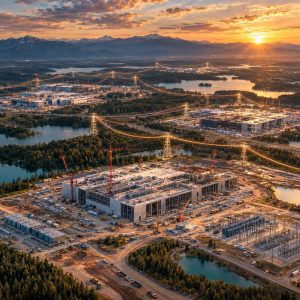
The scale of Texas’s data center ambitions is embodied by the Stargate project in Abilene — a four-million-square-foot AI data center campus built on over 1,000 acres of land approximately 180 miles west of Dallas. Part of a $500 billion nationwide AI infrastructure buildout led by OpenAI, Oracle, and SoftBank, the first two buildings on the planned 1.2 GW site became operational in late 2025, running Oracle Cloud Infrastructure for OpenAI. A second phase adding six more buildings is expected to complete in mid-2026, with construction employing over 6,400 workers at the site.
The Stargate expansion alone illustrates why Texas is winning: the state can offer gigawatt-scale sites, fast permitting, and power access at a pace that Virginia simply cannot match today.
Land and Geography
West Texas, Central Texas, and the Dallas-Fort Worth metropolitan area offer vast tracts of land suitable for data center development. Unlike the constrained parcels of Northern Virginia, Texas offers sites measured in hundreds or thousands of acres, capable of accommodating multi-gigawatt campus developments with room for phased expansion.
The geographic diversity of suitable sites in Texas is itself an advantage. Developers can choose locations that optimize for different factors: proximity to fiber routes, proximity to renewable generation, access to water for cooling, distance from populated areas for noise and emissions concerns, or proximity to workforce centers.
Business and Regulatory Environment
Texas’s business-friendly regulatory environment extends explicit welcome to data center development. Tax incentives, including abatements on property taxes and sales tax exemptions on equipment, are widely available. The permitting process for both data centers and associated power infrastructure is generally faster than in states with more complex regulatory frameworks.
Governor-level support for technology investment has made Texas aggressively competitive in recruiting data center projects. The state’s economic development agency actively courts hyperscaler investment, and multiple Texas communities have established enterprise zones and special tax districts specifically designed to attract data center development.
Advertisement
The Emerging Challengers: Beyond the Big Two
While the Texas-Virginia rivalry dominates headlines, the geographic redistribution of data center capacity extends well beyond these two markets. JLL estimates that 64% of the 35 GW North American construction pipeline now extends beyond traditional mature markets.
Tennessee has emerged as a significant contender, driven by the Tennessee Valley Authority’s large generation fleet and competitive electricity prices. The Nashville and Chattanooga metropolitan areas are attracting mid-scale data center developments, and TVA’s experience serving large industrial loads provides a favorable utility environment.
Wisconsin and Ohio are benefiting from proximity to Midwest population centers, abundant water for cooling, and competitive power costs. The Stargate project itself has announced expansion sites in both New Mexico and Ohio, signaling that the geographic distribution is widening further.
Georgia, already home to substantial data center capacity in the Atlanta metropolitan area, continues to attract development driven by its combination of connectivity, workforce, and moderate power costs. The state’s position as a logistics and connectivity hub extends naturally to data infrastructure.
Phoenix, Arizona, despite its water scarcity challenges, attracts data center development through its fiber connectivity (a legacy of its position on major east-west fiber routes), available land, and year-round solar energy production. The water issue, however, places a ceiling on Arizona’s growth potential, particularly for cooling-intensive facilities.
Internationally, the geographic shift is equally dramatic. Southeast Asia, the Middle East, and Latin America are all experiencing rapid data center growth as hyperscalers expand their global footprints. These markets, while smaller than North America in absolute terms, are growing faster and attracting billions of dollars in investment.
Power Market Implications
The geographic redistribution of data center capacity has profound implications for power markets. In established data center markets like Northern Virginia, data center load growth has driven electricity prices higher and strained grid infrastructure. Dominion Energy projects peak power demand for data centers in Virginia could rise to 13.3 gigawatts by 2038 — nearly a fivefold increase from about 2.8 gigawatts in 2022.
ERCOT’s experience is instructive — and sobering. The grid operator’s large load interconnection queue has nearly quadrupled in a single year, reaching approximately 226 GW by November 2025, up from 63 GW at end of 2024. More than 70% of these requests come from data centers, with another roughly 10% from cryptocurrency mining operations. The total requests are more than twice the state’s record peak summer demand of around 85 GW.
ERCOT has responded with new rules requiring large loads to demonstrate power contracts before connecting, has contracted McKinsey to improve its Large Load Interconnection process, and grid planners are modeling scenarios that account for data center growth projections. The grid operator increased its 2030 estimate of data center power demand from 29 GW to 77 GW — a recognition that even recent forecasts have consistently underestimated the pace of growth.
On the supply side, gas-fired power generation capacity in ERCOT’s queue rose from 26 GW in October 2024 to 48 GW by October 2025, reflecting a surge in dispatchable generation investment driven directly by data center demand.
The power market dynamics also influence the climate impact of data center growth. In markets with high renewable energy penetration, like Texas during daytime hours, new data center load can be served by clean energy. But during evening and nighttime hours, or during periods of low renewable production, that same load requires fossil fuel generation. The net climate impact depends heavily on the generation mix serving these facilities around the clock.
Workforce and Community Impact
The geographic shift in data center development is creating economic opportunities — and tensions — in communities across the country.
Data center construction provides significant short-term employment, with large projects employing thousands of construction workers over multi-year build-out periods. The Stargate campus in Abilene alone has created over 6,400 construction jobs, but also triggered a local housing crisis as worker demand outpaces available accommodation in the small city.
Operational employment is more modest but highly skilled and well-compensated — a single large data center might employ 50 to 200 permanent staff in technical operations, facilities management, and security roles.
Tax revenue from data center development can be transformative for rural communities. A single hyperscale campus might generate millions of dollars in annual property tax revenue, funding schools, roads, and public services in communities that previously had limited tax bases.
However, community tensions are emerging in some locations. Data center neighbors cite noise from cooling equipment, visual impact from large industrial facilities, increased truck traffic during construction, and water consumption as concerns. Data center opposition is gaining momentum across multiple states, with community groups citing power demand spikes and infrastructure strain.
The workforce challenge extends beyond the communities hosting data centers. The data center industry faces a nationwide shortage of skilled technicians, electricians, and mechanical engineers capable of building and operating modern facilities. This shortage is likely to intensify as the pace of construction accelerates, and it represents a constraint on how quickly the geographic redistribution can proceed.
The New Data Center Geography
The shift from Northern Virginia’s dominance to a more distributed data center geography is not a temporary fluctuation. It reflects structural changes in what matters most for data center siting in the AI era: power availability, speed of deployment, and cost optimization have displaced connectivity and proximity as the primary location factors.
For enterprise IT leaders and cloud architects, this geographic diversification is broadly positive. It creates more options for workload placement, enables latency optimization for geographically distributed user bases, and reduces concentration risk. The era of a single dominant data center market is giving way to a more resilient, more distributed infrastructure landscape.
For the communities and regions competing for data center investment, the message is clear: the winners will be those that can deliver power, land, water, and regulatory certainty on the timelines that hyperscalers demand. In the AI infrastructure race, the ability to build fast is the ultimate competitive advantage.
Frequently Asked Questions
What is texas vs. virginia?
Texas vs. Virginia: The Data Center Capital of the World Is Shifting covers the essential aspects of this topic, examining current trends, key players, and practical implications for professionals and organizations in 2026.
Why does texas vs. virginia matter?
This topic matters because it directly impacts how organizations plan their technology strategy, allocate resources, and position themselves in a rapidly evolving landscape. The article provides actionable analysis to help decision-makers navigate these changes.
How does why virginia is hitting its ceiling work?
The article examines this through the lens of why virginia is hitting its ceiling, providing detailed analysis of the mechanisms, trade-offs, and practical implications for stakeholders.
Sources & Further Reading
- JLL: Texas to Become World’s Largest Data Center Market by 2030 — Datacenter Dynamics
- Red-Hot Texas Is Getting So Many Data Center Requests That Experts See a Bubble — CNBC
- ERCOT’s Large Load Queue Has Nearly Quadrupled in a Single Year — Latitude Media
- Dominion Energy Admits It Can’t Meet Data Center Power Demands in Virginia — Datacenter Dynamics
- Data Center Opposition Gains Momentum as Power Demand Spikes — S&P Global
- Stargate Data Center Poised to Complete Construction This Year in Abilene — Texas Standard
- North America Data Center Trends H2 2025 — CBRE