The Invisible Thirst of the Cloud
Every photograph uploaded to the cloud, every search query processed, every AI model trained requires not just electricity but water — enormous, growing, and largely invisible quantities of water. Data centers, the physical infrastructure behind the digital economy, are among the most water-intensive industrial facilities on the planet, and their thirst is growing exponentially.
In Texas, data centers consumed an estimated 49 billion gallons of water in 2025, according to state water planning data. By 2030, that figure is projected to reach as high as 399 billion gallons — an eight-fold increase driven almost entirely by the construction of AI-focused data centers that generate far more heat per square foot than their predecessors. To put this in perspective, 399 billion gallons would represent nearly 6.6% of the state’s total water usage.
Nationally, the picture is equally alarming. A September 2025 report by Ceres, titled “Drained by Data,” found that 32% of data centers across the United States are located in areas of high or extremely high water stress. In the Phoenix metropolitan area alone, annual water use from data center electricity demand is expected to increase by 400% as planned facilities come online — enough water to supply the city of Scottsdale, Arizona, for over two years.
These numbers are startling, but they may understate the problem. Most states in the United States do not require data centers to report their water consumption. The industry has no standardized water usage metric that accounts for watershed stress. And technology companies, while increasingly transparent about their electricity consumption and carbon emissions, have been notably reluctant to discuss water.
When Sam Altman, CEO of OpenAI, was asked about the water consumption of AI infrastructure at the AI Impact Summit in February 2026, he dismissed water usage claims as “completely untrue, totally insane,” arguing that data centers have largely moved away from water-heavy evaporative cooling. But the communities living near data centers — communities watching their wells drop, their water bills rise, and their aquifers deplete — see the situation very differently. Researchers at the University of California, Riverside estimated that each 100-word AI response uses roughly 519 milliliters of water when accounting for both direct cooling and indirect power generation water use.
Why Data Centers Need So Much Water
Understanding data center water consumption requires understanding how these facilities stay cool. The servers inside a data center convert virtually all the electricity they consume into heat. That heat must be removed to prevent equipment damage and maintain performance. The dominant cooling technology for large data centers is evaporative cooling, which works on the same principle as perspiration: water absorbs heat as it evaporates, cooling the surrounding air.
Evaporative cooling is extremely energy-efficient compared to mechanical refrigeration. A data center using evaporative cooling might achieve a PUE of 1.1, meaning it uses just 10% more energy for cooling than the IT equipment itself consumes. The same data center using mechanical refrigeration might have a PUE of 1.4 or higher, consuming 40% more energy for cooling.
The trade-off is water. An evaporative cooling system for a large data center can consume millions of gallons per day, with consumption peaking during hot, dry weather — precisely when water is scarcest in drought-prone regions. The water evaporates into the atmosphere, meaning it is consumed, not merely used and returned. This distinguishes data center water use from many industrial applications where water is used as a coolant and returned to the source.
The scale of AI workloads has intensified this dynamic. Traditional enterprise data centers might dissipate 5 to 10 kilowatts per rack. AI training clusters can exceed 100 kilowatts per rack. More heat means more cooling, and more cooling means more water. A single large AI data center campus can consume as much water as a small city — and the industry is planning to build hundreds of them.
The Ceres report also highlighted a dimension often overlooked: indirect water consumption from electricity generation. Power plants — especially natural gas and nuclear facilities — use enormous quantities of water for cooling. When a data center draws power from the grid, its indirect water footprint from power generation can dwarf its direct on-site water use. This means that even air-cooled data centers have a significant water impact through their electricity consumption.
Some technology companies are investing in air-cooled and liquid-cooled data centers that reduce or eliminate direct water consumption. But these alternatives involve trade-offs: air cooling consumes more electricity, and liquid cooling requires significant capital investment. For many operators, evaporative cooling remains the most cost-effective option, and water consumption continues to grow.
Ground Zero: Texas and the Southwest
Texas exemplifies the collision between data center growth and water scarcity. The state is experiencing unprecedented data center construction, driven by the same factors that make it attractive for power — available land, business-friendly regulation, and grid capacity. In November 2025, Google alone announced $40 billion to construct three new data centers in the state. But Texas also faces chronic water stress, with much of the state classified as semi-arid and major aquifers already declining from agricultural and municipal demand.
In Hays County, south of Austin, community opposition to data center development has been particularly fierce. Residents who depend on well water from the Edwards Aquifer — a karst formation that is both the region’s primary water source and one of its most ecologically sensitive resources — have organized against proposed data center projects that would draw from the same aquifer. As of February 2026, water advocates in Hays County face five data centers on the horizon, and community groups see the fight as just beginning. The San Marcos City Council voted 5-2 to block one proposed data center, a rare instance of local government pushing back against the industry.
Their concerns are not hypothetical. The Edwards Aquifer has dropped 20 feet below its 10-year average, and over 70% of Texas was experiencing moderate to severe drought through 2025-2026. Adding millions of gallons per day of data center water consumption to an already stressed system risks triggering the aquifer authority’s drought management stages, which impose mandatory water use reductions on existing residents and businesses.
The Texas Commission on Environmental Quality, the state’s environmental regulator, has limited authority over data center water consumption. No state legislation limits water usage by data centers, though lawmakers did pass new provisions in 2025 to suspend data center power access during grid stress events. Large data centers in Texas can secure water rights through the same mechanisms available to any industrial user — purchasing rights from existing holders or contracting with water utilities — without special environmental review or cumulative impact assessment.
Arizona faces similar tensions. The Phoenix metropolitan area, which has attracted significant data center investment due to its fiber connectivity and available land, is located in the Sonoran Desert, one of the driest environments in North America. Maricopa County, home to the majority of Arizona’s data centers, relies on a water supply system that is already stressed by population growth, agricultural demand, and declining Colorado River allocations.
In June 2023, Arizona Governor Katie Hobbs declared a groundwater shortage affecting parts of the Phoenix metropolitan area, restricting new residential developments that lack assured water supplies. Groundwater in the Phoenix area is now fully allocated. Data centers, classified as industrial or commercial users, face different regulatory frameworks and have generally been able to secure water rights — a disparity that has fueled public resentment. The Ceres analysis projected that data center water demands could increase water stress in some Arizona areas by as much as 32% if all currently planned facilities come online.
Advertisement
The Transparency Gap
Perhaps the most frustrating aspect of the data center water crisis for communities and policymakers is the lack of information. Technology companies publish detailed reports on their electricity consumption, carbon emissions, and renewable energy procurement. Water receives far less attention.
Google has been more transparent than most, publishing facility-level water consumption data in its environmental reports and pledging to become water positive by 2030. Microsoft has published aggregate water usage data and committed to becoming “water positive” by 2030, meaning it will replenish more water than it consumes — the company has nearly doubled its water replenishment portfolio to include more than 49 projects worldwide. Microsoft also launched a new zero-water-cooling data center design in 2024 and is targeting a 40% improvement in water use efficiency from its 2022 baseline. Meta published water stewardship data for its data center communities in December 2025. Amazon Web Services, the world’s largest cloud provider, has provided comparatively little detail about its water consumption, though it reports a WUE of 0.19 liters per kWh.
The absence of standardized reporting makes it difficult to compare water efficiency across operators or assess the cumulative impact of data center water consumption in a given watershed. The data center industry has developed sophisticated metrics for energy efficiency (PUE) and carbon intensity, but no equivalent metric for water efficiency has achieved industry-wide adoption.
Water Usage Effectiveness (WUE), defined as the ratio of annual water use to IT equipment energy consumption, has been proposed as a standard metric. The average WUE across data centers is 1.9 liters per kWh. But the metric has limitations: it doesn’t account for the source of the water (municipal, groundwater, recycled), the stress level of the watershed from which it’s drawn, or the indirect water embedded in electricity generation. Using a gallon of water in water-rich Oregon is not equivalent to using a gallon of water in drought-stricken Arizona. China is currently the only country that has incorporated WUE performance standards into its data center building code, according to the IEA’s 2025 Energy and AI report.
The Legislative Response
The regulatory landscape is shifting rapidly, if unevenly. In 2025, more than 200 bills were introduced across all 50 US states aimed at regulating data centers, with more than 40 enacted into law addressing energy procurement, water usage, environmental considerations, siting, and labor standards.
Oregon has been a frontrunner. The state adopted rules limiting water usage for data center cooling systems, particularly in drought-affected regions. Oregon’s POWER Act, enacted in August 2025, established special electricity rates for data centers and other large power consumers, incentivizing efficiency and grid-friendly load profiles. Bills in Oregon also proposed annual or quarterly reporting on water and energy usage.
Washington is pressing ahead with House Bill 2515, which passed out of the Appropriations Committee in early 2026. The bill requires utilities to establish a tariff or policy for data centers by 2027 and calls on data centers to curtail electricity use and take other steps to manage their demand.
Virginia, home to the world’s largest concentration of data centers in Loudoun County, has seen growing scrutiny. All data centers in Northern Virginia consumed close to 2 billion gallons of water in 2023 — a 63% increase from 2019.
But most states, including Texas, still have no specific water reporting requirements for data centers, leaving communities to guess at the impact of the facilities in their midst. The European Union’s Delegated Regulation 2024/1364 set data center reporting requirements including WUE metrics, putting Europe ahead of the US on mandatory disclosure.
The Industry’s Response: Efficiency and Alternatives
The data center industry is not ignoring water concerns, though critics argue its response has been insufficient relative to the scale of the problem.
Closed-loop cooling systems recirculate water rather than evaporating it, dramatically reducing consumption. These systems use cooling towers that reject heat to the air through a combination of evaporation and sensible cooling, or mechanical chillers that use no water at all. The trade-off is higher electricity consumption and capital cost.
Air-cooled data centers eliminate direct water consumption entirely by using fans and heat exchangers to reject heat to ambient air. This approach works well in cool climates but becomes increasingly energy-intensive as ambient temperatures rise. In hot climates, air-cooled data centers can consume significantly more electricity than evaporatively cooled facilities, simply shifting the environmental impact from water to carbon.
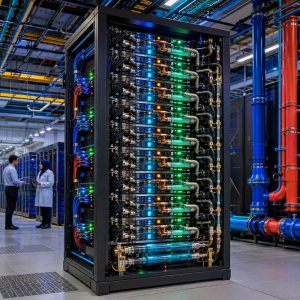
Liquid cooling technologies — direct-to-chip and immersion cooling — can reduce overall cooling water consumption by enabling heat rejection at higher temperatures, which makes dry cooling more efficient. Some liquid cooling systems are fully closed-loop, consuming no water at all. As AI rack densities push past 100 kW, liquid cooling is increasingly becoming a necessity rather than an option.
Recycled and non-potable water is increasingly used by data centers that do rely on evaporative cooling. Microsoft has committed to using zero potable water for cooling in new data centers, relying instead on recycled wastewater, rainwater harvesting, and industrial gray water. Google has made similar commitments for many of its newer facilities.
Siting decisions are perhaps the most impactful lever. Building data centers in water-rich regions rather than water-stressed ones eliminates the core tension. Google’s February 2026 announcement of a new data center in Pine Island, Minnesota — paired with 1.9 GW of clean energy including iron-air battery storage — illustrates a siting model that prioritizes water availability alongside renewable energy access. Northern European countries, the Pacific Northwest, and parts of the American Midwest offer abundant water alongside favorable climates for cooling. However, these regions may not offer the other factors — power availability, fiber connectivity, regulatory environment — that drive all siting decisions.
The Water Bill Comes Due
The data center industry has operated for decades on the assumption that water is cheap, abundant, and someone else’s problem. That assumption is collapsing under the weight of AI-driven growth, climate change-induced drought, and community resistance.
The companies building AI infrastructure face a choice. They can continue to site water-intensive facilities in water-stressed regions, relying on their economic power to secure water rights while externalizing the costs onto communities and ecosystems. Or they can invest in water-efficient technologies, site facilities in water-appropriate locations, and support the regulatory frameworks needed to manage shared water resources sustainably.
The scale of the coming challenge is staggering. According to a January 2026 analysis by Xylem and Global Water Intelligence, AI’s water usage is projected to grow by approximately 130% — roughly 30 trillion liters (7.9 trillion gallons) — through 2050. This is not a future risk; it is a present trajectory that demands immediate action from industry, regulators, and the communities affected.
For the communities on the front lines, the stakes are immediate and existential. Wells don’t refill on corporate timelines. Aquifers don’t respond to sustainability reports. The water war is not a future risk — it’s happening now, in communities across the American Southwest and increasingly around the world.
Frequently Asked Questions
What is data centers are draining aquifers?
Data Centers Are Draining Aquifers: The Water War Big Tech Doesn’t Want You to See covers the essential aspects of this topic, examining current trends, key players, and practical implications for professionals and organizations in 2026.
Why does data centers are draining aquifers matter?
This topic matters because it directly impacts how organizations plan their technology strategy, allocate resources, and position themselves in a rapidly evolving landscape. The article provides actionable analysis to help decision-makers navigate these changes.
How does why data centers need so much water work?
The article examines this through the lens of why data centers need so much water, providing detailed analysis of the mechanisms, trade-offs, and practical implications for stakeholders.
Sources & Further Reading
- Drained by Data: The Cumulative Impact of Data Centers on Regional Water Stress — Ceres
- Data Centers and Water Consumption — EESI
- Data Centers Are Thirsty for Texas’ Water, but State Planners Don’t Know How Much They Will Need — The Texas Tribune
- With 5 Data Centers on the Horizon, Hays County Water Advocates See the Fight as Just Beginning — KUT
- Sam Altman Defends AI Resource Usage: Water Concerns ‘Fake’ — CNBC
- Beneath the Surface: Water Stress in Data Centers — S&P Global
- States Push to End Secrecy Over Data Center Water Use — E&E News / Politico
- Microsoft Sustainable by Design: Transforming Datacenter Water Efficiency — Microsoft