Why a Fiber Connector Made Global Tech News
On July 15, 2026, 3M and Microsoft announced a strategic partnership covering AI data center infrastructure and enterprise transformation. The headline element: Microsoft’s Azure will be the first publicly named hyperscale cloud provider to deploy 3M’s Expanded Beam Optical (EBO) technology inside its data centers. In exchange, 3M will run parts of its own enterprise operations — including customer order management in its Global Business Services team — on Microsoft’s AI agent platforms for tasks like credit checks and delinquency assessments.
The deal was announced by Cliff Henson, Microsoft’s corporate vice president for cloud supply chain and engineering, and Jon Van Wyck, 3M’s executive vice president and chief strategy officer, according to Microsoft’s official announcement. On paper, a fiber-optic connector deal sounds like a minor supply-chain footnote next to the multi-billion-dollar data center announcements dominating the news cycle. In practice, it addresses a constraint that increasingly rivals electricity for how fast AI capacity can actually come online.
What Expanded Beam Optical Actually Fixes
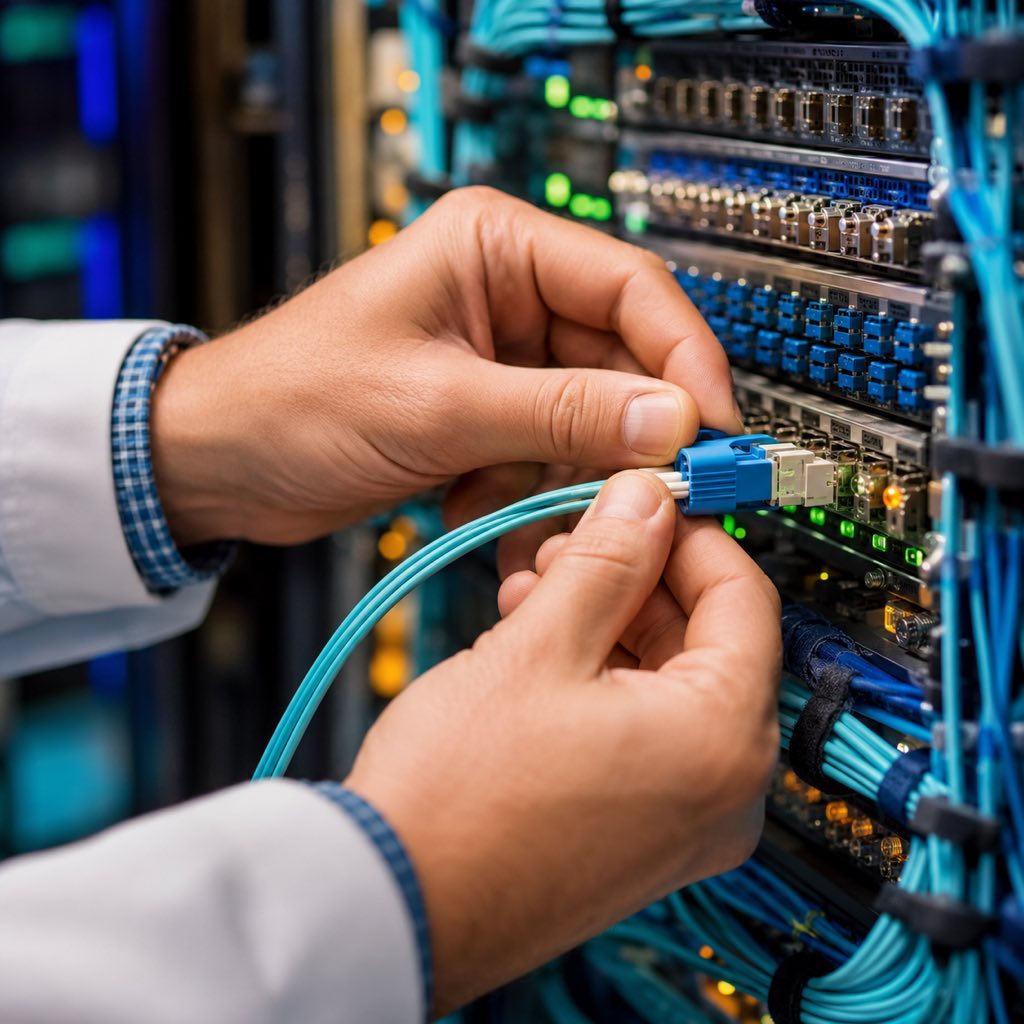
Traditional fiber connectors rely on direct physical contact between polished glass fiber ends — a design that is exquisitely sensitive to dust. A single speck of contamination on a connector face can degrade or kill an optical signal, which is why technicians spend time cleaning and inspecting every connection before it goes live. In a hyperscale AI data center, where a single GPU cluster can require thousands of fiber runs, that cleaning step compounds into a real bottleneck.
EBO technology replaces direct-contact connections with an expanded beam optical interface — using lens arrays to widen the light path across the connection point instead of butting polished fiber ends together. According to 3M’s own product documentation, this design is dramatically more tolerant of dust and handling, largely eliminating the need for the cleaning and inspection cycle that slows conventional installs. The connectors also support far higher density — up to 144 fibers in a single connector, compared with the 12- or 24-fiber counts typical of legacy MPO connectors — which matters directly for rack space and airflow in packed AI data halls.
The efficiency gain is not marginal. Vendor testing cited by 3M and its manufacturing partners found that a conventional connector’s roughly 3-minute plug-up time drops to about 30 seconds with EBO — an 85% reduction in per-connector deployment time. 3M’s Alex An, vice president of the company’s data center vertical, said early EBO deployments — the technology debuted in 2019 — cut network bring-up timelines “from weeks down to just days,” and that 3M was the first to demonstrate single-mode expanded beam optics at scale, a capability the wider industry had been chasing without success.
Fiber Is Becoming the New Power Bottleneck
The timing of the deal lines up with a structural shift in what actually gates AI data center readiness. For most of the current AI buildout cycle, the binding constraint has been electricity — grid interconnection queues, substation capacity, transformer lead times. That is still the dominant story in most markets. But Landgate’s analysis of 2026 site selection flags fiber as “a second constraint that power-first site selection often overlooks” — a gap that tends to surface late in diligence, after a site has already been chosen for its power access, at which point fiber (not power) becomes the item that actually defines the schedule.
The scale of Microsoft’s own network illustrates why a connector-level fix matters at all. Azure’s AI Wide Area Network runs across roughly 120,000 miles of dedicated fiber, interconnecting custom Maia 100 AI accelerators and Cobalt 100 CPUs across Microsoft’s global footprint. At that scale, even small per-connector time savings compound into meaningful throughput gains for bringing new GPU capacity online — which is precisely why Microsoft is betting on a physical-layer fix rather than only adding more fiber crews.
The broader stakes around deployment speed are real, even if they are mostly about power rather than fiber: industry analysis of the 2026 AI data center pipeline estimates that 30-50% of planned 2026 AI data center capacity is at risk of slipping to 2028 because of grid interconnection queues, transformer lead times, and construction bottlenecks. Any physical-layer efficiency gain — including a faster fiber connector — helps compress the portion of that timeline hyperscalers can actually control.
Advertisement
The Market This Deal Sits Inside
The 3M-Microsoft partnership lands inside a data center infrastructure market valued at $297.07 billion in 2025 and projected to reach $752.12 billion by 2034 — a compound annual growth rate of 10.9%. That growth is increasingly concentrated in AI-specific infrastructure: GPU-intensive workloads now account for roughly 18% of total cloud spend at AI-forward companies, up from just 4% a few years ago, according to the State of FinOps 2026 report. Every physical-layer improvement that shortens the path from “GPUs delivered” to “GPUs generating revenue” has an outsized effect on that spend curve.
3M is not the only vendor chasing this niche — competitors including Molex and Senko have also launched expanded-beam interconnect products for hyperscale data centers, a sign the entire fiber-connectivity supply chain is racing to solve the same dust-and-density problem Microsoft is now addressing with 3M specifically.
What This Means for Cloud Infrastructure Buyers
1. Physical-layer bottlenecks are now a legitimate vendor-selection criterion
For any organization evaluating cloud or colocation providers for AI workloads, deployment speed claims should be scrutinized past the marketing headline. A provider whose fiber plant uses legacy direct-contact connectors will structurally lag one using expanded-beam technology when it comes to standing up new GPU capacity — ask providers directly what connector technology underlies their AI-cluster interconnects.
2. Capacity delay risk is now multi-factor, not just power-driven
Buyers negotiating long-lead-time GPU capacity commitments should treat fiber readiness as a distinct risk line item alongside power availability, not a subordinate detail. The 30-50% capacity-slip estimate for 2026 AI data center plans is a reminder that “the data center is built” and “the data center is fiber-connected and live” are two different milestones with two different failure modes.
3. Vendor partnerships signal where the next efficiency gains will come from
The fact that a materials-science company (3M) and a hyperscaler (Microsoft) are co-announcing a connector deal — rather than 3M simply selling parts through a distributor — signals that physical-layer efficiency has become strategic enough to warrant an executive-level partnership. Enterprise IT buyers should watch for similar vertical-integration announcements from other hyperscalers (AWS, Google Cloud) as a leading indicator of where capacity will loosen first.
The Bigger Picture
The 3M-Microsoft deal is a reminder that AI infrastructure bottlenecks are rarely singular. Power gets the headlines because it is visible in gigawatt terms and shows up in utility rate cases and local zoning fights. Fiber connectivity is comparatively invisible — it lives inside the data hall, in a component that costs a few dollars per connector — but at hyperscale, thousands of small frictions add up to weeks of delay on capacity that costs hundreds of millions of dollars to sit idle.
What makes this deal notable is not the technology itself (EBO has existed since 2019) but the signal that a hyperscaler is willing to make it a named, exclusive-at-launch differentiator. If Azure’s bet pays off in measurably faster GPU-cluster bring-up, expect AWS and Google Cloud to either follow with their own EBO deployments or reach for a comparable physical-layer fix of their own — turning what looks today like a supply-chain footnote into a genuine competitive front in the hyperscaler race.
Frequently Asked Questions
What is 3M’s Expanded Beam Optical (EBO) technology?
EBO is a fiber-optic connector design that uses lens arrays to widen the light beam at the connection point instead of relying on direct physical contact between polished fiber ends. This makes connections far more tolerant of dust and handling, largely eliminating the cleaning and inspection steps required by traditional connectors, according to 3M’s product documentation.
Why does a fiber connector matter for AI data centers?
At hyperscale, a single GPU cluster can require thousands of fiber connections, and each one traditionally needs manual cleaning and inspection. Industry analysis of 2026 site selection notes that fiber is a constraint power-first planning often overlooks, so cutting per-connector deployment time by roughly 85% compounds into materially faster capacity bring-up across an entire data hall.
Is Microsoft Azure the only cloud provider using this technology?
Microsoft is the first publicly named hyperscale cloud provider to deploy 3M’s EBO technology specifically, per the July 15, 2026 announcement. Other vendors, including Molex and Senko, have released competing expanded-beam connector products, suggesting the broader industry — not just 3M — is racing to solve the same dust-and-density problem across hyperscale fiber plants.
Sources & Further Reading
- 3M and Microsoft Announce Strategic Partnership — Microsoft Source
- 3M’s Fiber Optic Breakthrough Is Helping Power AI’s Massive Buildout — 3M News
- 3M Expanded Beam Optical Solutions for Data Center — 3M
- Expanded Beam Connector — Molex
- AI-First Hyperscalers: 2026’s Sprint Meets the Power Bottleneck — Data Center Knowledge
- The Power-to-Fiber Ratio: Connectivity Is the New Interconnection Queue — Landgate
- Tokens per Watt Determines AI Factory Revenue as Power Constraints Tighten — Tech Times
- Data Center Infrastructure Market Expected to Reach US$752.12 Billion by 2034 — GlobeNewswire
- Machine Learning Cloud Costs 2026: Training, Inference & GPUs — Spendark
🔗 Related Intelligence
Modular Data Centers: The 6-Month Build Strategy Disrupting AI Infrastructure

The $112 Billion Quarter: Inside the Q1 2026 Hyperscaler AI Infrastructure Sprint

Microsoft and OpenAI Break Up Exclusivity: What the Multicloud AI Restructure Means
AI Data Centers: How They Work and Why They Matter