
What the May 25 Government Meeting Actually Validated
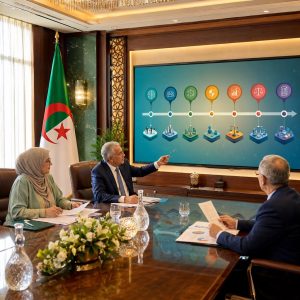
On May 25, 2026, Prime Minister Sifi Ghrieb chaired a government meeting that did two things at once: it reviewed the draft national AI strategy and approved the deployment plan for Dzair Digital Services, the government’s unified e-services portal. The combination is significant because it pairs a long-horizon policy framework (the AI strategy, aligned with the 2025–2030 National Digital Transformation Strategy) with a near-term operational deliverable that enterprises and citizens can touch this year.
According to iAfrica’s coverage of the meeting, the strategy is formally organised around six pillars: advancing research and innovation, developing skills, investing in infrastructure, promoting an AI ecosystem, establishing a regulatory framework, and targeting priority sectors including health, agriculture, and energy. The same coverage notes that the High Commission for Digitalisation, led by Meriem Benmouloud, is steering the implementation alongside the ministries of Higher Education, Interior, and National Defence.
The cleaner way to read these six pillars — and the framing officials have been using in public communication — is to cluster them around three operational anchors. Research, sectors, and ecosystem all depend on data: who holds it, who can access it, and under what conditions. Infrastructure investment and the regulatory framework converge on digital infrastructure: compute capacity, connectivity, and the rules that govern both. Skills development on its own forms the human capital anchor. The Ecofin Agency’s briefing on the strategy preparation frames the next phase as a series of action plans with “predefined priorities and timelines” once the Council of Ministers signs off.
Dzair Digital Services: The Tangible Half of the Announcement
The portal is the part of this story enterprises will feel first. Dzair Digital Services launched with 52 government services drawn from civil registry, justice, health, land registry, and national solidarity, with additional services scheduled to roll on progressively. It includes a built-in digital identity system and an electronic wallet — two capabilities that, once made accessible to private-sector integrations, change what is technically feasible for fintech, e-commerce, and HR platforms operating in the country.
The Middle East AI News breakdown confirms that the portal cleared cybersecurity testing coordinated with the Information Systems Security Agency (ASSI), and that pilot trials ran across March and April 2026 with 1,700+ participants drawn from seven ministerial sectors. That validation pipeline matters: it means the launch is not a press-release object but a tested platform with documented stress data. For Algerian CTOs evaluating which integrations to prioritise in H2 2026 planning, that is the difference between a roadmap bet and a buildable foundation.
The strategic envelope is wider still. Algeria currently ranks 116th on the UNDESA E-Government Development Index with a score of 0.5956 out of 1 — above the African average of 0.4247 and within striking distance of the global average of 0.6382. Dzair Digital Services, executed against the three operational pillars, is the lever the High Commission for Digitalisation is using to close that distance.
Advertisement
The Workforce Pipeline Is Already Producing at Scale
The most concrete of the three pillars today is human capital, because the inputs are countable. Algeria offers 74 master’s programmes in artificial intelligence across 52 universities, with more than 57,000 computer science students enrolled nationally. iAfrica’s reporting on the strategy review further notes that Algerian researchers rank among the top 2% of scientists globally and that the country places in Africa’s top five for recognised scientific publications. These numbers are not promises about future capacity — they describe today’s pipeline.
For enterprises this changes the hiring calculus in two ways. First, the volume of AI-credentialed graduates entering the market over 2026-2028 will be larger than most workforce plans currently assume, which compresses the wage premium on imported senior talent. Second, the regional distribution (52 universities, not three or four flagship campuses) means recruitment beyond Algiers, Oran, and Constantine becomes economically rational for the first time. Companies that build campus-presence programmes outside the capital triangle in the next 6-12 months will lock in cohort relationships before competitors arrive.
What Algerian Enterprises Should Do With the Three-Pillar Framing
1. Map your AI ambition against the three operational pillars before the action plans drop
Do not wait for the Council of Ministers’ formal approval of the action plans before doing the homework. Take each AI initiative you have in flight or in planning and tag it against data, infrastructure, or human capital. For each one, identify the specific government pillar lead — the High Commission for Digitalisation for the digital service layer, the Ministry of Higher Education for skills, and the sector ministries (Health, Agriculture, Energy) for the priority verticals. When the action plans publish, you want to already know which conversations you need to be in. The Algerie Presse Service statement from the PM’s office confirms the strategy and Dzair Digital Services were reviewed in the same session, signalling that the consultation windows that follow will be short.
2. Treat Dzair Digital Services as a platform, not a portal
The 52 launched services and the embedded digital identity plus electronic wallet are the start of a public-sector platform, not the end. Enterprises that build integrations against the identity layer in the next 6-12 months — KYC flows for fintech, employee verification for HR, supplier onboarding for procurement — will compound their advantage as the catalogue grows. The portal cleared ASSI’s cybersecurity testing and ran a 1,700-participant pilot, which gives you a credible baseline to plan against. Assign a named integration owner now, document the API surface as it becomes available, and prioritise three internal workflows where digital identity removes a manual step.
3. Build a workforce pipeline strategy that uses the 52-university footprint, not the top three
Algeria’s 74 master’s programmes in AI and 57,000+ computer science students are not concentrated in three flagship campuses — they sit across 52 universities. The hiring teams that adapt fastest will be the ones that build relationships with five to seven regional universities each, not the ones that compete for the same hundred graduates from USTHB, ESI, and Polytechnique. Sponsor a final-year project, host a regional hackathon, fund a teaching assistantship. The cost per relationship is small; the cohort access compounds over three years. The reference is the way Singapore’s enterprises systematically partnered with NTU and SUTD beyond the obvious NUS pipeline through the late 2010s — that is the model worth borrowing.
4. Get your data house in order before the regulatory pillar publishes
The strategy’s regulatory framework pillar will eventually define how AI systems access, process, and store data — including how Dzair Digital Services data flows interact with private-sector AI. Right now your window is open: classify the data you hold by sensitivity and provenance, document your training-data lineage, and identify which AI workloads currently sit on cross-border infrastructure. The High Commission for Digitalisation has flagged data governance as central, and the regulatory consultation timeline will move quickly once the action plans are approved. Internal readiness in the next 90 days is cheaper than retrofit later.
The Bigger Picture
The shift from a six-pillar policy diagram to a three-anchor operational framing is more than a communication choice. It signals that the strategy is moving into a phase where execution must be measurable — and that the government wants the private sector to be able to read its roadmap and act on it without a translation layer. Data, digital infrastructure, and human capital are the three categories that map cleanly onto budget lines, headcount plans, and procurement cycles. When the Council of Ministers approves the action plans, those three anchors are how enterprises will hear the timelines.
There is also a sequencing message in this announcement. The fact that Dzair Digital Services launched on the same day the strategy was reviewed tells you the operational layer is moving ahead of the policy layer — the government is not waiting for every detail to be ratified before it ships the things citizens and businesses will use first. That gives Algerian enterprises a window to learn the platform, build integrations, and inform the regulatory conversation from a position of operational knowledge rather than from a whitepaper. The companies that use the next 6-12 months this way will shape the next phase of the strategy more than the ones that wait.
The three-pillar framing, combined with the workforce numbers already in the pipeline and a tested digital services portal already live, makes this the most actionable moment Algeria’s AI policy has presented to date. The opportunity is to treat it that way.
Frequently Asked Questions
Q: What did Algeria’s government decide about the AI strategy on May 25, 2026?
PM Sifi Ghrieb chaired a government meeting that reviewed the draft national AI strategy and approved the deployment plan for Dzair Digital Services. The strategy is structured around six pillars — research and innovation, skills, infrastructure, ecosystem, regulatory framework, and priority sectors — increasingly communicated as three operational anchors: data, digital infrastructure, and human capital. Action plans with predefined priorities and timelines will follow Council of Ministers approval.
Q: What is Dzair Digital Services and how many services does it offer?
Dzair Digital Services is Algeria’s unified e-government services portal, launched on May 25, 2026 with an initial catalogue of 52 services drawn from civil registry, justice, health, land registry, and national solidarity. It includes a built-in digital identity system and an electronic wallet, cleared cybersecurity testing coordinated with the Information Systems Security Agency (ASSI), and went through pilot trials with 1,700+ participants across seven ministerial sectors in March-April 2026.
Q: How large is Algeria’s AI workforce pipeline today?
Algeria offers 74 master’s programmes in AI across 52 universities, with more than 57,000 computer science students currently enrolled. Algerian researchers also rank in the top 2% of scientists globally and the country places in Africa’s top five for recognised scientific publications. This is the most countable of the three operational pillars and gives enterprises a credible base for workforce planning over 2026-2028.
Sources & Further Reading
- Algeria reviews national AI strategy progress and approves launch of Dzair Digital Services Portal — iAfrica
- Algeria prepares AI strategy to advance its digital transformation — Ecofin Agency
- Algerian PM reviews AI strategy status — Middle East AI News
- PM chairs government meeting on national AI strategy — Algerie Presse Service
- SAMENA Daily News — Algeria AI Strategy update
🔗 Related Intelligence

Algeria’s National AI Strategy: 500 Digital Projects and the Implementation Reality in 2026

Algeria’s 2025-2030 AI Strategy: Implementation Checkpoint at 16 Months

Algeria’s Six-Pillar AI Strategy: Road Map to 7% GDP by 2027
Algeria’s National AI Strategy 2024-2030: The Governance Roadmap Taking Shape in 2026