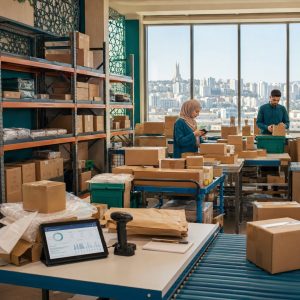
The $7B Opportunity Is Already Here
Algeria’s e-commerce sector has crossed the inflection point that markets like Egypt and Nigeria reached three to four years ago. The market was valued at roughly $1.5 billion in 2024 and projected at $2 billion in 2025 if the current trajectory continued, with Tunisie Numérique citing UNCTAD’s eTrade Readiness Assessment for an average annual growth of 92% between 2020 and 2024. Multi-year projections published by local sector trackers and reported by the North Africa Journal now put the addressable market at close to $7 billion by 2026 with roughly 25% sustained annual growth as Cash-on-Delivery converts to digital payments and basket sizes rise. Statista’s Algeria e-commerce outlook confirms the country sits among North Africa’s fastest-growing online markets, underpinned by demographic tailwinds that show no sign of reversing.
The growth is real because the demand-side fundamentals are real. Internet penetration is at 77%, with more than 33 million internet users and nearly 48.5 million combined fixed and mobile subscriptions on a population of about 47 million. Mobile broadband covers 98% of the territory. Roughly 200,000 online merchants are already operating, including a fast-growing cohort of Shopify storefronts — about 3,679 active Shopify stores, a 34% year-over-year increase, per the Ecommaps 2026 merchant census. The platform mix is broadening as well, with domestic operators like SINOBATIS, Colivraison, Superetti and Decathlon El Djazair reshaping consumer expectations alongside Ouedkniss and the social-commerce long tail on Instagram and TikTok.
What changed in 2026 is not awareness — it is mobile centrality. About 75% of online orders are now placed on smartphones, and that single number rewrites every operational decision a merchant makes, from the homepage layout to the payment integration to the SMS notification template after delivery.
The Mobile-First Reality Rewrites Operations
A mobile-first market is not a desktop market with a smaller screen. It is a different operating model with different cost structures, different drop-off points, and different trust signals. Algerian merchants are discovering that the same product listing that converted at 3% on desktop in 2023 converts at less than 1% on a 5-inch screen if the images are sized for desktop and the checkout pushes the customer to a separate payment page that loads slowly on 4G in a basement.
The shift shows up across every step of the funnel. Discovery now happens inside Instagram Reels, TikTok For You feeds, and Ouedkniss search — not Google search. Comparison happens via WhatsApp screenshots sent between friends, not browser tabs. Checkout is judged on three taps from cart to confirmation, not on the elegance of a desktop side cart. Post-purchase support is judged on whether the SMS delivery update arrives the same morning, not whether the email confirmation has a tracking link.
The categories driving the next leg of growth amplify this. Automotive accessories and smart-home electronics — the two leaders in Q1 2026 — both require richer media (multiple angles, short video demos), more specification detail (compatibility, warranty), and higher trust signals (returns policy, technical support) than fashion. Higher average order values mean buyers want to ask one or two clarifying questions before paying. If the merchant cannot answer on WhatsApp within minutes from a mobile dashboard, the order moves to a competitor.
The payment side has shifted in parallel. Cash-on-Delivery still dominates — UNCTAD-cited figures show over 85% of e-commerce transactions still settle in cash, and some local trackers put COD as high as 95% — but BaridiMob and CIB rails have made digital settlement viable for the merchants who set them up properly. Total electronic payments have tripled over the past four years, and merchants who accept BaridiMob and CIB report measurably lower return rates because the buyer is committed at the point of order, not at the door.
Advertisement
Top Categories and What Q1 2026 Demand Tells Us
The category mix in Q1 2026 is the clearest leading indicator of where merchant investment should go. Technology products account for roughly 35% of online sales, fashion for about 28%, and food and grocery for about 18%, with health-sector e-commerce recording 40% growth in 2024 alone. Inside the technology slice, automotive accessories and smart-home electronics are the two segments now pulling growth, both because the underlying physical markets are maturing (older car fleets needing aftermarket parts, new residential builds wired for connected devices) and because younger Algerian buyers are willing to trust online specifications for higher-ticket purchases.
For merchants, the implication is concrete. Building a mobile-first storefront for fashion is a different exercise than building one for smart-home electronics: fashion needs swipeable image galleries and size guides; smart-home electronics needs compatibility filters, embedded short videos, and a frictionless WhatsApp escalation for technical questions. The same checkout, the same payment integration, the same delivery flow — but a different product-page architecture, a different return policy, and a different SMS cadence after the order.
The B2C share of GDP is still small at about 0.8%, and the government’s National Strategy for the Development of the Digital Economy targets a digital-economy contribution of 20% of GDP by 2030. That gap is the runway. It is what makes the 25% annual growth credible without requiring a step change in consumer behaviour — only steady year-on-year compounding from a base that is still under-served on mobile UX.
What Algerian merchants should do
1. Rebuild the storefront mobile-first, not mobile-responsive
A responsive desktop site that “also works on mobile” is no longer competitive when 75% of orders come from phones. The product page must load in under three seconds on 4G, lead with a vertical hero image (not a wide one cropped awkwardly), and place the add-to-cart button above the fold. Image weight is the silent killer: a single 800KB hero shot will bounce more buyers than any pricing decision. Compress all images to WebP under 120KB, use lazy loading below the fold, and audit the page with Google Lighthouse mobile mode — target a performance score above 70. Build the checkout as a single page with three fields (name, phone, address) and a delivery selector — every extra field cuts conversion by 5-7 percentage points. The merchants growing fastest on Shopify and Ecommaps in 2026 share the same three-tap checkout pattern; merchants still on multi-step desktop-style checkouts are losing the comparison war before the price is even discussed.
2. Integrate BaridiMob and CIB before adding any other tool
Payment integration is the highest-leverage move available to an Algerian merchant in 2026 and the one most often deferred. Cash-on-Delivery still settles the majority of orders, but every BaridiMob or CIB transaction the merchant captures removes a return risk, removes a counting cost, and removes a same-day collection trip. Set up CIB e-payment through the Société d’Automatisation des Transactions Interbancaires et de Monétique (SATIM) flow first — it is the rail every Algerian card already runs on — then layer BaridiMob for the substantial Algérie Poste customer base who do not hold a CIB card. Ecommaps’s e-commerce law guide for Algeria outlines the compliance steps for activating both rails under Law 18-05, which covers electronic payments and digital commerce contracts. Make digital payment the default option at checkout, not the alternative tucked at the bottom. Offer a small discount (2-3%) for prepaid orders to subsidise the behaviour change. Track the digital-payment share weekly: merchants moving from 5% digital to 25% digital within six months consistently report return rates dropping from the local norm of 25-35% to under 12%.
3. Treat WhatsApp and Instagram as the real storefront
The web store is the catalog; WhatsApp and Instagram are the actual sales channel for a meaningful share of Algerian buyers. Set up a WhatsApp Business account with a catalog, quick-reply templates for the top ten questions (price, delivery time, return policy, payment options), and an SLA of under fifteen minutes for first response during business hours. Use Instagram Shopping tags on every product post and run a content cadence of at least three short videos per week — Reels for new arrivals, behind-the-scenes for trust, customer testimonials for social proof. Tag the geographic wilaya in posts so the algorithm surfaces them to local buyers. For higher-value categories — automotive and smart home — the WhatsApp conversation before the order matters more than the product page; merchants who staff a dedicated WhatsApp operator from 9am to 9pm report 40-60% higher conversion on inbound DMs than merchants relying on website chat alone.
4. Plug into a unified logistics API instead of negotiating each carrier separately
Algeria’s last-mile network now covers all 58 wilayas through providers like Yalidine, Maystro, Nord Ouest, and ZR Express, but managing each integration manually consumes the operational bandwidth of a small team. Adopt a logistics aggregator — Ecommaps, DZMobPay-linked partners, or one of the unified APIs emerging in 2026 — so a single backend hand-off creates the shipping label, updates the order status, sends the buyer SMS, and pushes the COD reconciliation back to the merchant. The merchant gains three operational hours a day, the buyer gets consistent tracking regardless of carrier, and the reconciliation at month-end takes minutes instead of days. Negotiate a flat rate band per wilaya in the API contract so checkout can show the buyer an exact delivery price before the order is placed — opaque shipping is the second-highest checkout abandonment trigger after slow page load.
5. Build the trust layer before scaling acquisition spend
Mobile buyers in a maturing market trust signals before they trust brands. Publish a return policy that is one screen tall, in plain language, with a 7-14 day window — and honour it without friction. Show real customer reviews on the product page (Algerian first names, dated, with photos when possible) — fake review patterns are easy for buyers to spot and corrode trust permanently. Display a clear physical address and a wilaya-tagged phone number; mobile buyers cross-reference these against Google Maps and Ouedkniss listings before a first purchase. Register the business under the auto-entrepreneur regime via anae.dz to gain the 0.5% turnover tax band and a verifiable commercial register entry that buyers can check. Every merchant that scaled past 100 orders per day in 2025 had these five trust signals in place before they spent a dinar on paid acquisition; the merchants stuck below 30 orders per day are universally missing two or more.
Where This Fits in Algeria’s 2026 Ecosystem
The $7 billion projection and the 25% annual growth rate are not abstract macroeconomic numbers. They are the cumulative effect of about 200,000 individual merchant decisions about storefront, payment, fulfilment, and trust — most of them made on a 5-inch screen, in a category that did not lead the market two years ago, with payment rails that are themselves still maturing. The merchants who treat the mobile-first reality as an opportunity to rebuild operations end up capturing the disproportionate share of the next leg of growth. The ones who treat their existing desktop site as “good enough” lose ground every quarter, even as the overall market expands around them.
The supporting infrastructure is improving faster than the merchant playbook is propagating. Logistics coverage now reaches all 58 wilayas. BaridiMob and CIB e-payment have become reliable rails. The legal framework around auto-entrepreneur registration and Law 18-05 provides a clean compliance path. The categories with the largest 2026 growth headroom — automotive and smart home — are the ones where mobile-first operations matter most and where merchant rewards from doing the work are highest. The window to build a category-leading mobile-first storefront in Algeria is open now in a way it will not be in 2028, when paid acquisition costs catch up to the regional average and the easy share-of-voice on Instagram and TikTok thins out. The toolkit exists. The market is moving. The operational rebuild is what separates the merchants who reach the $7 billion market from the ones who watch it from the sidelines.
Frequently Asked Questions
How big is Algeria’s e-commerce market in 2026?
The market is valued at roughly $1.9 billion in 2025 and is projected to reach close to $7 billion by 2026 if current growth holds, according to figures circulated by Ecommaps and reported by the North Africa Journal. Growth has averaged about 25% per year recently, after several years of UNCTAD-cited 92% annual compounding from a smaller base.
What share of Algerian e-commerce orders are placed from mobile devices?
Around 75% of online orders are now placed from smartphones, per Tunisie Numérique’s market briefing on Algerian e-commerce. Internet penetration is at 77%, mobile broadband covers 98% of the territory, and the cohort of buyers under 35 is overwhelmingly mobile-only — a mobile-first storefront is no longer optional for any serious merchant.
Which payment methods should an Algerian merchant prioritise?
Cash-on-Delivery still dominates with over 85% share, but the highest operational leverage comes from integrating CIB e-payment (the inter-bank card rail via SATIM) and BaridiMob (the Algérie Poste mobile wallet). Total electronic payments have tripled over the past four years, and merchants who default to digital payment at checkout report lower return rates and faster cash cycles than COD-only peers.
Sources & Further Reading
🔗 Related Intelligence

Algeria’s E-Commerce Boom: 92% Annual Growth and What Comes Next for Digital Merchants

Algeria E-Commerce in 2026: A $7B Market Meets Legal Maturity
Algeria’s $1.7B E-Commerce Market After Jumia: Local Merchants Race to Fill the Gap
Algeria’s E-Commerce Pivot: From COD Dominance to Digital Payment Adoption