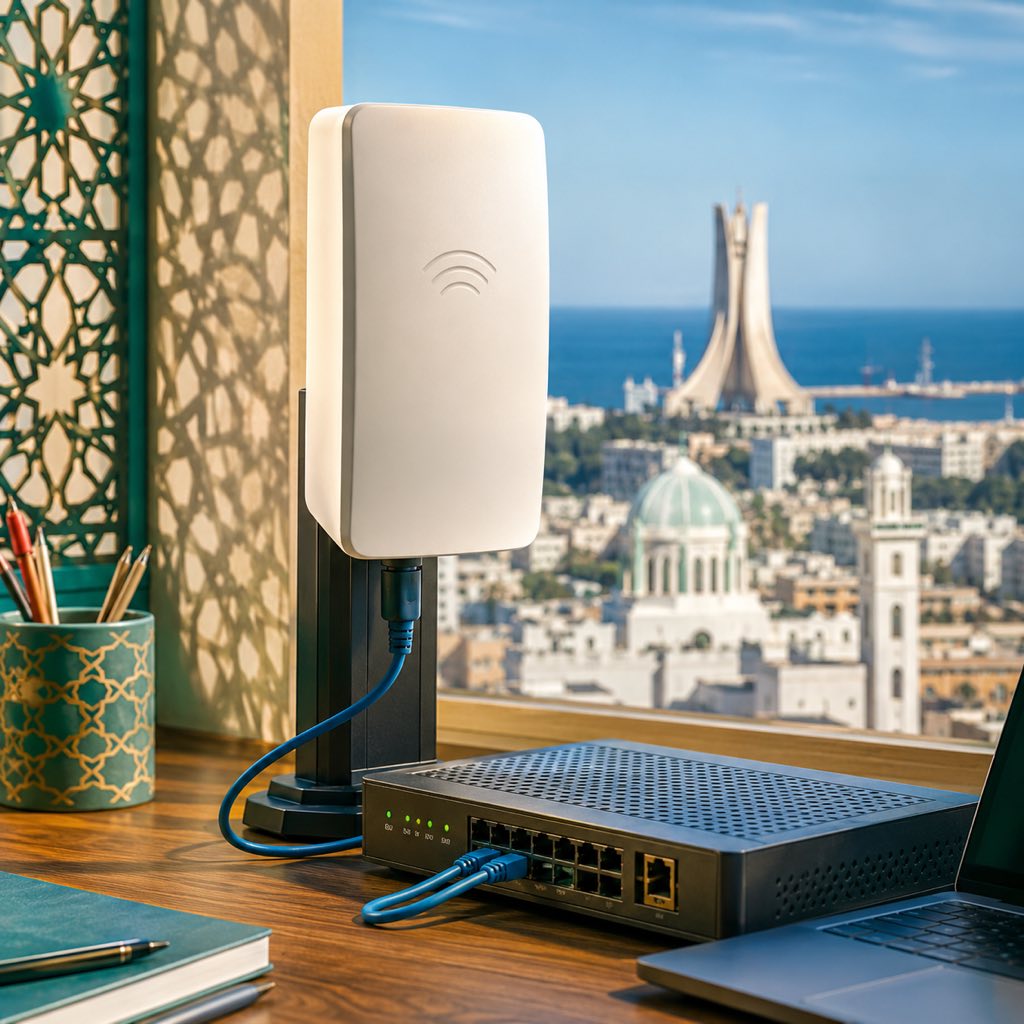
Why Fixed Wireless Access, and Why Now
Algeria’s broadband problem is not a demand problem — it is a last-mile infrastructure problem. Laying fiber in mountain areas, the southern hauts-plateaux, and dense urban peri-urban zones is either prohibitively expensive or logistically constrained. Algerie Telecom’s CEO Abdelghani Ait Said presented the 5G FWA initiative at a government infrastructure upgrade meeting, positioning it explicitly as the solution for areas “where traditional fibre deployment may face operational or economic limitations.”
Fixed wireless access works by using 5G radio signals to deliver broadband to a premises-installed CPE (customer premises equipment) device rather than running physical cable. The advantage is speed-of-deployment: a 5G FWA network can reach a business or household within weeks of a tower going live, versus the months or years required for buried cable. The technology is especially powerful in enterprise contexts because it handles large volumes of data efficiently and maintains performance stability during high-traffic periods — characteristics that cloud-dependent workloads specifically require.
The timing also aligns with a structural milestone. Ecofinagency reports that the copper network phase-out is scheduled for end of 2027, with the Medusa submarine cable — which will dramatically expand Algeria’s international bandwidth — expected to land in late 2026. The sequencing matters: Medusa brings international capacity, FWA distributes it domestically. Together they represent Algeria’s most consequential connectivity infrastructure upgrade since the FTTH program launched in 2017.
The Enterprise Connectivity Gap FWA Is Targeting
Enterprise leaders outside Algiers, Oran, and Constantine know the problem viscerally: reliable, symmetric broadband is simply not available at the speeds cloud applications demand. A business running ERP workloads on cloud infrastructure needs upload performance comparable to download performance — something legacy ADSL and 4G connections cannot guarantee at scale.
According to Telecompaper, the FWA rollout explicitly targets zones where the copper network retirement will leave a coverage gap. This creates a specific transition window: businesses that currently rely on ADSL copper lines will lose their connection when the copper network is decommissioned, and FWA is the planned replacement. The implication for enterprise IT teams is that the 2027 launch is not a nice-to-have — it is the planned end-of-life event for a large share of Algeria’s fixed broadband base.
FWA also enables connectivity use cases that matter directly to enterprise operations. Remote site connectivity for construction, energy, and agriculture operations — where trenching fiber is uneconomical — becomes viable on 5G FWA with a portable CPE. Branch offices in secondary cities gain symmetric bandwidth that supports video conferencing, cloud-hosted applications, and real-time data synchronization with headquarters. The technology supports cloud migration for businesses that have been held back by unreliable connectivity rather than by reluctance to modernize.
Advertisement
What Enterprise IT Leaders Should Do Before 2027
1. Audit Your Current Connectivity Contracts and Copper Dependency
The copper phase-out by end of 2027 creates a hard deadline that enterprise IT teams need to map against their lease and service contract timelines now. Identify every site running on ADSL or legacy DSL connections, and classify them by how critical their connectivity is to business operations. Offices with moderate cloud workloads can transition to FWA seamlessly when the service launches; data-intensive sites (financial processing, video production, industrial IoT aggregation) should be prioritizing fiber now, before 2027 pressure builds. Request from Algerie Telecom’s enterprise division a preliminary coverage map for the FWA rollout zones — these conversations are happening now at the government planning level, and enterprise anchor demand signals matter to how operators sequence deployments.
2. Redesign Branch Office Architecture for FWA-Native Connectivity
Enterprises that have built branch IT around the assumption of continuous copper ADSL should redesign those architectures for FWA’s characteristics. FWA provides higher aggregate bandwidth than copper ADSL but may have different latency profiles depending on tower load — this affects application design choices. Cloud-native applications using asynchronous APIs handle connectivity variations better than client-server applications with synchronous database calls. Review your branch office application stack and identify which applications require hardening before they move onto FWA connections. SD-WAN becomes particularly valuable in this context: it can bond FWA connectivity with 4G mobile backup, ensuring business continuity during the transition and afterward for critical workloads.
3. Engage the Enterprise Sales Pipeline at Algerie Telecom Early
Algerie Telecom’s enterprise division (DZ-Connect Business) typically runs pre-commercial agreements with anchor customers before major service launches. Enterprises that signal contractual interest early influence both coverage zone prioritization and service tier structuring — the FWA product for a 100-employee branch office will look different from what a consumer household receives. Request dedicated briefings on the enterprise FWA tier pricing, SLA guarantees (particularly upload speed floors and latency caps), and redundancy options. Early engagement also opens access to pilot programs that provide real performance data ahead of the general launch, allowing your team to validate architecture decisions with measured results rather than theoretical specifications.
4. Plan a Hybrid Transition — Not an Overnight Switch
The copper phase-out and FWA launch will not happen simultaneously at every location. Some areas will see fiber deployed as the copper replacement rather than FWA, depending on population density and infrastructure economics. Build a transition plan that accounts for this ambiguity: maintain existing connections through a six-month overlap period, design new branch deployments to be fiber-or-FWA-agnostic at the CPE level, and avoid locking into VSAT contracts as a stopgap (VSAT latency at 600ms+ is incompatible with real-time SaaS applications). The transition window between copper retirement and FWA commercial launch is the highest-risk period — enterprises with continuity-critical operations need explicit fallback plans documented at the site level.
The Bigger Picture: FWA as Algeria’s Cloud On-Ramp
The 5G FWA rollout is not simply a connectivity story. It is the infrastructure prerequisite for a larger digital transformation agenda. Algeria’s 6.82 million fixed broadband subscribers as of September 2025 represent significant households and businesses that have been using services not designed for cloud-era workloads. The copper phase-out accelerates the timeline for that entire segment to upgrade.
For the enterprise sector specifically, reliable broadband unlocks a cascade of productivity-enhancing investments that have been economically unjustifiable on unreliable or slow connections: cloud ERP, video collaboration, remote monitoring, IoT data collection. International experience with FWA rollouts — in markets from Poland to Kenya — shows that enterprise adoption of cloud services accelerates meaningfully in the 18 months following FWA availability, because connectivity was the binding constraint rather than software readiness or budget availability.
Algeria’s FWA program also arrives at a moment when hyperscalers are examining North Africa as a deployment region. According to the Hyperscaler Test analysis on Africa’s cloud region prerequisites, “contractable enterprise demand” is one of the three core criteria — alongside scalable power supply and predictable permitting — that hyperscalers assess when selecting cloud region sites. In this sense, the FWA rollout is not only a connectivity infrastructure project; it builds the demand signal that makes deeper digital infrastructure investment more attractive to global partners. Enterprise IT leaders who advocate for early FWA deployment and adopt it at scale are, in a small but meaningful way, contributing to the conditions that make a Tier-I cloud region possible in Algeria.
Frequently Asked Questions
What is the difference between 5G FWA and regular 5G mobile?
5G FWA (Fixed Wireless Access) uses 5G radio signals to deliver broadband to a fixed location via a premises-installed CPE device, replacing traditional cable or DSL lines. Regular 5G mobile is designed for smartphones and portable devices moving across coverage areas. FWA delivers higher consistent throughput to a fixed point because the CPE antenna can be optimized for a specific tower direction, while mobile 5G must handle handoffs and varying signal conditions as devices move.
Will 5G FWA be fast enough for enterprise cloud workloads?
5G FWA in commercial deployments internationally typically delivers 200 Mbps to 1 Gbps downstream speeds, with upstream performance significantly better than ADSL. For cloud ERP, video conferencing, and SaaS applications, these speeds are adequate for branch offices of up to 100 users. For high-throughput use cases (large file transfers, real-time video production, high-frequency IoT data upload), organizations should evaluate whether FWA meets their specific upload floor requirements and assess SD-WAN bonding with 4G as a performance supplement.
What happens to businesses still on ADSL copper when the network is retired by end of 2027?
Algerie Telecom’s plan is to replace copper-based connections with either fiber or 5G FWA, depending on the location’s economics and infrastructure feasibility. Businesses should not assume automatic migration — active engagement with Algerie Telecom’s enterprise division is needed to confirm the planned replacement technology for each site, agree on transition timelines, and negotiate service continuity during the cutover period. Organizations that wait until 2027 to begin this process will face compressed timelines and potentially service gaps.
Sources & Further Reading
- Algeria Targets Early 2027 Launch of G5 LTE Fixed Internet Network — MEA Tech Watch
- Algeria Targets Early 2027 for Nationwide 5G Fixed Wireless Access Rollout — Ecofinagency
- Algeria Sets Early 2027 as Launch Target for 5G FWA — Telecompaper
- Ericsson FWA Insights 2026 — Ericsson
- Algeria Prepares for 5G FWA for High-Speed Fixed Broadband — Algerie-Eco
🔗 Related Intelligence

Algeria’s 5G Commercial Launch: Enterprise IoT Connectivity Roadmap for 2026

Algerie Telecom 400G Backbone: The Upgrade Powering Algeria’s Digital Future

Algeria 5G Goes Nationwide: What the Full-Coverage Milestone Means for Enterprise Cloud

Algeria 5G Enterprise: Industrial IoT and Smart Factory Use Cases Now Viable in 2026