Algeria’s Rarest Export: Hardware That Actually Works at Scale
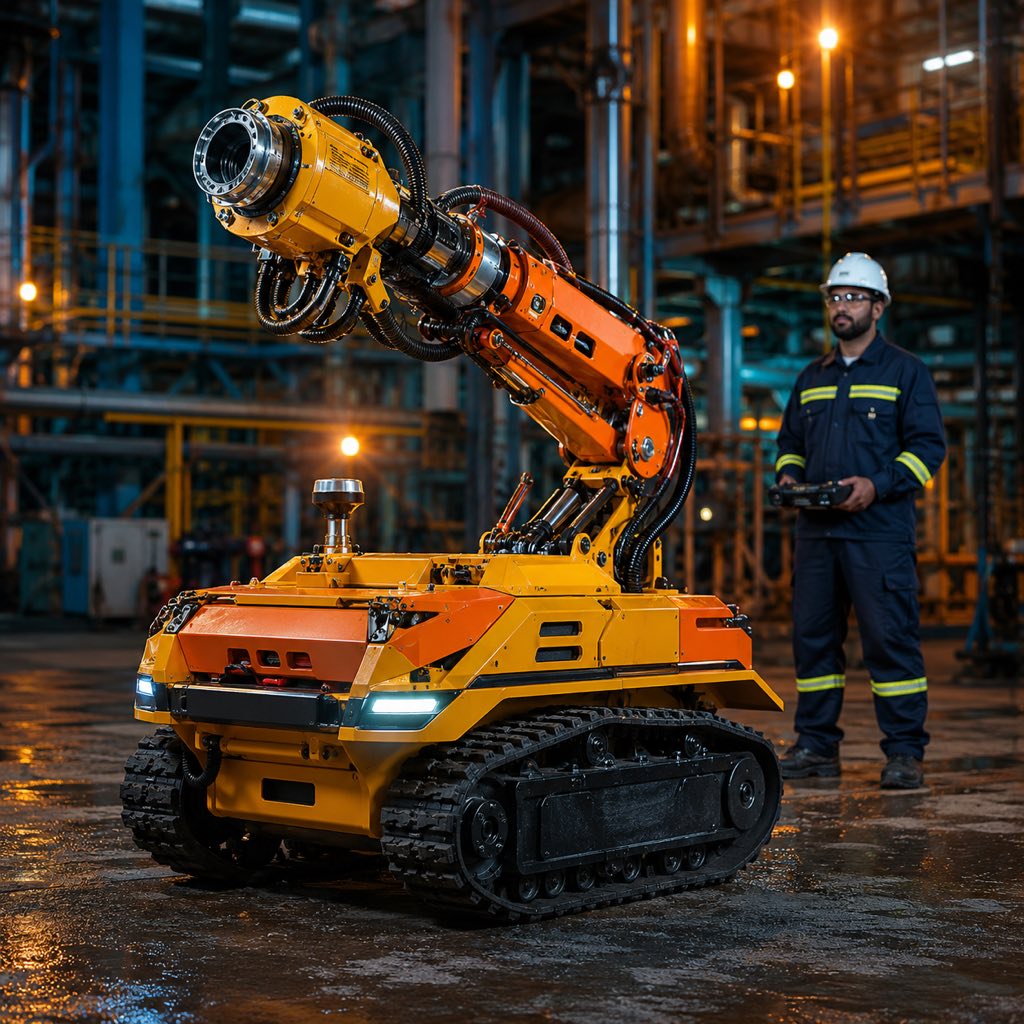
Most discussions of Algerian tech innovation focus on software — apps, platforms, SaaS. BK Fire’s Icosium breaks that pattern entirely. It is a 480-kilogram machine built in Algiers that fights fires in environments where human firefighters cannot enter: petrochemical plants, oil and gas infrastructure, forest perimeters, tunnels, and seaports. It operates for six continuous hours, projects water jets up to 80 meters, and can be controlled from up to 300 meters away. It has been exhibited at Interschutz — the world’s leading international trade show for fire prevention and rescue — placing it in the same catalog as German, Japanese, and American industrial safety equipment.
Founded by Khaled Basta and registered as EURL BK Fire in Saoula (Algiers), the company describes itself as specializing in fire prevention and protection systems. It started not as a startup in the conventional venture-backed sense, but as an SME that pivoted into deeptech hardware. That distinction matters: Icosium was developed through engineering and iterative industrial design, not through a VC funding cycle. BK Fire is featured in Mag Startup’s 2026 Algerian startups-to-watch list, a sign of growing recognition of the product’s export potential.
The 2026 roadmap adds the layer that changes the product’s competitive tier: an AI-powered autonomous detection and intervention module. Instead of waiting for a human operator to assess and command, the upgraded Icosium would detect fire independently, evaluate the optimal intervention vector, and act — without a delay loop. That upgrade positions the robot not just as remote-controlled equipment, but as an autonomous agent in the industrial safety stack.
What Makes Icosium Technically Distinct
Before assessing export potential, the product’s technical claims deserve grounding. According to BK Fire’s product specifications, Icosium carries:
- Water cannon flow rate: 150–600 gallons per minute, adjustable based on fire intensity
- Operating temperature tolerance: up to 2,000°C — enabling intervention in petrochemical blazes that exceed standard firefighter gear limits
- 4K cameras: providing real-time visual feed to the remote operator
- Autonomous transport: the robot can transport injured persons during natural disasters, adding a dual-use safety function
- Integration rate: 80%, meaning most components are locally manufactured or sourced
- Service efficiency rating: 85%, cited internally as a reliability figure
The 80% local integration rate is significant. It signals that BK Fire is not merely assembling imported parts — the machine is substantially made in Algeria, which supports both cost competitiveness and potential for technology transfer agreements with foreign buyers. For petrochemical facilities in Algeria (where Sonatrach’s upstream and downstream infrastructure spans dozens of high-risk sites), the domestic availability and serviceability of Icosium is itself a commercial advantage.
The GITEX Dubai appearance — where the robot was described as maneuvering into “tight spots like it’s on a mission” in small alleys and confined corners — confirms that the product performs in public demonstration conditions, not just in controlled factory tests.
Advertisement
What Algerian Industrial Deeptech Founders Should Do
The Icosium story contains a playbook that extends beyond BK Fire. Algeria has dozens of industrial-sector engineers working in oil, gas, construction, water treatment, and logistics — sectors that generate real physical-world problems that no app can solve. BK Fire’s trajectory offers a model for that talent cohort.
1. Target industrial sectors first, consumer markets second
BK Fire chose to serve petrochemical, oil and gas, and port authorities — buyers who have procurement budgets, long-term service contracts, and regulatory requirements that mandate specific safety equipment. The global industrial fire protection market was valued at $4.2 billion in 2023 and is growing. Compared to Algeria’s fragmented consumer market, industrial buyers provide predictable revenue, larger average contract sizes, and referenceable clients that open other doors. Founders building deeptech hardware in Algeria should map their product to at least one regulated industrial category where safety compliance creates non-discretionary demand.
2. Use international trade shows as primary go-to-market, not local events
BK Fire’s appearance at Interschutz in Hannover — alongside German giant Rosenbauer, Japanese manufacturer Morita, and US-based Hale Products — placed Icosium in the reference catalog that international procurement teams use. Local expos and Algerian government showcases build brand recognition domestically, but they do not generate export orders. Industrial buyers evaluate equipment through a shortlist process that starts with recognized directories: trade show catalogs, sector-specific databases, and international certification bodies. A presence at one credible international trade show creates a verifiable public record that a product exists and performs — which is a prerequisite for most procurement processes.
3. Structure AI integration as a modular upgrade, not a product redesign
BK Fire’s 2026 AI upgrade is being added to an already commercially viable hardware platform. This is the right sequencing. Deploying a working robot and then adding intelligence as a firmware and sensor upgrade is vastly more capital-efficient than trying to build an autonomous firefighting robot from scratch. Industrial clients are also more comfortable upgrading a proven platform than adopting an unproven autonomous system. The AI layer — autonomous fire detection, threat classification, intervention initiation — becomes a premium SKU that existing clients can upgrade to, generating recurring software revenue on top of the hardware sale. Algerian deeptech founders building physical products should plan for this pattern from day one: ship the hardware, prove reliability, then layer intelligence.
4. Leverage Sonatrach’s infrastructure as a home-field proof case
Algeria operates one of the largest hydrocarbon infrastructure networks in Africa. Sonatrach alone manages over 14,000 km of pipelines and dozens of processing plants — all high-risk fire environments with mandatory safety compliance. A single contract with Sonatrach or Sonelgaz would provide the reference case that unlocks bids from comparable national oil companies in West Africa, Gulf Cooperation Council states, and North Africa. BK Fire should treat domestic institutional clients not as a revenue source alone, but as a credentialing mechanism for export bids. The home-field contract is the passport.
The Structural Lesson: Hardware Is Algeria’s Underinvested Edge
Algeria’s startup ecosystem has largely replicated the software-first patterns of Silicon Valley and London — mobile apps, e-commerce platforms, fintech APIs. BK Fire’s Icosium reveals a gap that is simultaneously an opportunity: Algeria’s industrial and engineering talent base is sufficient to build complex physical systems, but the pathways to commercializing hardware — trade show access, industrial certification processes, international procurement networks — are not yet well-mapped for Algerian founders.
The country’s exposure to petrochemical engineering (through Sonatrach, Sonelgaz, and their contractor ecosystems) and to construction-scale manufacturing (through state infrastructure projects) has produced a generation of engineers who understand physical-world problem-solving at industrial scale. What is missing is not technical capability, but market access infrastructure: export credit mechanisms, international certification support, and a government procurement framework that counts Icosium-class products as strategic industrial exports rather than domestic novelties.
BK Fire’s growing ecosystem recognition is one signal that institutional support is building. The 2026 AI integration announcement is another. If the company converts its Interschutz visibility into a single verified export contract — in the Gulf, West Africa, or Europe — it will become the reference point that proves Algerian deeptech hardware can compete globally. That proof case, more than any policy document, is what unlocks the next generation of Algerian founders willing to build things that weigh 480 kilograms.
Frequently Asked Questions
What does Icosium actually do that standard firefighting equipment cannot?
Icosium is a remote-controlled firefighting robot designed for environments that exceed safe human entry thresholds — petrochemical fires, tunnel blazes, and confined industrial spaces where temperatures can reach 2,000°C. With a 300-meter control range, 80-meter water projection, and 6-hour autonomy, it bridges the gap between stationary fixed suppression systems and human firefighting teams, enabling intervention where neither alternative is viable.
Is BK Fire seeking international export markets in 2026?
Yes. BK Fire exhibited at Interschutz in Hannover — the global benchmark for fire prevention and rescue industry — placing Icosium in an international procurement catalog. The 2026 AI upgrade (autonomous detection and intervention) is designed to raise Icosium’s competitive position against international robotic firefighting products from Europe and Asia.
What would it take for Algerian industrial deeptech startups to scale exports consistently?
Three structural enablers are currently missing at scale: export credit facilities for hardware manufacturers, government support for obtaining international industrial certifications (CE, UL, ATEX for hazardous environments), and institutional broker relationships with international procurement networks. BK Fire has navigated these gaps individually, but a systemic framework — similar to Germany’s Mittelstand support system or Singapore’s enterprise development grants — would significantly compress the timeline for the next generation of Algerian hardware exporters.
Sources & Further Reading
🔗 Related Intelligence
Industrial Robotics in Algeria: The State of Manufacturing Automation from Sonatrach to
Algeria Tech Ecosystem: How AI Is Reshaping the Startup Scene
Algeria’s AI & Cybersecurity Cluster: How Startups Can Join and Benefit
Algerie Telecom’s $11M Fund: Inside Algeria’s AI and Robotics Bet