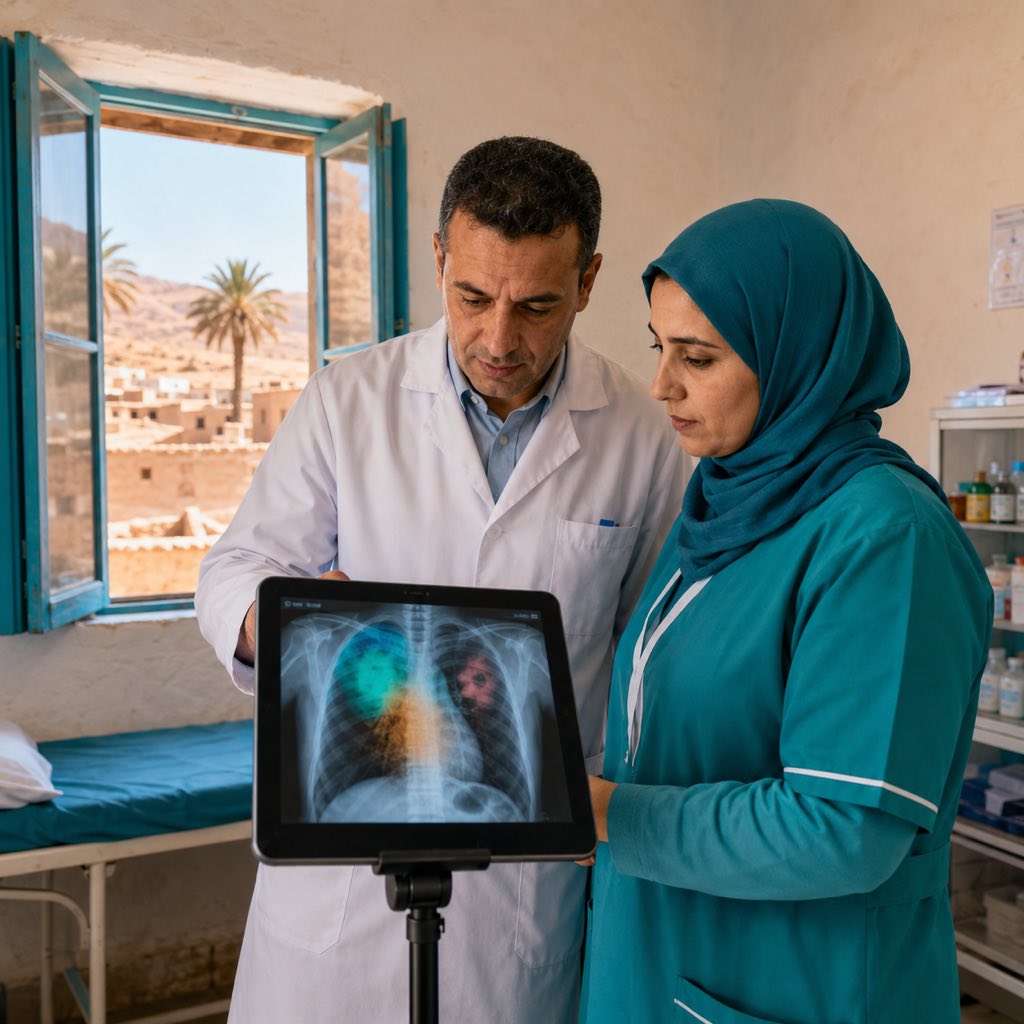
The Diagnostic Divide Algeria Cannot Afford to Ignore
Algeria’s healthcare system faces a structural paradox. The country graduates approximately 30,000 engineers per year and has invested heavily in digitizing government services, yet a 2025 radiation oncology workforce survey found that 97% of Algerian medical professionals cited a need for modernized educational tools — a figure that points to a deeper gap between ambition and clinical reality.
The radiology and oncology workforce data is striking. Algeria currently has 218 senior radiation oncology professionals serving a population of 48 million, distributed across 22 radiotherapy centers — 15 operational, seven planned. Of the 57 linear accelerators in the country, 43 are in the public sector. But distribution is deeply uneven: the capital, Algiers, with over six million inhabitants, runs just three public linear accelerators. Bechar, with roughly 350,000 residents, also operates three. The ratio in Algeria’s interior wilayas is far worse.
For diagnostic radiology — the X-ray and CT-scan interpretation that guides everything from fracture management to tuberculosis follow-up — the challenge multiplies across rural polyclinics that were never designed to host full radiology suites. Patients in wilayas like Tamanrasset, Illizi, or Bordj Badji Mokhtar must travel hundreds of kilometers for specialist-read imaging, or receive none at all. The result: delayed diagnoses, preventable complications, and accelerating pressure on urban referral hospitals already operating beyond capacity.
This is precisely the gap that AI-powered medical image analysis tools are beginning to address — not by replacing radiologists, but by extending their reach into settings where they cannot physically be.
What AI Medical Imaging Actually Delivers in Low-Resource Settings
The global AI medical imaging market is maturing rapidly. According to Jenova AI’s 2026 industry analysis, AI-assisted diagnostic imaging now encompasses chest X-ray triage, bone fracture detection, tuberculosis screening, and preliminary CT interpretation — all running on cloud-connected devices that require no on-site radiologist for initial flagging.
The practical model is a two-stage workflow. A technician at a rural polyclinic captures the image using standard equipment. The image uploads to a cloud inference engine — either provided by a specialized vendor or hosted on a national health platform — and receives an AI-generated annotation: “normal,” “requires review,” or “urgent referral.” A remote radiologist, potentially based in Algiers or Oran, reviews only flagged cases, dramatically reducing their cognitive load while ensuring every image is read within hours rather than days or weeks.
OpenMedScience’s 2026 review of portable diagnostics confirms this pattern is accelerating globally: compact mobile CT systems are being trialled for stroke assessment in rural health centres, and AI overlays are helping less-experienced users obtain usable images and interpret basic findings. The technology no longer requires a tier-1 hospital environment to function reliably.
For Algeria, the opportunity is compounded by an existing digital backbone. The Bawabatak portal already digitizes over 342 public services across 25 ministerial departments. The health ministry’s e-santé roadmap provides a structural home for a national radiology AI layer. What remains missing is the procurement and deployment signal — a formal programme to equip rural polyclinics with AI-assisted image triage.
Advertisement
What Algerian Health Ministry Officials Should Do Now
1. Commission a National Radiology AI Pilot Across Five Wilaya Clusters
The Ministry of Health should launch a structured 18-month pilot targeting five geographic clusters that lack resident radiologists: one in the deep south (e.g., Tamanrasset), one in the Hauts-Plateaux (e.g., Djelfa), one in the northeast mountains (e.g., Tébessa), one in the northwest steppe (e.g., Naâma), and one mixed urban-rural wilaya (e.g., Médéa). Each cluster should include three to five polyclinics equipped with standardized AI triage software, connected to a regional radiologist hub for case review. The pilot design should include a control group (standard referral pathway) to generate publishable outcome data — Algeria needs its own evidence base, not just extrapolations from India or South Korea.
2. Standardize on DICOM-Compatible, Sovereign-Data Platforms
AI medical imaging vendors come in three procurement models: cloud-based SaaS from international providers (Aidoc, Rad AI, Nuvolo), open-source inference frameworks (MONAI from NVIDIA and King’s College London), and national-build platforms. For Algeria, the sovereignty constraint is real: patient imaging data cannot leave the country under Law 18-07 on personal data protection. Any procurement must require DICOM compatibility, on-premise or in-country cloud deployment, and Arabic-language reporting interfaces. Prioritizing vendors who will establish local data residency is not bureaucratic overhead — it is a compliance requirement that should be written into every tender specification from day one.
3. Build a National Teleradiology Network on Top of AI Triage
AI triage alone is not a complete solution — it flags; it does not diagnose. The complementary infrastructure is a national teleradiology network connecting rural polyclinics to specialist radiologists at CHU Mustapha, CHU Oran, and the regional teaching hospitals in Constantine and Annaba. With AI pre-filtering reducing the volume of cases requiring human review by an estimated 40-60% (consistent with global pilots in comparable settings), a network of 50 remote radiologists could credibly serve thousands of rural consultations per month. The Ministry should negotiate teleradiology duty schedules with medical training institutions, treating it as a structured internship pathway — graduates gain supervised hours, rural patients get timely reads, and the state builds institutional capacity simultaneously.
4. Fund Darija-Language Annotation Pipelines for Algerian Pathology
Every AI medical imaging model trained on Western datasets carries demographic bias. Chest X-ray models trained predominantly on North American or European cohorts show lower sensitivity for tuberculosis presentations common in North Africa. Algeria’s research institutions — USTHB, ESI, and the university hospitals — should be funded to build annotated Algerian radiology datasets covering TB, parasitic lung conditions, and musculoskeletal presentations specific to the local population. This is not a five-year project: a focused annotation sprint with 10,000 labeled cases per condition would materially improve model performance for Algerian patients within 18 months, and the resulting datasets could be shared regionally across the Maghreb.
The Bigger Picture: AI as Healthcare Equity Infrastructure
Algeria’s healthcare AI challenge is not primarily a technology problem — it is a distribution problem. The radiologists exist, concentrated in Algiers and the major university hospitals. The equipment exists, 57 linear accelerators and hundreds of X-ray suites. What AI medical imaging does is change the unit economics of distribution: a radiologist’s attention, once bounded by physical proximity, becomes a network-accessible resource.
The countries that have moved fastest on this — Rwanda with its AI-assisted tuberculosis screening programme, and Singapore with its national diabetic retinopathy screening platform — did so by treating AI diagnostics as infrastructure procurement, not experimental technology. They defined the clinical standard, built the data residency framework, and then procured at scale. Algeria has the institutional capacity to follow this model. The ASJP repository at CERIST already hosts peer-reviewed Algerian medical AI research. The question is whether the Ministry of Health will translate that academic output into a procurement programme before the radiology gap widens further.
For the 58 wilayas that are not Algiers, the calculus is straightforward: an AI-assisted X-ray read tonight is categorically better than a specialist read in three weeks, after the patient has travelled 400 kilometers and potentially deteriorated. That is the operational reality that should drive urgency.
Frequently Asked Questions
What AI medical imaging tools are currently available for rural clinic deployment?
The most widely deployed tools in comparable healthcare environments include Aidoc (chest X-ray and CT triage), Qure.ai (tuberculosis and fracture detection, with active deployments in India and sub-Saharan Africa), and MONAI (NVIDIA’s open-source framework used by research hospitals). All three support DICOM-compatible workflows and can be configured for on-premise or in-country cloud deployment — a requirement under Algeria’s Law 18-07 on personal data protection.
How does AI-assisted imaging actually improve patient outcomes in rural settings?
AI triage operates as a first-pass filter that flags urgent or abnormal findings for priority radiologist review. In global pilots, this reduces average time-to-read for urgent cases from days to hours, and ensures that no image is ignored due to volume pressure. The patient in Tamanrasset does not get a faster specialist — they get their image flagged immediately, and the specialist in Algiers reviews it the same day instead of the following week. That time compression is where clinical outcomes improve.
Is Algeria’s digital infrastructure ready to support AI radiology at scale?
The core digital backbone exists: the Bawabatak portal demonstrates the government’s capacity to digitize and interconnect services at national scale, and ALCES shows that complex multi-site data platforms can be deployed across Algeria’s geography. The gaps are connectivity reliability in deep southern wilayas and GPU compute availability for local inference. Both are solvable through a combination of satellite-connected edge devices (which several AI imaging vendors already support) and in-country compute procurement — a conversation that becomes more feasible as Ooredoo and other regional operators expand GPU-as-a-service offerings in Algeria.
Sources & Further Reading
- Being a Radiation Oncologist in Algeria — PMC/NIH (2025)
- AI Medical Image Analysis: How AI Is Transforming Diagnostic Imaging — Jenova AI (May 2026)
- Medical Imaging in 2026: Smarter Scanners, Portable Diagnostics — OpenMedScience
- AI in Medical Imaging Market Share & Opportunities 2026-2033 — Coherent Market Insights
- The Algerian Arabic AI Gold Rush: Why Darija and Tamazight Are the Next Frontier — AlgeriaTech
- Algeria Tech and AI Startup Ecosystem in 2026 — AlgeriaTech
🔗 Related Intelligence

AI Radiology in Algeria: How CHUs Are Building the Diagnostic Imaging Backbone
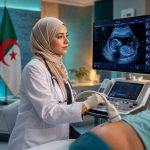
Algeria’s Medical AI Moment: Fetal Ultrasound Models Trained on Local Datasets

AI Agents in Algerian Healthcare: From Clinic Digitalization to Autonomous Triage

Algeria HealthTech 2026: AI Diagnostics and Telemedicine Startups Targeting the Public Hospital Gap