The Problem Qareeb Was Built to Solve
Algeria has more than 8.5 million hectares under cultivation and an agriculture sector that contributes roughly 13% of GDP. Yet the dominant story in Algerian farming remains unchanged: over-irrigation in some regions, water stress in others, and crop disease losses that could be reduced dramatically with better real-time data. The problem is not a lack of technical knowledge. It is a lack of connectivity.
In Algeria’s rural and southern wilayas, mobile network coverage is patchy at best and absent at worst. Conventional IoT sensors that rely on GSM or LTE to transmit data from the field simply don’t function in these zones. Satellite-based alternatives exist but remain prohibitively expensive for smallholders. The result is a data vacuum in the places where agricultural decisions matter most — and where the consequences of a wrong call, whether it’s over-irrigating or missing an early sign of fungal disease, can erase months of work.
Qareeb, founded in 2023 by Adam Debba, was designed from the ground up to operate in this data vacuum. Its core technical bet is LoRa (Long Range) radio technology, a low-power wireless protocol capable of transmitting small data packets across distances of up to 30 kilometers — even in areas with no mobile signal. This is not a marginal technical feature. It is the enabling condition that makes Qareeb’s offering relevant to the two-thirds of Algeria’s agricultural land that sits outside robust mobile coverage.
What Qareeb Actually Builds
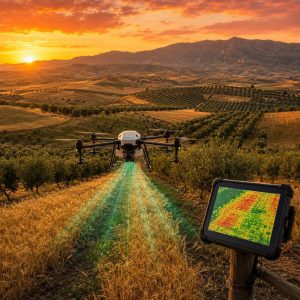
The company’s primary product, Q-Farming, is a smart agriculture platform that installs a network of soil sensors in a field. Each sensor continuously measures moisture, temperature, and soil composition. This data is transmitted via LoRa to a central gateway, where Qareeb’s edge computing layer — running AI models locally, without sending data to remote servers — processes the readings and determines irrigation needs in real time.
The distinction between edge computing and cloud-based AI is deliberate. Sending data to a cloud server requires reliable internet connectivity, which may not exist on the farm. It also introduces latency and privacy concerns for operators who distrust third-party storage. Qareeb’s edge-first architecture runs inference on-device: the decision about whether to trigger irrigation happens in the field, not in a data center in another country. This is a systems architecture choice with direct commercial relevance in Algeria’s infrastructure environment.
Beyond Q-Farming, the company has developed two additional products that extend the same architecture into adjacent domains:
Q-Vision is a surveillance system designed for farm perimeter security and unusual behavior detection. Using the same local AI processing approach, Q-Vision sends real-time alerts when it detects intrusion or abnormal activity, without requiring continuous video streaming to the cloud.
Q-Access is a multifunctional access control solution that combines facial recognition, RFID, QR code scanning, and fingerprint analysis in a single terminal. While initially designed for secure facility access, it has applications in cold storage management and agricultural supply chain verification.
The coherence across Q-Farming, Q-Vision, and Q-Access is not coincidental. All three products reflect the same engineering thesis: AI and automation can be made to work at the edge, in low-connectivity environments, using local compute resources. This is an infrastructure philosophy as much as a product roadmap.
Advertisement
Awards That Validate the Model
In 2024, Qareeb competed in and won multiple international competitions in a single year — an unusual acceleration for a startup in its first full year of operations.
According to We Are Tech Africa’s profile of Adam Debba, Qareeb took first place at the Algeria Startup Challenge Greentech Challenge, the most competitive cleantech-focused track of Algeria’s national startup competition, organized by the Ministry of Knowledge Economy with over 3,000 applicants annually. It also won first place at TechWadi, a Silicon Valley-based Arab tech innovation competition, placing Qareeb in front of US-based investors and partners. The startup took second place at the Arab IoT & AI Challenge, a pan-Arab competition that drew entries from 22 countries, and received the Innov’Up award at the TotalEnergies Startupper Challenge — one of the most prestigious corporate innovation programs in the energy sector.
Qareeb also secured first prize at the IATF African Union pitch competition, held at the Intra-African Trade Fair, the continent’s largest business-to-business platform organized by Afreximbank. This placed Qareeb among the most recognized agritech startups on the African continent.
The pattern of these wins is significant. Qareeb did not win a single domestic competition and then struggle to translate international validation. It won across geographies — national, pan-Arab, African, and transatlantic — in the same 12-month window, suggesting that its technical approach resonates with diverse evaluators who range from government program officers to private sector venture judges.
What This Means for Algerian Agritech Founders and Investors
Qareeb is not an isolated story. It is a signal about where Algerian agritech is heading. Several implications are worth unpacking.
1. Edge computing fills the connectivity gap that cloud-first agritech cannot
The majority of globally marketed precision agriculture platforms are designed for markets with reliable broadband or 4G coverage in rural zones — conditions that describe Western Europe, parts of the US, and large commercial farming operations in Brazil. They do not describe most of Algeria’s agricultural surface. Qareeb’s edge-first design is not a workaround for a temporary infrastructure gap; it is a durable technical advantage in markets where that gap will persist for years.
2. The government program architecture creates a runway for deeper adoption
Algeria’s Ministry of Knowledge Economy, alongside the Ministry of Water Resources and the Ministry of Higher Education, launched in March 2026 a national open call for water and agriculture innovation startups, explicitly citing IoT-based smart irrigation and AI-powered water management as priority domains. Startups operating in the space Qareeb occupies are being actively recruited into a government-backed pipeline that includes incubation, pilot testing, and institutional partnerships. This is a procurement signal, not just a competition.
3. International recognition converts to bankable credibility
Algeria’s startup ecosystem has historically struggled with the credibility gap: investors outside the country don’t know the ecosystem, and local capital markets have limited liquidity for early-stage technology ventures. Qareeb’s string of international awards — particularly the TechWadi win and the IATF first prize — creates the kind of external validation that makes initial conversations with non-Algerian investors and potential enterprise clients significantly easier. This matters most for the company’s next milestone: moving from pilot installations to scaled commercial deployment.
Precision Agriculture and Algeria’s Food Security Mandate
Algeria’s agriculture sector faces compounding pressure. Climate change is reducing rainfall reliability across the north and accelerating desertification in the interior. The Algerian government committed to a billion-dollar infrastructure program in early 2026 to address water scarcity in drought-prone regions. The challenge is not just physical infrastructure — it is operational intelligence. Knowing where water is being wasted, when soil conditions are suboptimal, and where disease vectors are emerging requires exactly the kind of real-time sensor network that Qareeb is building.
The startup’s trajectory over the next 12 to 18 months will depend on whether it can translate its award validation into commercial contracts with Algerian agribusinesses, cooperatives, or state agricultural entities. The government pipeline exists. The technology has been externally validated. What remains is the organizational scaling — hiring, deployment capacity, and the institutional partnerships required to move from a handful of farm installations to a national network.
Adam Debba’s background is worth noting in this context. His doctorate in fluid mechanics from IMT Atlantique in France, combined with experience at Armines, Capgemini Engineering, and Expleo Group, positions him as an engineer who understands both the physics of water and the mechanics of enterprise technology delivery. Qareeb is not a university project that stumbled into a competition. It is a research-grade engineering approach that has been deliberately commercialized — and one that sits exactly at the intersection of two of Algeria’s most urgent national priorities: agricultural productivity and water security.
Frequently Asked Questions
What makes Qareeb’s technology different from standard agricultural IoT sensors?
Qareeb uses LoRa radio technology combined with edge computing — meaning the AI that processes sensor data runs locally on-device rather than being sent to a cloud server. This allows the system to function in areas with no mobile or internet connectivity, covering distances up to 30 kilometers per gateway. Most commercial precision agriculture platforms require reliable LTE or broadband connectivity to operate, which excludes large parts of Algeria’s rural agricultural land.
What international awards has Qareeb won, and why do they matter?
In 2024, Qareeb won first place at the Algeria Startup Challenge Greentech track, first place at TechWadi (a Silicon Valley-based Arab innovation competition), second place at the Arab IoT & AI Challenge, the TotalEnergies Startupper Innov’Up award, and first prize at the IATF African Union pitch competition. These wins matter because they provide independent third-party validation from evaluators in Algeria, the Arab world, Africa, and the US — making it easier for Qareeb to open doors with investors and enterprise clients who don’t know the Algerian startup ecosystem.
How does the government’s March 2026 water innovation call affect Qareeb’s growth prospects?
Algeria’s Ministry of Knowledge Economy launched a national open call in March 2026 targeting startups working on IoT-based smart irrigation, water management, and AI-powered agricultural monitoring — exactly Qareeb’s domain. Selected startups gain access to incubation support, pilot testing facilities, and institutional partnerships with ministries and public utilities. For Qareeb, this is a potential pathway from award-winning pilot projects to large-scale government-backed deployments.
—
Sources & Further Reading
- Adam Debba Uses Local AI to Optimize Irrigation — We Are Tech Africa
- Adam Debba LinkedIn — TotalEnergies Startupper Win
- Algeria Launches National Innovation Call for Water Management — iAfrica
- Algeria Speeds $1 Billion Water Fix for Drought-Prone Regions — Bloomberg
- 10 Algerian Startups to Watch in 2026 — Mag Startup
- Algeria Tech and AI Startup Ecosystem in 2026 — AlgeriaTech
🔗 Related Intelligence
Algeria’s AgriTech Awakening: Smart Farming and AI Startups Driving Precision Agriculture

Algeria’s AI Startup Map: 50-60 Active Companies and the Sectors They’re Targeting

Algeria’s InnovAgro: The EU-Backed Agritech Accelerator Betting on Drone AI and Precision Farming
Smart Farming in Algeria: How AI Startups Are Modernising a 12% GDP Sector