What the April 20 Inauguration Actually Established
The launch ceremony at the Chahid Abdelhafid-Ihaddaden Pole brought together three ministers in a single venue — Kamel Baddari (Higher Education and Scientific Research), Noureddine Ouadah (Knowledge Economy and Startups), and Sid Ali Zerrouki (Post and Telecommunications). That tri-ministerial presence is the structural signal: the cluster is being treated as a cross-portfolio asset, not a single ministry’s pet project. Algeria has launched university hubs, incubators, and innovation pôles before, but this is the first time a startup cluster is being formally framed as an AI and cybersecurity venture pipeline anchored to a national-school campus.
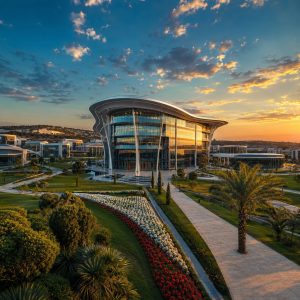
The host site is itself a recent build. The Abdelhafid-Ihaddaden Hub at Sidi Abdellah was inaugurated by President Abdelmadjid Tebboune in 2024 and now spans 87 hectares, hosting four national schools, 20,000 educational places, and residences for 11,000 students, according to Middle East AI News. The anchor academic institution is the National School of Artificial Intelligence (ENSIA), established in 2021 and ranked by Times Higher Education as one of Algeria’s most internationalised research universities for AI. Putting the cluster on this campus places founders, students, and faculty within walking distance — the ingredient most missing from earlier Algerian innovation hubs that separated incubator floors from degree programmes.
Why This Launch Looks Different From Earlier Hubs
Algeria has labelled more than 2,300 startups since the startup label framework was introduced, and the country already has a Sidi Abdellah CyberParc, an Algiers Smart City roadmap, and dispersed university incubators. What changes with the April 20 inauguration is the explicit focus on two verticals — AI and cybersecurity — rather than horizontal “tech” framing. Officials quoted by Horizons and Middle East AI News described the move as a “strategic shift” from scattered initiatives toward “structured clusters that bring together universities, research centres, and emerging companies.”
The application sectors named at launch — health, agriculture, energy, and digital services — track the priority sectors in Algeria’s National AI Strategy 2020-2030, which sets 2027 as a “benchmark horizon for consolidating knowledge-driven growth.” The cluster is therefore positioned as the operational vehicle for the strategy’s industrialisation phase: turn university theses into pilot contracts, and pilot contracts into procurement-ready vendors. The presence of the Post and Telecommunications minister — who oversees ARPCE and the data-protection regulator ANPDP — signals that the cybersecurity track will be plugged into national compliance and infrastructure procurement, not just academic research.
Advertisement
The Three Ministries and What Each Contributes
Each ministry brings a distinct lever, and the cluster only works if all three pull together. Higher Education and Scientific Research controls ENSIA, the four national schools on the Sidi Abdellah campus, and the doctoral pipeline that feeds AI research. Knowledge Economy and Startups controls the startup label, the National Fund for Startup Financing, and ANADE-style support schemes that founders need to graduate from incubation to revenue. Post and Telecommunications controls ARPCE licensing, telecom infrastructure access, and the cybersecurity regulatory perimeter.
The risk in previous Algerian innovation initiatives has been that one ministry would dominate the narrative while the other two failed to deliver complementary inputs — a researcher-heavy hub with no commercial pipeline, or a startup label with no academic depth. The tri-ministerial inauguration on April 20 is an attempt to lock all three contributions into a single governance frame from day one. Whether that holds through the first 18 months will be visible in three signals: doctoral students co-founding labelled startups, ARPCE producing a cybersecurity sandbox aligned with the cluster, and the National Fund for Startup Financing channelling tickets specifically into cluster-resident teams.
What Algerian Founders and CTOs Should Do Now
1. Map your venture against the cluster’s four named sectors before applying
The cluster’s stated application areas — health, agriculture, energy, and digital services — are not decorative. They mirror the priority sectors in the National AI Strategy and the procurement appetite of major state-owned operators. If your venture sits cleanly inside one of the four (e.g., agritech computer vision for wheat-rust detection, energy-grid anomaly detection for Sonelgaz, cybersecurity for healthcare records, NLP for digital-services delivery), your fit narrative writes itself. If your venture is in adjacent territory (gaming, consumer social, e-commerce), you need a sharper sector framing or a different programme entirely. Don’t pretend a B2C app is “digital services” — programme officers see this constantly and it weakens applications.
2. Pair early with an ENSIA or national-school faculty co-PI, not just a student intern
The cluster’s value is the academic-industry interface. The most effective founder profile in this kind of structure is one who has signed a research-collaboration agreement with an ENSIA or sister-school faculty member as a named co-PI, not a vague “we’ll hire interns” line in the deck. Faculty co-PIs unlock equipment access, doctoral student pipelines, and EU/Chinese collaboration channels that solo founders cannot reach. Treat the co-PI agreement as foundational paperwork, not optional. Founders Network and African Founders communities have written extensively on the value of named-faculty arrangements for early-stage deep-tech ventures.
3. Plan your cybersecurity compliance path before your product roadmap
If your venture lands in the cybersecurity track, the cluster’s connection to the Ministry of Post and Telecommunications matters more than its connection to ENSIA. ARPCE holds the licensing perimeter, ANPDP holds the data-protection compliance perimeter, and DZ-CERT holds the incident-coordination perimeter. Ventures that build product first and then discover they need an ARPCE licence to sell to a regulated buyer lose 6-12 months. Map your buyer’s compliance obligations (Law 18-07 on personal data, ARPCE Decision No. 48 on data localisation, sectoral banking and health rules) onto your roadmap before the first sprint, and treat compliance milestones as features.
4. Negotiate IP and equity terms with the cluster operator before signing
University-industry clusters everywhere have one recurring failure mode: ambiguous IP ownership when a startup’s core algorithm was developed using campus equipment, faculty time, or doctoral student labour. Algeria’s legal framework on academic IP is still evolving, and the cluster’s operator handbook should be read with care before you sign incubation papers. Ask for: explicit founder ownership of pre-existing IP, named transfer terms for cluster-developed IP, and a written equity-stake position by the host institution (zero, capped, or staged). If the operator cannot answer in writing, escalate before committing.
The Structural Lesson
The April 20 inauguration matters less for what it announced than for what it admits. After more than a decade of dispersed innovation programmes — incubators in Algiers, technopoles in Sidi Abdellah and Sidi Bel Abbès, a startup label, a national fund, and ICT academies — the Algerian state is implicitly conceding that a horizontal “tech” framing did not concentrate enough capital, talent, or buyer demand on any single front to produce category-defining ventures. The bet on AI and cybersecurity verticals, anchored to a single 87-hectare campus, is a structural simplification: pick two fights, fight them at one address, route the funding and the regulatory perimeter through a tri-ministerial governance structure.
What this cluster reveals about the broader market is that Algeria’s competitive opening is in deep-tech specialisation, not consumer scale. The country has too few users to win horizontal SaaS races, but enough doctoral talent, state-owned-enterprise demand, and sectoral data (energy, health, agriculture) to win vertical AI and cybersecurity races. The next 24 months will tell whether the cluster’s operating model can convert that bet into named venture exits or whether it joins the long list of well-launched Algerian innovation pôles that struggled to graduate ventures past the prototype stage.
Frequently Asked Questions
What is the Sidi Abdellah AI and cybersecurity startup cluster?
It is the first vertically focused startup cluster announced by the Algerian government, inaugurated April 20, 2026 at the Chahid Abdelhafid-Ihaddaden Scientific and Technology Hub in Sidi Abdellah. It is anchored to the 87-hectare campus that hosts ENSIA and three other national schools, and is designed to convert academic AI and cybersecurity research into commercial ventures targeting health, agriculture, energy, and digital services.
Which ministries are backing the cluster and why does that matter?
Three ministries are formally backing the cluster: Higher Education and Scientific Research (Kamel Baddari), Knowledge Economy and Startups (Noureddine Ouadah), and Post and Telecommunications (Sid Ali Zerrouki). The tri-ministerial structure matters because it bundles academic talent, startup financing, and telecom and cybersecurity regulatory access into a single governance frame, addressing the historic failure mode where Algerian innovation hubs were strong on one input and weak on the other two.
How does this cluster differ from earlier Algerian incubators and technopoles?
Earlier structures were horizontally framed (general “tech” or “innovation”) and dispersed across multiple sites. The April 2026 cluster is vertically focused on AI and cybersecurity, anchored to a single 87-hectare campus with co-located national schools, and explicitly tied to the National AI Strategy 2020-2030. The combination of vertical focus, co-location, and tri-ministerial governance is what makes it structurally distinct from the Sidi Abdellah CyberParc or the existing university incubator network.
Sources & Further Reading
- Algeria Launches First AI and Cybersecurity Startup Cluster — Middle East AI News
- Algeria Launches First AI-Cybersecurity Startup Cluster — Horizons
- Algeria Launches First AI and Cybersecurity Startup Cluster — Innovation Village
- Algeria Launches First AI and Cybersecurity Startup Cluster at Sidi Abdellah — iAfrica
- Algeria Builds First AI and Cybersecurity Hub to Scale Startup Ecosystem — Ecofin Agency