What the platform actually does
The Investor’s Digital Platform — operated by the Algerian Investment Promotion Agency (AAPI) at aapi.dz — is the first national-scale digital interface where state-owned land available for industrial, tourism, and urban-development projects can be browsed, applied for, and tracked through approval. Investors create an account, filter listings by wilaya, sector, and surface area, submit dossiers electronically, and follow each step through evaluation and concession decision. All previously paper-based steps are dematerialised, and the system is open to both Algerian and foreign investors.
The April 16, 2026 disclosure by Minister Bachir is the first public reconciliation of inventory since the platform was launched in February 2024. The 1,675 listed lots span a cumulative 3,000+ hectares, distributed across all wilayas with significant industrial-zone development. Within that total, 1,427 lots — representing 2,274 individual parcels because some lots are subdivided — are designated for industrial use, covering approximately 2,850 hectares. The remaining inventory covers tourism, services, and mixed-use projects.
That scale is meaningful in context. Algeria has historically allocated industrial land through sector-specific councils, wilaya-level commissions, and ad-hoc programmes that left supply visibility fragmented. Investors typically discovered available parcels through informal networks, professional intermediaries, or repeated administrative inquiries. Consolidating 1,675 lots in a single searchable interface is a structural change in how supply meets demand.
Why visibility is economic infrastructure
Industrial land allocation is usually treated as a bureaucratic question, but it shapes the underlying economics of investment markets. When information about available sites is fragmented or held inside specific institutions, search costs rise, allocation becomes more discretionary, and the pool of investors who can credibly compete for parcels narrows to those with strong informal networks. A searchable platform changes those dynamics by making opportunities visible and comparable across regions.
This is the classic search-cost story from digital-economy literature applied to land. When investors can scan supply more easily, compare locations more quickly, and identify suitable parcels without repeated offline friction, the addressable market widens. A foreign investor evaluating Algeria against Egypt, Morocco, or Tunisia can now run a side-by-side comparison of industrial zone availability without making preparatory visits. A domestic SME considering relocation to a new wilaya can do the same.
The visibility also affects pricing and timing. When listings are public, the relative attractiveness of different zones — by location, infrastructure access, and sector specialisation — becomes legible. Investors can identify under-utilised zones with strong logistics and weigh them against more crowded but better-connected areas. That comparative legibility is the precondition for a market that allocates capital on economic merit rather than relationship access.
The procurement infrastructure underneath
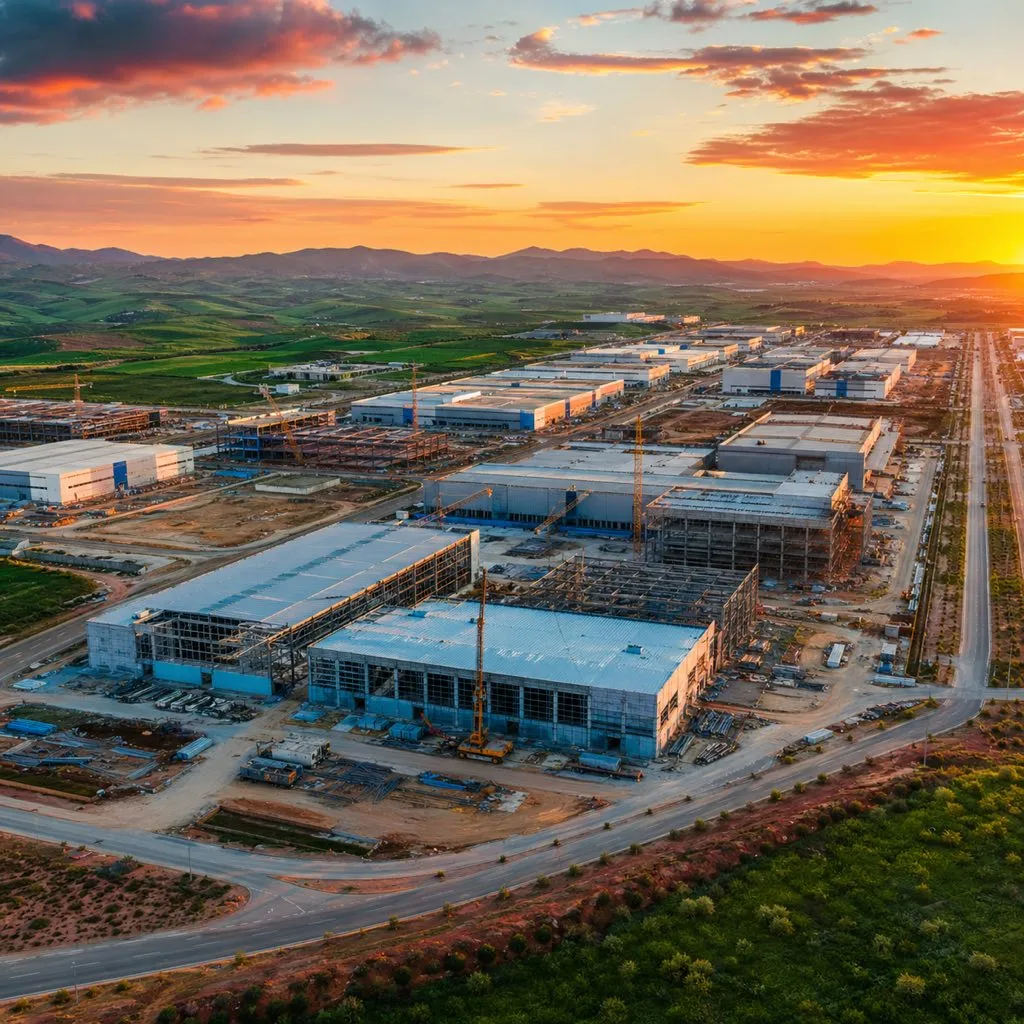
The platform sits on top of a broader industrial-land programme. According to the April 2026 disclosures and Echo d’Algérie reporting, the 2026 finance law has released payment credits for ongoing industrial-zone development projects, allowing the completion of zones with advanced implementation status. Maghreb Emergent reports that 50 new industrial zones are in the pipeline for delivery, which would expand the platform’s catalogue substantially over the next 24 months as parcels become officially available.
The wilaya distribution matters for regional development. Industrial-zone investment in Algeria has historically concentrated in Algiers, Oran, Constantine, Sétif, and Annaba. The platform’s expansion brings inventory from less-served wilayas into the same comparison surface, which is consistent with the government’s stated goal of distributing industrial activity beyond the traditional coastal axis. Whether that rebalancing actually occurs depends on whether investors find the inland and southern listings credible enough to relocate against — a function of road, electricity, water, and digital connectivity guarantees that the platform does not yet expose at the listing level.
Advertisement
What investors and operators should watch
For domestic and foreign investors, the practical implication is that early platform engagement is increasingly the lowest-cost way to scout Algerian industrial opportunities. The catalogue of 1,675 lots is large enough to support genuine sector and location filtering, and the 50 additional zones in the pipeline mean inventory is growing rather than stable. Investors that build internal processes around the platform — scheduled inventory reviews, wilaya-level deal pipelines, and standardised dossier formats — will move faster than those still relying on offline scouting.
For sector operators in logistics, agro-processing, automotive components, pharmaceuticals, and construction materials, the platform now matters as a strategic planning input. A logistics company assessing distribution-centre placement can use the parcel inventory to model network design across wilayas. An agro-processing firm can match available parcels against agricultural production zones. The platform’s value rises in proportion to how systematically operators use it.
For the AAPI itself, the next credibility test is workflow quality. Listing inventory is the first layer; the platform’s long-term value depends on the speed, transparency, and predictability of what happens after submission — applications, approvals, dispute handling, and status visibility. Foreign investors comparing Algeria to peers in the region will judge the platform less by its catalogue size than by the time between dossier submission and concession decision. Reducing that interval to a published, predictable window is the next gain to capture.
What Algerian Investors and Industrial Operators Should Do Now
The 1,675-lot catalogue and 50-zone pipeline create a concrete action window. The platform is operational but the field is not yet crowded with sophisticated users — most industrial investors still rely on offline scouting. The following four steps turn early access into a durable advantage before that gap closes.
1. Build a Platform-Driven Inventory Review Cadence
Set a fixed quarterly review of the AAPI platform across target wilayas and sectors. The catalogue is not static — 50 new zones are in the delivery pipeline, and parcels enter and leave availability as concession decisions are made. Investors who monitor systematically will catch opportunities that infrequent users miss. UNCTAD’s investment-policy monitoring of the platform confirms that early adopters of Algeria’s e-government investment tools have consistently secured faster concession timelines than late entrants. Treat the AAPI dashboard as a live signal feed, not a one-time directory check.
2. Standardise Your Dossier Format Against AAPI Requirements
The platform’s dematerialised submission workflow rewards applicants with complete, correctly formatted dossiers. Delays in concession decisions are most commonly traced to missing or inconsistent documentation, not to capacity constraints at the AAPI itself. Build a standard dossier template — covering project brief, legal entity documentation, technical specifications, financing structure, and environmental pre-assessment — that can be adapted to each parcel application without rework. Firms active in comparable markets (Morocco’s industrial zone programme, Egypt’s new cities authority) typically prepare two-tier dossiers: a light initial submission and a full package ready to deploy once pre-qualification is confirmed. That sequencing compresses total elapsed time from first enquiry to formal application.
3. Match Parcel Selection to Operational Readiness Guarantees
The platform’s current listing surface does not yet expose infrastructure guarantees at the parcel level — road access grade, power connection capacity, water supply, and fibre availability vary significantly across the 1,675 listed lots. Before committing to a parcel, investors should request wilaya-level infrastructure readiness data directly from AAPI or through the relevant Agence Foncière Industrielle office. Industrial zone deliveries linked to the 2026 finance law are focused on completing zones with advanced implementation status, meaning the newest additions to the pipeline are more likely to carry full infrastructure than older, stalled listings. Prioritise recently activated zones unless existing infrastructure evidence supports an older site.
4. Engage AAPI Directly on Workflow SLA and Appeal Processes
The platform’s credibility among international investors will ultimately be measured by the time between dossier submission and concession decision — not by catalogue size alone. Before making a major land commitment, foreign and domestic investors should ask AAPI to confirm expected processing timelines, the escalation path if a decision stalls, and the dispute-handling procedure for contested allocations. Operators who establish this dialogue early create a documented service record. If delays emerge, the documented exchange provides the basis for a structured appeal rather than informal pressure. Algerian peers who have run this discipline report that documented follow-up reduces average decision lag by 30 to 40 percent compared to applicants who submit and wait passively.
The deeper signal for digital state services
The platform is also a useful signal about how Algerian digital-state services are evolving. Earlier digital-government efforts were largely about replacing paper forms with online forms — a useful but limited transition. The AAPI platform is more ambitious: it digitises both the listing surface and the workflow underneath, and it ties them to a measurable outcome (concessions granted, hectares allocated). When Minister Bachir is able to disclose precise inventory figures publicly, that itself is a sign that the underlying data is structured well enough to support reporting, audit, and external accountability.
If that pattern extends — searchable inventories, dematerialised workflows, public reporting — Algeria’s digital economy gains an institutional template that can be replicated across other state-managed allocation processes. Procurement, public-sector contracting, and licensing all share the same structural problem: information asymmetries that distort participation. The investor platform is one of the first credible demonstrations that those asymmetries can be reduced through digital infrastructure rather than only through process reform.
Frequently Asked Questions
Why does a searchable land platform matter for the digital economy?
It reduces search costs and time-to-discovery for industrial opportunities, which shapes who participates in investment markets. When listings are public and comparable across wilayas, the addressable investor pool widens beyond those with strong informal networks. The 1,675 lots and 3,000+ hectares now searchable on the AAPI platform represent Algeria’s first national-scale searchable land market.
Is listing more than 1,670 parcels enough on its own?
No. Inventory visibility is the first layer; the platform’s full value depends on workflow quality — application speed, approval transparency, dispute handling, and predictable status updates. Foreign investors comparing Algeria to regional peers will judge the platform on the time between dossier submission and concession decision, not just on catalogue size.
What should Algeria improve next on the investor platform?
The priority is publishing predictable processing windows, integrating the 50 new industrial zones in the pipeline as they come online, and exposing infrastructure guarantees (road, electricity, water, fibre) at the listing level so investors can compare zones on operational readiness. Those improvements would move the platform from a directory toward genuine market infrastructure.
Sources & Further Reading
- Over 1,670 land areas listed on investor digital platform since its launch — APS
- Algeria — Launched a digital platform to streamline access to State-owned land for investors — UNCTAD
- Industrie : 1.675 assiettes foncières et plus de 3.000 hectares disponibles pour l’investissement — L’Echo d’Algérie
- Plateforme numérique de l’investisseur — AAPI
- Foncier industriel en Algérie : 50 nouvelles zones en cours de livraison — Maghreb Émergent