A Workforce Pipeline Built for Sovereignty
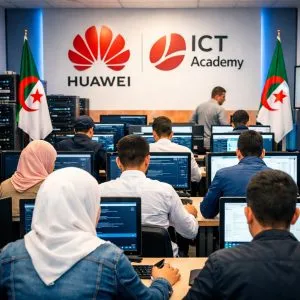
When Algeria’s national AI strategy set a target of AI contributing 7% of GDP by 2027, it immediately raised the question every country in a similar position has to answer: where do the engineers come from? The September 2026 launch of a new joint diploma programme, co-delivered by the Ministry of Vocational Training and Education and Huawei, is the most concrete answer the Algerian government has put on the table to date.
The programme is the visible layer of a broader digital-economy cooperation track with China that covers infrastructure, standards, and training. It sits alongside the Ministry’s February 2026 announcement of 285,000 new vocational training places for the 2026 cycle and the expansion of certificate-oriented qualification programmes built around a competency-based approach. The combined effect is a structural shift in how Algeria develops the technical workforce that will operate the AI, cloud, and cybersecurity layer of the national digital stack.
What the Programme Covers
Three training tracks define the September 2026 intake.
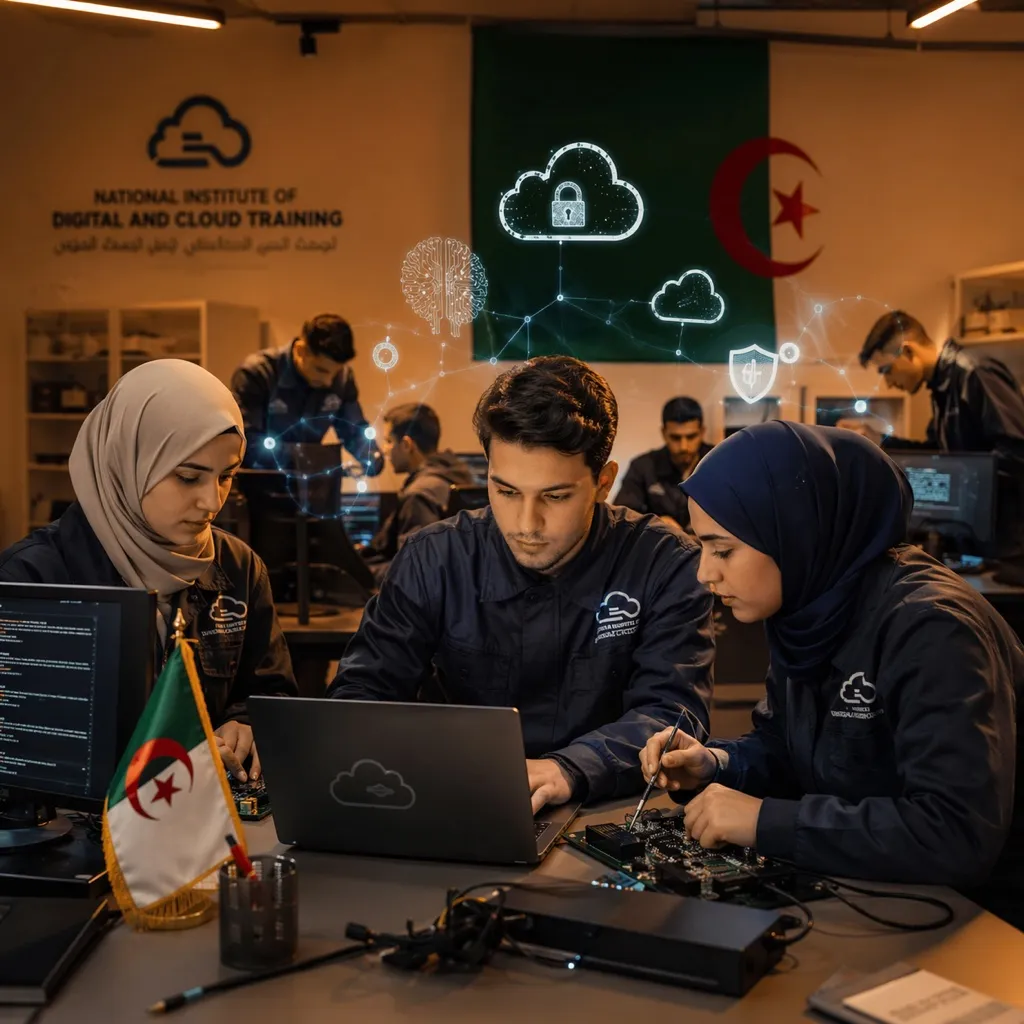
The first is cloud computing, with a curriculum spanning infrastructure-as-a-service fundamentals, hybrid cloud architecture, and practical deployment on Huawei Cloud Stack — the same underlying platform Sonatrach is using for its ERP and digital-transformation programme. Graduates will have hands-on credentials in the cloud foundation that Algeria’s major enterprises are now standardising on.
The second is cybersecurity, covering network security, endpoint defence, incident response, and the growing field of cloud-native security. The Minister of Vocational Training and Education has highlighted cybersecurity as a specific priority category for the new certificate-oriented qualifications — a direct response to enterprise demand amplified by incidents like the April 2026 Microsoft SharePoint zero-day and the broader wave of ransomware and supply-chain attacks that have targeted African organisations since 2024.
The third is artificial intelligence, with a curriculum built around Huawei’s AI Engineer certification framework (HCIA-AI and above). Students learn practical model training, MLOps, and deployment on both public-cloud and sovereign infrastructure. The programme explicitly targets the enterprise-scale AI skills required by Sonatrach, Algerie Telecom, the public banks, and the super-app layer including Yassir and TemTem.
A joint Ministry-Huawei diploma is the distinguishing output. It sits between a purely academic degree and a pure vendor certification, and it carries both sovereign and commercial recognition — exactly the combination Algerian employers have been asking for.
Three Institutions, One Template
The partnership concentrates delivery at three core institutions: the National Specialized Institute for ICT at Rahmania, the National Institute for Vocational Training (INSFP) at Bousmail, and the African Institute for Vocational Training at Boumerdes.
The choice of institutions matters. Rahmania sits on the western outskirts of Algiers and has long served as the country’s reference training site for ICT; Bousmail is a mid-scale institute with strong vocational-track alumni across the wilayas; Boumerdes, home to one of Algeria’s strongest technical-university clusters, brings both ICT and industrial-automation capacity. Between the three, the programme covers ICT, mainstream vocational training, and pan-African positioning — a range that matches the different employer segments a graduate will eventually enter.
Capacity expansion at these three academies, announced in the memorandum of understanding, is the second lever. Algeria has already trained 8,000 students through earlier Huawei ICT Academy partnerships (universities including Algiers 1, Batna-2, Oran 1 USTO-MB, ENSIA, and HNS-RE2SD have run Huawei ICT Academies for several years). The September 2026 programme effectively adds a vocational layer underneath the university track, closing the skills gap between the degree and the job.
Advertisement
Why Sovereign-Branded Diplomas Matter
A conventional vendor certification — a Huawei HCIA-AI or HCIP-Cloud badge — is valuable, but it is not enforceable in a way a public-sector employer can treat as a formal qualification. A ministry-issued diploma is. The joint-diploma design bridges the gap: employers get the vendor-specific skills signal, while the public-sector ecosystem gets a recognised sovereign credential it can write into hiring criteria, promotion tracks, and compensation grids.
This matters for three reasons.
First, enterprise demand. Every 2026 global AI-adoption survey names workforce skills as the top obstacle to scaling. KPMG’s Q4 AI Pulse survey found 62% of leaders cite skills gaps as the leading challenge to demonstrating ROI. Algerian enterprises report the same pattern — and a formal ministerial diploma gives HR teams a clean filter for hiring decisions in a market where credentials are still maturing.
Second, public-sector absorption. Sonatrach, Algerie Telecom, the public banks, and the utilities all hire from a graded career ladder that requires formally recognised diplomas for entry and promotion. A Huawei-only badge sits outside that ladder; a jointly-issued diploma sits inside it.
Third, diaspora pull-back. Algerian tech talent has been a substantial export for two decades, with strong clusters in France, Canada, and the Gulf. A credential that is recognised at home and has weight abroad (because the Huawei component is internationally portable) makes it materially easier for diaspora professionals to return on competitive terms.
The Broader China Cooperation Track
The September 2026 programme is part of a wider China-Algeria digital-cooperation trajectory that has been building steadily. Algeria and China signed a second five-year comprehensive strategic cooperation plan covering 2022-2026, and eight new cooperation agreements in April 2025 formalised sector-by-sector engagement in digital infrastructure, satellites, renewables, and industrial parks.
The diploma programme complements the other Huawei-anchored programmes already running in the country: the 400G WDM national backbone network for Algeria Telecom (deployed through 2025), the Huawei Cloud Stack sovereign-cloud template being used by Sonatrach and Algeria Telecom, and the Yassir-Huawei strategic partnership signed in December 2025. Each of these programmes creates specific job demand that the new diploma track is designed to feed.
Similar models exist elsewhere. Morocco’s public-private training partnerships with the OCP Foundation and international technology partners produce several thousand certified ICT graduates per year; Singapore’s SkillsFuture framework is the global benchmark for continuous workforce upskilling in small, digitally-ambitious countries. Algeria is not trying to copy either model directly, but the shared pattern is clear: when a country commits to a sovereign AI target, it also commits to an industrialised workforce pipeline.
What to Watch
The September 2026 intake is the first test. Three metrics will define whether the programme delivers on its scale and sovereignty promises.
The first is enrolment. Three institutions, delivering certificate-grade training across three specialisms, can realistically absorb 1,500 to 3,000 students per intake in the first year. If the programme hits the upper end, it immediately becomes the largest sovereign AI-cloud-cybersecurity credential pipeline in the Maghreb.
The second is placement. Anecdote is not enough; within 12 months of first graduation, the Ministry and Huawei should be able to publish placement statistics into the large public employers (Sonatrach, Algerie Telecom, the banks), into the super-app and startup ecosystem (Yassir, TemTem, Algerie Telecom’s 11 million dollar fund portfolio), and into the public-service digital-transformation programmes.
The third is curriculum evolution. AI moves faster than curriculum committees. A programme that is rewriting modules annually to reflect new patterns — MCP, agentic systems, RAG pipelines, AI governance — will retain relevance; one that locks in 2026 patterns will be obsolete by 2029.
The signals so far are strong. Algeria has put the political weight, the physical sites, the partnership, and the budget behind a single, clear workforce thesis. September 2026 is the starting gun.
Frequently Asked Questions
How is a joint Ministry-Huawei diploma different from a standalone Huawei certification?
A Huawei HCIA-AI or HCIP-Cloud badge is a vendor credential — valuable but not enforceable inside Algeria’s public-sector career ladder. The joint diploma is ministry-issued, which means Sonatrach, Algerie Telecom, and the banks can write it into formal hiring, promotion, and salary-grade criteria.
Which institutions will deliver the programme?
Three: the National Specialized Institute for ICT at Rahmania (western Algiers), the National Institute for Vocational Training (INSFP) at Bousmail, and the African Institute for Vocational Training at Boumerdes. Together they cover ICT, mainstream vocational training, and pan-African positioning.
What is the realistic enrolment capacity for year one?
Three institutions across three specialisms can plausibly absorb 1,500 to 3,000 students in the first intake. If the programme hits the upper end, it immediately becomes the largest sovereign AI-cloud-cybersecurity credential pipeline in the Maghreb.
Sources & Further Reading
- Algeria and Huawei forge strategic partnership to modernize vocational training in ICT — SAMENA Daily News
- Algeria Plans 285,000 New Vocational Training Places in 2026 — Ecofin Agency
- Algeria Expands Vocational Training to Meet Growing Cybersecurity Demand — TechAfrica News
- Why Algeria Is Positioned to Become North Africa’s AI Leader — New Lines Institute
- Huawei ICT Academy — Official Talent Portal
- China and Algeria Sign Eight Cooperation Agreements — China-Global South Project