From Science Fiction to Feasibility Study
China’s State Administration of Science, Technology and Industry for National Defense has formally initiated a feasibility study and pre-project assessment for a space-based intelligent computing constellation. Announced at the 2026 Space Computing Industry Conference, the project represents one of the most ambitious digital infrastructure initiatives in history.
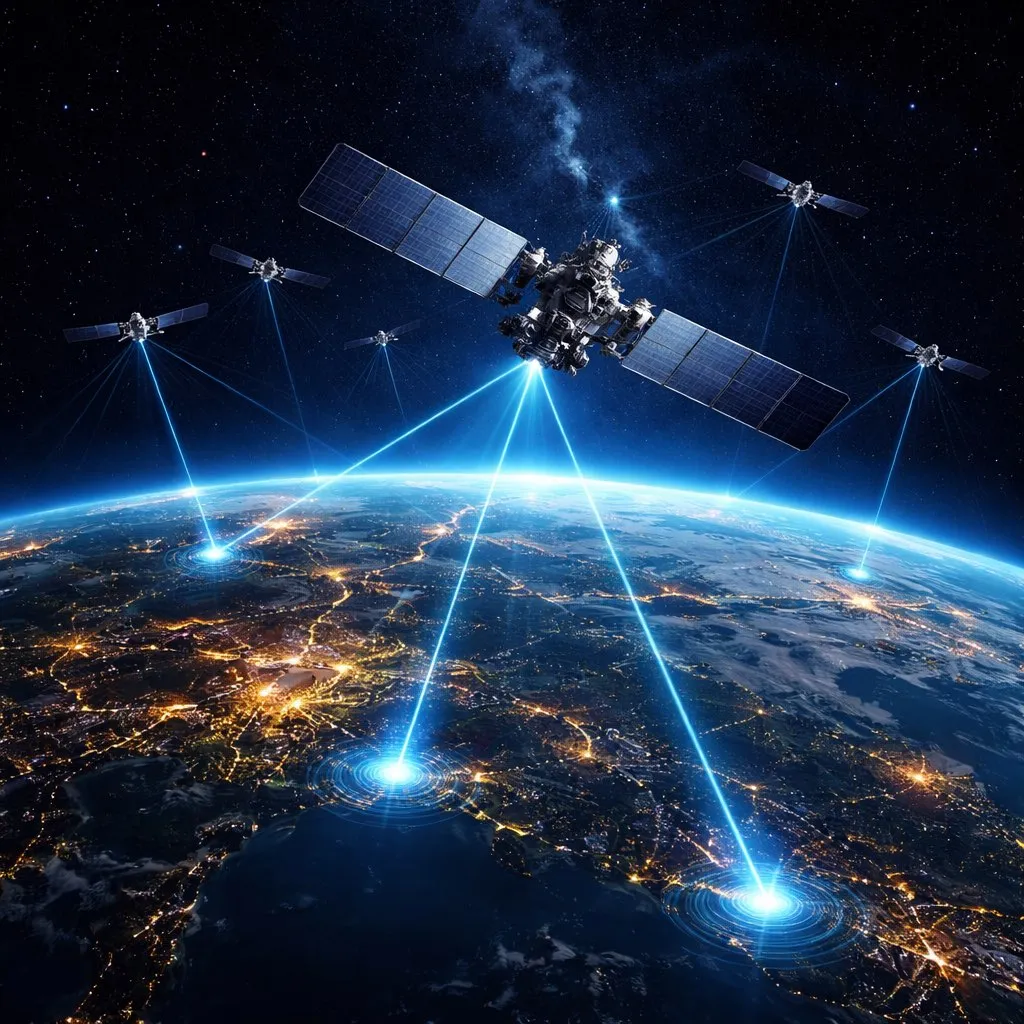
The concept is straightforward in theory, revolutionary in practice: instead of building all compute capacity on Earth’s surface in power-hungry data centers, deploy computational capacity in orbit where solar energy is abundant and cooling is simplified by the vacuum of space.
China Aerospace Science and Technology Corporation has committed to promoting space-based digital infrastructure during the 15th Five-Year Plan period, with plans including building gigawatt-scale space computing facilities. The China Academy of Information and Communications Technology and more than a dozen research institutions and companies have released a joint initiative promoting the development of a “computing satellite network.”
What Is Already in Orbit
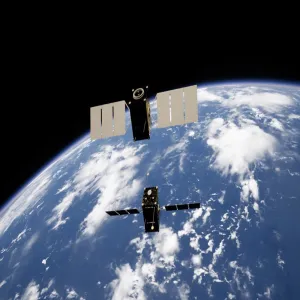
The feasibility study does not start from zero. China has already launched an initial constellation of 12 AI-equipped satellites that serve as a proof of concept. These satellites carry 10 AI models, including two 8-billion-parameter models for remote sensing and astronomical time-domain analysis — ranking among the largest AI models currently operating in space.
The existing constellation has demonstrated inter-satellite networking, proving that distributed computing across orbital platforms is technically viable. This capability is critical for the envisioned 2,800-satellite constellation, which would need to coordinate processing across hundreds of nodes simultaneously.
The full constellation targets combined real-time processing power of 1,000 Peta operations per second — equivalent to one quintillion operations per second. To put this in perspective, this would rival the computational capacity of several of the world’s largest terrestrial supercomputers combined.
The Strategic Logic
Several factors make space-based computing increasingly compelling from a strategic and economic perspective.
Energy Availability: Terrestrial data centers face growing power constraints, with leading AI companies securing gigawatts of capacity and power availability becoming the primary bottleneck. In orbit, solar panels can capture energy continuously (no nighttime, minimal atmospheric interference), offering an essentially unlimited power source.
Cooling Efficiency: Data center cooling accounts for a significant portion of energy consumption. In space, radiative cooling in the vacuum environment is far more efficient than terrestrial air or liquid cooling systems.
Sovereignty and Security: Space-based compute infrastructure is inherently more difficult to physically attack or seize than terrestrial data centers. For nations concerned about digital sovereignty, orbital infrastructure provides a unique form of strategic resilience.
Global Coverage: Satellite-based computing can serve any location on Earth without requiring ground-based infrastructure, potentially bridging the digital divide for remote and underserved regions.
Advertisement
Technical Challenges
Despite the strategic appeal, significant technical challenges remain.
Launch Costs: While costs have decreased dramatically — SpaceX’s Starship targets $10/kg to orbit — deploying 2,800 satellites with computing hardware remains a multi-billion-dollar endeavor.
Latency: Light-speed communication between Earth and low-Earth orbit introduces approximately 2-10ms of latency, plus processing time. This makes space computing unsuitable for latency-sensitive applications but viable for batch processing, AI training, and edge inference.
Maintenance and Upgrades: Unlike terrestrial servers that can be physically maintained and upgraded, orbital hardware must be designed for long-duration autonomous operation. Hardware failures in orbit are difficult or impossible to repair.
Space Debris: Adding 2,800 satellites to an already congested orbital environment raises concerns about collision risk and the sustainability of the space environment.
Global Competition in Space Computing
China is not alone in exploring space-based computing, but it is arguably the most organized. The United States has seen private companies like Lumen Orbit and others investigate orbital data centers. The European Space Agency has funded studies on space-based cloud computing. Singapore and the UAE have expressed interest in space-based digital infrastructure as part of their national strategies.
However, China’s approach is distinguished by its state-level coordination. The feasibility study involves the national defense administration, the telecommunications research academy, and major aerospace corporations operating under a unified Five-Year Plan framework. This top-down coordination enables the kind of long-term, capital-intensive investment that market-driven approaches struggle to match.
Implications for the Global Digital Economy
If realized, space-based computing constellations would fundamentally reshape the global digital economy. The most immediate impact would be on AI infrastructure economics — orbital compute could eventually compete with terrestrial data centers on cost for specific workloads, particularly those that are latency-tolerant and energy-intensive.
Longer term, space computing could enable new categories of applications: real-time Earth observation with on-orbit AI processing, global mesh networks that combine communication and computation, and sovereign compute infrastructure that operates beyond the reach of any terrestrial jurisdiction.
For the global technology industry, this initiative adds a new dimension to the infrastructure competition between major powers. The race to build AI infrastructure is no longer confined to Earth’s surface.
Frequently Asked Questions
Why would you put computing power in space instead of on Earth?
Three key advantages drive space-based computing. First, solar energy in orbit is nearly unlimited — no nighttime, no weather, no grid constraints — solving the power bottleneck that limits terrestrial data centers. Second, cooling in the vacuum of space is far more efficient than on Earth, eliminating a major cost and energy drain. Third, orbital infrastructure provides global coverage and is inherently more difficult to physically attack, offering sovereignty and resilience benefits.
How much processing power would China’s space computing constellation have?
The planned 2,800-satellite constellation targets 1,000 Peta operations per second (1,000 POPS), equivalent to one quintillion operations per second. This would rival several of the world’s largest terrestrial supercomputers combined. The first 12 satellites already in orbit carry 10 AI models including two 8-billion-parameter models, demonstrating that meaningful AI processing in orbit is already possible.
When could space-based computing become commercially available?
China’s feasibility study is in its early stages, with the full constellation likely a decade away from completion. However, limited space computing services from the existing 12-satellite constellation may become available sooner. Commercial space computing from multiple providers could emerge by 2030-2032, initially for specialized workloads like Earth observation AI, climate modeling, and communication-computation hybrid services.
Sources & Further Reading
- China Starts Feasibility Study for Space-Based Intelligent Computing Constellation — Xinhua
- Space-Based Computing Moves into Focus as Costs Continue to Fall — CGTN
- China Launches AI-Driven Satellite Constellation to Transform Space Computing — Orbital Today
- China Demonstrates AI Computing Power in Outer Space with Satellite Network Breakthrough — China.org.cn
- Beijing’s Orbital Ambitions: China Races to Deploy Space-Based Data Centers — WebProNews