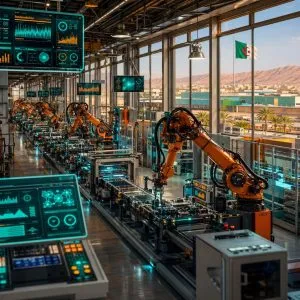
When a production line stops unexpectedly at Condor Electronics in Bordj Bou Arréridj, the cost is not abstract. Every hour of unplanned downtime on a high-speed electronics assembly line represents lost output, idle workers, missed delivery commitments, and potential contract penalties. Multiply that across dozens of production lines in Algeria’s major industrial zones, and unplanned downtime becomes one of the largest hidden costs in the country’s manufacturing sector.
Globally, the answer to this problem is increasingly clear: predictive maintenance powered by artificial intelligence. Instead of waiting for machines to break (reactive maintenance) or servicing them on fixed schedules regardless of actual condition (preventive maintenance), AI-driven predictive maintenance uses sensor data and machine learning to forecast exactly when equipment will fail and intervene just before it does.
The global predictive maintenance market reached USD 13.65 billion in 2025 and is projected to grow to USD 17.11 billion in 2026, expanding at a CAGR of 24.3% through 2034 according to Fortune Business Insights. Major manufacturers worldwide have demonstrated 30-50% reductions in unplanned downtime and 10-40% reductions in maintenance costs through AI-powered approaches, with the U.S. Department of Energy documenting 70-75% decreases in equipment breakdowns at facilities that implement predictive systems.
Algeria’s industrial zones, home to the country’s most important non-hydrocarbon manufacturing capacity, have barely begun this journey. The technology is ready. The economic case is compelling. The question is whether Algeria’s industrial sector can overcome the practical barriers to adoption.
Algeria’s Industrial Geography
Algeria’s manufacturing sector is concentrated in several major industrial zones, each with distinct characteristics and maintenance challenges.
Bordj Bou Arréridj: Algeria’s Electronics Capital
The BBA industrial zone is Algeria’s electronics heartland. Condor Group, founded in 2002 and now the country’s largest private industrial conglomerate, manufactures televisions, smartphones, air conditioners, washing machines, and solar panels here. Condor holds a 35% market share in Algerian home appliances and 55% in mobile phones. In 2025, Condor partnered with Chinese giant Hisense to build Africa’s largest air conditioner plant in BBA, a $200 million investment expected to produce two million units annually, with 80% destined for export.
The production environment at Condor and other BBA manufacturers combines high-speed automated assembly (SMT lines for circuit boards, injection molding for plastic components) with labor-intensive final assembly. Equipment ranges from state-of-the-art pick-and-place machines imported from Japan and Germany to older assembly fixtures that have been in service for a decade or more.
Unplanned downtime on an SMT line, caused by a failed servo motor, a degraded vacuum pump, or a contaminated solder paste feeder, can halt production for hours while spare parts are located and repairs completed. For a line producing thousands of circuit boards per shift, each hour of downtime translates directly to lost revenue and missed export deadlines.
Sétif: Electronics, Appliances, and Diverse Manufacturing
The Sétif industrial zone hosts a mix of electronics manufacturing, household appliances, food processing, and light industry. IRIS Algérie, founded in 2004 and headquartered in Sétif’s industrial zone, has become the undisputed leader in Algeria’s TV segment and a major manufacturer of consumer electronics and home appliances. The wilaya of Sétif is home to 23 major industrial enterprises and over 26,000 active SMEs. Cevital, one of Algeria’s largest private groups, invested EUR 250 million in a 110-hectare industrial park in Sétif designed for household electronics production with a capacity of up to eight million appliances per year.
The zone’s proximity to the University of Sétif 1 (Ferhat Abbas University), which was founded in 1978 and houses 46 research laboratories across science, technology, and engineering disciplines, creates a potential talent pipeline for technology adoption. However, the gap between academic computer science programs and industrial AI applications remains wide.
Rouiba-Reghaïa: Automotive and Heavy Industry
The Rouiba-Reghaïa industrial zone east of Algiers spans 1,000 hectares, hosts over 200 industrial units, and employs more than 27,000 workers. This is Algeria’s automotive and heavy industry heartland. SNVI (Société Nationale des Véhicules Industriels), a state-owned company with a capital of 2.2 billion DA, manufactures trucks from 6.6 to 26 tonnes, road tractors, coaches, buses, and railway equipment at its Rouiba headquarters. SNVI alone accounts for nearly half the zone’s workforce. The company’s manufacturing processes include hot stamping, machining, gear cutting, grinding, and heat treatments, all processes where equipment monitoring can prevent costly failures.
The zone also hosts companies including Henkel, ZF, and various food processing facilities. The maintenance challenges here differ from BBA and Sétif. Automotive manufacturing involves heavy presses, CNC machining centers, welding systems, and paint lines, equipment where failures can be catastrophic and dangerous, not just costly.
Other Key Zones
Arzew and Hassi Messaoud serve the hydrocarbons sector, where Sonatrach already deploys sophisticated monitoring systems. ENIEM (Entreprise Nationale des Industries de l’Electroménager), located in the industrial zone of Oued Aïssi near Tizi Ouzou, manufactures refrigerators, cookers, air conditioners, and washing machines. ENIEM holds a leading position in Algeria’s white goods market and received a 3.5 billion DZD government recovery plan to modernize operations, making it another prime candidate for predictive maintenance investment.
The Economics of Unplanned Downtime
To understand why predictive maintenance matters for Algeria, consider the economics. Industry research consistently shows that unplanned downtime costs industrial manufacturers significantly more than planned downtime due to emergency repairs requiring expedited parts, disrupted production schedules, potential cascade damage to adjacent equipment, and overtime labor costs. According to research cited by manufacturing analytics firms, unplanned equipment failures cost organizations an average of $260,000 per hour in the most critical production environments.
For a medium-scale Algerian manufacturer with annual revenue of 5-10 billion DA ($37-74 million), unplanned downtime typically consumes 5-15% of production capacity. Even at the lower end, that represents roughly 250 million DA ($1.85 million) in lost annual output. For Condor, with its new $200 million Hisense partnership facility ramping up, or SNVI with its critical role in Algeria’s industrial vehicle supply, the stakes are far higher.
The economics of predictive maintenance are well documented through industry benchmarks:
- 25-40% reduction in maintenance costs (fewer emergency repairs, better parts inventory management)
- 30-50% reduction in unplanned downtime (failures predicted and addressed before they occur)
- Up to 35% extension of equipment life (condition-based maintenance reduces wear from both over-maintenance and under-maintenance)
- 70-75% decrease in equipment breakdowns (U.S. Department of Energy benchmarks)
- Typical ROI of 10:1 or higher within 12-18 months for well-implemented systems (McKinsey research)
For an Algerian manufacturer spending 500 million DA annually on maintenance, a 25% reduction represents 125 million DA in savings, enough to fund the AI system and sensor infrastructure with room to spare.
How AI Predictive Maintenance Works
Predictive maintenance is not a single technology but a stack of capabilities that work together.
Sensor Networks and Data Collection
The foundation is data. Equipment must be instrumented with sensors that capture operating parameters in real time. The most common sensor types for manufacturing predictive maintenance include:
Vibration sensors: Attached to rotating equipment (motors, pumps, fans, spindles), these detect changes in vibration patterns that indicate bearing wear, imbalance, misalignment, or looseness. Vibration analysis is the most mature and widely deployed predictive maintenance technique.
Temperature sensors: Monitor bearing temperatures, motor winding temperatures, hydraulic fluid temperatures, and process temperatures. Abnormal temperature trends often precede failures by hours or days.
Current sensors: Measure electrical current drawn by motors. Changes in current draw can indicate mechanical load changes, winding degradation, or power supply issues. Schneider Electric’s EcoStruxure platform uses electrical signal analysis rather than traditional vibration sensors, monitoring current signatures from motor control cabinets to predict failures up to six months in advance.
Acoustic sensors: Detect ultrasonic emissions from compressed air leaks, electrical discharge, and bearing defects. Particularly useful for early detection of problems not yet visible in vibration data.
Oil analysis sensors: For hydraulic systems and gearboxes, inline oil sensors monitor particle counts, moisture content, and viscosity, indicators of component wear and fluid degradation.
Modern industrial IoT sensors are wireless, battery-powered, and relatively inexpensive ($100-500 per sensor). A typical production line might require 20-50 sensors to provide comprehensive coverage, representing an investment of $5,000-25,000 per line in hardware.
Edge Computing and Data Processing
Sensors generate enormous volumes of data. A single vibration sensor sampling at 25 kHz produces gigabytes per day. This data must be processed close to the source (edge computing) to extract meaningful features before transmission to analytics platforms.
Edge computing devices, small industrial computers installed on or near equipment, run signal processing algorithms that convert raw sensor data into features: vibration frequency spectra, temperature trends, statistical indicators. Only these compressed features are transmitted to central systems, reducing bandwidth requirements dramatically.
This is particularly important for Algerian industrial zones where network infrastructure may be limited. Edge computing reduces the dependence on fast, reliable connectivity between factory floor and analytics platform.
Machine Learning Models
The core of predictive maintenance AI is machine learning models trained to recognize patterns that precede failures. Several approaches are used:
Anomaly detection models learn what “normal” operation looks like for each piece of equipment and flag deviations. These are useful when failure modes are diverse or poorly characterized. Autoencoders and isolation forests are common techniques.
Classification models learn to distinguish between specific failure modes, such as bearing wear versus misalignment versus imbalance. These require labeled training data (historical examples of each failure type) but provide more actionable diagnostics when available.
Regression models predict remaining useful life (RUL), estimating how many hours or cycles of operation remain before a component reaches failure threshold. This enables optimal maintenance scheduling.
Time series forecasting models predict future sensor readings based on historical patterns, identifying trends that project toward failure thresholds. LSTM (Long Short-Term Memory) networks and transformer-based architectures have shown strong performance for this application.
Integration with Maintenance Management
AI predictions are only valuable if they trigger action. Predictive maintenance systems integrate with Computerized Maintenance Management Systems (CMMS) to automatically generate work orders, schedule maintenance during planned downtime windows, reserve spare parts from inventory, and assign appropriate maintenance personnel.
For the approach to deliver full value, this integration must be seamless. An AI prediction that a motor will fail in 72 hours is useful only if the maintenance planning system can schedule the repair, confirm parts availability, and alert the maintenance team without manual intervention.
Global Case Studies with Algerian Relevance
Several global implementations provide blueprints that Algerian manufacturers could adapt.
Samsung Electronics: AI-Driven Factory Strategy
Samsung Electronics announced in 2025 its strategy to transition all global manufacturing operations into AI-driven factories by 2030, with predictive maintenance as a core pillar. Through a partnership with NVIDIA, Samsung is building digital twins of its semiconductor fabs and electronics manufacturing facilities using Omniverse technology, integrating data from physical equipment and production workflows to enable AI-driven predictive maintenance and real-time decision-making.
Samsung’s AI agents will handle quality control, predictive maintenance, repair operations, and logistics coordination across all global sites. For Condor and IRIS, which operate similar electronics assembly equipment (SMT lines, injection molding), Samsung’s approach demonstrates where the global electronics industry is heading and what will increasingly become the competitive baseline.
Schneider Electric: Motor and Drive Monitoring
Schneider Electric’s EcoStruxure Asset Advisor platform, expanded through a partnership with Semiotic Labs, monitors electric motors, pumps, conveyors, and compressors using AI-based analytics. The system analyzes electrical signal “fingerprints” from AC motors, with sensors installed inside motor control cabinets rather than on the equipment itself, simplifying deployment. At Schneider’s own Xiamen manufacturing plant, the system achieved $1.2 million in annual savings from reduced unplanned downtime.
Given that electric motors are ubiquitous in all of Algeria’s industrial zones, driving conveyors, pumps, compressors, fans, and production equipment, motor predictive maintenance represents a horizontal application relevant to every manufacturer. The EcoStruxure approach, which avoids placing sensors directly on aging equipment, is particularly practical for Algeria’s older industrial installations.
Renault: Connected Automotive Manufacturing
Renault Group has connected approximately 15,000 pieces of equipment across its manufacturing workshops, generating over 3 billion data sets daily. Through its industrial metaverse initiative launched in 2019, Renault uses digital twins, cloud computing, and AI analytics to monitor welding robots and predict failures, a capability that also allowed engineers to anticipate welding defects before they occurred. The program has driven over 300 projects and achieved EUR 700 million in cumulative savings.
For SNVI in Rouiba, which operates similar automotive manufacturing equipment including stamping presses and welding systems, Renault’s experience demonstrates both the potential and the reality that retrofitting AI monitoring onto older equipment requires more engineering effort than equipping modern lines, but delivers substantial returns when implemented systematically.
Danone: AI-Enabled Supply Chain and Manufacturing
Danone has partnered with Microsoft in a multi-year collaboration to integrate AI across its supply chain and manufacturing operations. The partnership focuses on predictive forecasting, real-time production adjustments, and digital twin technology for procurement, production, and distribution optimization. While still early in implementation, the initiative has deployed Microsoft 365 Copilot to over 50,000 employees and is upskilling 100,000 workers. For Algeria’s food processing facilities, including those in the Sétif zone, Danone’s approach to combining AI technology deployment with workforce upskilling offers a practical model.
Advertisement
Implementation Challenges in Algeria
Aging Equipment and Sensor Compatibility
Many machines in Algeria’s industrial zones predate the digital era. A CNC lathe from the 1990s or a stamping press from an earlier generation was not designed for sensor integration. While external sensors (clamp-on vibration sensors, non-contact temperature sensors) can be added to most equipment, the process requires engineering expertise and may face physical constraints.
SNVI’s Rouiba facility, which inherited infrastructure from the original Berliet factory established in 1957 and has operated continuously since Algeria’s independence, faces this challenge acutely. ENIEM’s appliance manufacturing lines in Tizi Ouzou present similar challenges with aging infrastructure alongside the 3.5 billion DZD recovery plan. The pragmatic approach is to start with the most critical and most modern equipment, building experience before tackling legacy machines.
Connectivity on Factory Floors
Many Algerian factory floors lack the network infrastructure for large-scale IoT deployment. Wi-Fi coverage is spotty, Ethernet is not routed to equipment locations, and cellular coverage inside steel-and-concrete factory buildings is unreliable.
Solutions exist: industrial-grade wireless mesh networks (LoRaWAN, industrial Wi-Fi 6), edge computing that reduces bandwidth requirements, and cellular boosters for factory environments. But these require additional investment and planning that goes beyond the AI system itself. Algeria’s plan to register more than 500 digital infrastructure projects between 2025 and 2026 may eventually improve industrial connectivity, but manufacturers cannot wait for public infrastructure to catch up.
Skills Gap: Data-Literate Maintenance Technicians
Predictive maintenance changes the role of maintenance technicians. Instead of responding to breakdowns or following fixed schedules, they must interpret AI-generated alerts, prioritize based on risk assessments, and perform condition-based interventions.
This requires a new skill set that blends traditional mechanical and electrical maintenance knowledge with data literacy. Algeria’s CFPA vocational training centers, a network of over 800 centers with a capacity exceeding 236,000 trainees, need to evolve their curricula to include IoT, data analysis, and AI-assisted maintenance concepts. Technical universities like the University of Sétif 1, the Ecole Nationale Polytechnique in Algiers (Algeria’s most selective engineering school, admitting fewer than 200 students annually), and the University of Boumerdès (UMBB) have the research capability but need stronger industry partnerships to bridge the gap.
The challenge is not just technical training but cultural change. Maintenance teams accustomed to “run to failure” or “calendar-based” approaches may resist data-driven methods, particularly if early AI predictions are inaccurate (as they often are before models are properly trained and calibrated).
Spare Parts and Supply Chain
Predictive maintenance is most valuable when it enables proactive spare parts procurement. An AI system that predicts a bearing failure in two weeks is useful only if the bearing can be procured and delivered within that window.
Algeria’s industrial spare parts supply chain, dependent on imports for most precision components, can have lead times of weeks or months. This means predictive maintenance in Algeria may need to operate with longer prediction horizons than in countries with more responsive supply chains. Schneider Electric’s EcoStruxure system, which can predict failures up to six months in advance, offers the kind of extended warning window that Algeria’s supply chain realities demand.
CMMS Maturity
Many Algerian manufacturers still manage maintenance through paper-based work orders or basic spreadsheets. The absence of a proper CMMS means that even if AI predictions are accurate, there is no system to efficiently translate them into maintenance actions.
Implementing predictive maintenance often requires simultaneous CMMS deployment, doubling the change management challenge but also doubling the organizational benefit.
A Phased Implementation Roadmap
Given Algeria’s industrial realities, a phased approach is most practical.
Phase 1: Assessment and Quick Wins (0-6 months)
Maintenance audit: Document current maintenance practices, costs, and downtime patterns at target facilities. Identify the 10-20 pieces of equipment that cause the most unplanned downtime and cost.
Vibration monitoring pilot: Deploy wireless vibration sensors on 5-10 critical rotating machines (motors, pumps, fans). Use cloud-based analytics from vendors like SKF, Fluke, or Augury for initial analysis. This requires minimal infrastructure and provides immediate visibility into equipment health.
CMMS implementation: If no CMMS exists, deploy one. Solutions like Fiix, UpKeep, or Maintenance Connection offer cloud-based platforms that are accessible and affordable for medium-scale manufacturers.
Phase 2: Focused AI Deployment (6-18 months)
Expand sensor coverage to 50-100 critical assets across the facility. Add temperature, current, and acoustic sensors alongside vibration.
Deploy edge computing for data processing. Install industrial gateways that process sensor data locally and transmit features to analytics platforms.
Train initial AI models using 6+ months of collected data. Start with anomaly detection (requires no labeled failure data) and progress to failure-specific models as maintenance events provide training examples.
Integrate with CMMS so that AI-generated alerts automatically create work orders with priority rankings, affected equipment details, and recommended actions.
Phase 3: Scale and Optimize (18-36 months)
Expand to multiple production lines and facilities. Transfer models between similar equipment (a model trained on one motor type can often be adapted to similar motors elsewhere).
Integrate with spare parts procurement. AI predictions feed into purchasing systems to ensure parts availability before scheduled interventions.
Develop internal data science capability. Train plant engineers and maintenance supervisors in data analysis and model monitoring. Move from vendor-dependent to self-sufficient.
Measure and communicate ROI. Document downtime reductions, cost savings, and quality improvements to justify continued investment and expansion.
Phase 4: Industry 4.0 Integration (36+ months)
Connect predictive maintenance with production planning. Schedule maintenance during natural production pauses identified by production planning algorithms.
Deploy computer vision for visual inspection of product quality alongside equipment monitoring. Use the same edge computing infrastructure for both applications.
Explore digital twin technology for complex processes, following the path demonstrated by Renault and Samsung, enabling simulation-based optimization of maintenance strategies.
The Sonatrach Precedent
Algeria’s hydrocarbons sector offers a local precedent for advanced equipment monitoring. In 2024, Sonatrach and Huawei jointly developed a smart pipeline fiber optic sensing solution, unveiled at MWC Barcelona. The system uses distributed fiber optic sensing technology deployed across Sonatrach’s 43 pipelines and 14,000 km of optical cables to enable 24/7 automated inspection with positioning accuracy of less than 10 meters. Baker Hughes has also provided digital solutions for Sonatrach’s compressor station modernization.
While the oil and gas context differs from manufacturing (higher criticality, larger budgets, international partner expertise), the principle is proven on Algerian soil. The Sonatrach-Huawei partnership demonstrates that Algeria can successfully deploy advanced monitoring technology at scale. The challenge is transferring this capability and mindset to non-hydrocarbon manufacturing, where budgets are smaller but the aggregate economic impact is potentially larger.
The Role of Algerian Universities and Startups
Algeria’s universities produce strong mechanical engineers, electrical engineers, and increasingly competent computer scientists. The intersection, engineers who understand both manufacturing equipment and data science, is where predictive maintenance talent lives.
The University of Sétif 1 with its 46 research laboratories, the Ecole Nationale Polytechnique in Algiers with its 13 engineering departments, and the University of Boumerdès (UMBB) with its dedicated Faculty of Technology all have relevant capabilities. Collaborative research programs with industrial partners could accelerate both technology development and talent pipeline creation.
For Algeria’s startup ecosystem, predictive maintenance represents an opportunity to build B2B solutions with clear ROI propositions. With approximately 2,300 companies holding the formal “Startup Label” and 124 active university incubators engaging 60,000 students, the ecosystem infrastructure exists. The Algerian Startup Fund (ASF), which achieved its first exit with a 3.35x return through VOLZ, and incubators like Algeria Venture (A-VENTURE), the country’s first public open innovation center, could specifically target industrial AI startups, providing funding and connections to manufacturing partners for pilot deployments.
A startup that packages sensor hardware, edge computing, and AI analytics into a turnkey solution for Algerian manufacturers, with local support, Arabic/French interfaces, and dinar pricing, would address a genuine market need that no international vendor currently serves well.
Conclusion
Algeria’s industrial zones represent the backbone of the country’s non-hydrocarbon manufacturing ambition. Condor with its $200 million Hisense expansion in BBA, IRIS leading the electronics market from Sétif, SNVI producing trucks and buses in Rouiba, ENIEM manufacturing appliances in Tizi Ouzou, and dozens of other manufacturers are competing not just domestically but increasingly in export markets where quality and reliability are table stakes.
Predictive maintenance powered by AI is not experimental technology. It is proven, deployed at scale globally, and delivers documented ROI that is compelling even in Algeria’s cost-conscious industrial environment. The sensors are affordable. The analytics platforms are accessible. The engineering knowledge required is within reach of Algeria’s technical workforce.
What is needed is a decision to start. The most successful implementations globally began small, 5-10 sensors on critical equipment, one production line, one facility, and expanded based on demonstrated results. Algerian manufacturers do not need to build the factory of the future overnight. They need to instrument their first motor, collect their first dataset, and train their first model.
The cost of inaction is not zero. It is the cumulative toll of every unplanned breakdown, every missed delivery, every scrapped batch, and every lost export opportunity that a smarter maintenance approach could have prevented.
Frequently Asked Questions
What is AI predictive maintenance and how does it differ from preventive maintenance?
Predictive maintenance uses IoT sensors and machine learning algorithms to monitor equipment condition in real time and predict failures before they occur. Unlike preventive maintenance, which services equipment on fixed calendar schedules regardless of actual condition, predictive maintenance triggers interventions only when data indicates a specific component is approaching failure. This eliminates both the waste of unnecessary scheduled maintenance and the cost of unexpected breakdowns.
How much does it cost to implement predictive maintenance in an Algerian factory?
A pilot deployment on 5-10 critical machines costs approximately $5,000-25,000 in sensor hardware, plus cloud-based analytics subscriptions of $500-2,000 per month. Full-scale deployment across a major production facility (50-100 monitored assets with edge computing and CMMS integration) typically requires $100,000-500,000 in total investment, which industry benchmarks show pays back within 12-18 months through reduced downtime and maintenance costs.
Which Algerian industrial zones would benefit most from predictive maintenance?
Bordj Bou Arréridj (electronics assembly, Condor Group), Sétif (electronics and appliances, IRIS and Cevital operations), and Rouiba-Reghaïa (automotive and heavy industry, SNVI) are the highest-priority zones. Each has high-value production lines where unplanned downtime directly impacts revenue and export commitments. ENIEM’s facilities in Tizi Ouzou are also strong candidates given the government’s 3.5 billion DZD recovery investment.
Sources & Further Reading
- Predictive Maintenance Market Size, Share & Trends Report 2026-2034 — Fortune Business Insights
- Renault Group and the Industrial Metaverse: The Revolution of Connected Factories — Renault Group
- Schneider Electric and Semiotic Labs Expand EcoStruxure Asset Advisor for Rotating Equipment — Schneider Electric
- Samsung Electronics Announces Strategy to Transition Global Manufacturing Into AI-Driven Factories by 2030 — Samsung Newsroom
- Sonatrach and Huawei Jointly Innovate Smart Oil and Gas Pipeline Fiber Sensing Solution — Huawei Enterprise
- Condor and Hisense to Build Africa’s Biggest AC Plant in Algeria — Billionaires Africa
- 15+ Predictive and Preventive Maintenance Statistics — Verdantis
- The Wilaya of Sétif Develops as Key Industrial Centre — Oxford Business Group