Algeria’s pharmaceutical sector has undergone a quiet transformation over the past decade. The country now covers more than 82% of its domestic medicine needs through local production, a figure that would have seemed implausible in the early 2000s when import dependency dominated the market. Companies like Saidal Group, Biopharm, and El Kendi Pharmaceutical have built manufacturing capacity that positions Algeria as the second-largest pharmaceutical market in Africa and home to roughly a third of the continent’s pharmaceutical plants.
But production volume alone does not guarantee quality. As Algeria’s pharma industry scales — targeting export markets in Sub-Saharan Africa and pursuing WHO Level 3 maturity certification — the stakes for quality control have never been higher. Manual visual inspection, paper-based batch records, and reactive quality management are reaching their limits. The question facing Algerian pharmaceutical manufacturers in 2026 is not whether to adopt AI-powered quality control, but how quickly they can move.
The Scale of Algeria’s Pharmaceutical Industry
Algeria’s pharmaceutical market is valued at approximately $4 billion, making it the second-largest in Africa after South Africa and the largest in the Maghreb. The sector supports a network of more than 218 manufacturing facilities across the country — a figure that climbed to approximately 230 by late 2025, representing roughly 30% of all pharmaceutical plants on the African continent.
Saidal Group, the state-owned flagship created in 1982, operates eight production sites across Algiers (El Harrach and Dar El Beida), Medea, Constantine, Annaba, Cherchell, and Batna, with an average annual production of 250 million sales units. Saidal’s El Harrach 2-Zemirli site specializes in dry forms — tablets and capsules — at a capacity of 70 million units per year, while the Medea complex handles antibiotic production and is relaunching penicillin and non-penicillin raw material manufacturing. Since the pandemic era, Saidal has expanded into insulin production, with locally manufactured insulin pens entering the market in 2025. The group is also commissioning three new production units in Ouled Djellal, Ouargla, and Tamanrasset as part of the national push toward pharmaceutical sovereignty.
Biopharm, the leading private manufacturer founded in 1992 by Abdelmadjid Kerrar, operates from a state-of-the-art 8,000-square-meter facility in Oued Smar, Algiers, producing approximately 35 million units annually. The Biopharm group has expanded into wholesale distribution, retail pharmacy, and logistics, with manufacturing partnerships spanning Sanofi, Eli Lilly, Pierre Fabre, and Boehringer Ingelheim for antihypertensive products.
El Kendi, a subsidiary of MS Pharma with over 900 employees, has invested more than $100 million in its facility at the Sidi Abdallah Rahmania Industrial Zone. El Kendi has carved out a leadership position in oncology, with its oncology manufacturing line approved by the Ministry of Pharmaceutical Industries — a significant milestone for Algeria’s healthcare sovereignty. The company markets more than 75 international nonproprietary names (INNs) with growing capabilities in injectables and biosimilars.
These companies face a common challenge: as production scales, the quality control burden grows exponentially. A single high-speed tablet press can produce 500,000 tablets per hour. Inspecting even a statistical sample manually at that speed creates bottlenecks. And in pharmaceutical manufacturing, a missed defect is not just a business problem — it is a patient safety issue.
Where AI Fits in Pharmaceutical Quality Control
The global pharmaceutical industry is rapidly adopting AI across the quality value chain. McKinsey estimates that AI-driven quality improvements in biopharma operations represent a $4 billion to $7 billion annual opportunity, with quality control labs alone seeing 30-40% productivity increases and potential cost reductions exceeding 50%. Case studies show a 40% reduction in deviation closure time and 10-30% fewer quality- and expiry-related write-offs. The applications fall into several distinct categories, each relevant to Algerian manufacturers.
Visual Inspection of Tablets and Packaging
Traditional visual inspection relies on human operators examining tablets, capsules, and packaging under controlled lighting conditions. Even trained inspectors miss defects at rates of 5-15%, and fatigue compounds the problem over extended shifts. AI-powered machine vision systems can inspect every single unit at production speed with defect detection rates exceeding 99.5%.
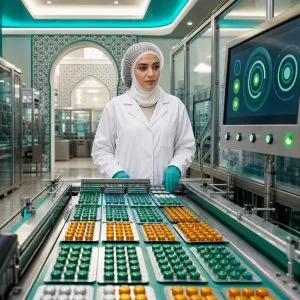
For Algerian manufacturers, this is perhaps the most immediately deployable application. Modern inspection systems use convolutional neural networks trained on thousands of images of acceptable and defective products. They can detect chipped tablets, color variations, printing errors on blister packs, and seal integrity issues on vials — all in real time.
Companies like Cognex, SICK, and Optel have deployed such systems globally. Cognex’s AI-powered vision systems learn the difference between subtle defects and acceptable variations, improving accuracy as they train on more images. SICK’s Inspector83X sensors have built-in AI that allows non-expert users to teach the system using examples. Optel, which acquired Vanguard Robotics in 2025 to combine vision inspection with collaborative robot automation, offers systems like CountSafe that verify pill counts and detect wrong colors or broken pieces. The investment for a single production line inspection station ranges from $150,000 to $500,000 depending on complexity — significant but amortizable over 3-5 years given the cost of batch recalls.
Saidal’s El Harrach 2-Zemirli facility, which handles solid dosage forms at a capacity of 70 million units per year, would be a natural pilot site. The production volumes justify the investment, and the facility’s relatively modern equipment could accommodate retrofit sensors without major line modifications.
Predictive Quality Analytics
Beyond catching defects after they occur, AI enables a shift toward predicting quality deviations before they happen. By analyzing process parameters — granulation moisture content, compression force, coating temperature, humidity levels — machine learning models can identify patterns that precede out-of-specification results.
This approach, known in the pharmaceutical context as Process Analytical Technology (PAT), aligns with frameworks promoted by both the FDA and EMA. The International Society for Pharmaceutical Engineering (ISPE) has established dedicated Communities of Practice for both PAT and Artificial Intelligence, recognizing their convergence as a foundation for Pharma 4.0. Algeria’s regulatory authorities have been moving toward harmonization with international standards, making PAT adoption a strategic move.
For a company like Biopharm, which manufactures complex products including antihypertensives under license from Boehringer Ingelheim, predictive analytics could monitor process parameters across production runs to flag potential deviations before they compromise a batch. The savings from avoiding even one failed batch of regulated products — which can cost $500,000 or more — would cover the analytics platform investment.
Batch Release Optimization
Batch release in pharmaceutical manufacturing is traditionally a document-heavy, time-consuming process. Quality assurance teams review batch production records, in-process control results, lab test outcomes, and environmental monitoring data before releasing a batch for distribution. This manual review can take days for complex products.
AI-powered batch review systems can automate the initial screening of batch records, flagging anomalies and potential deviations for human review while automatically clearing straightforward batches. Siemens (with its Opcenter platform), SAP (with S/4HANA for pharmaceutical manufacturing), and specialized vendors like Tulip and MasterControl have developed platforms specifically for this purpose.
For Algerian manufacturers managing dozens of products across multiple production lines, the efficiency gains are substantial. Batch release times could be cut from 5-7 days to 1-2 days for routine products, improving inventory turns and reducing working capital requirements.
GMP Compliance Monitoring
Good Manufacturing Practice (GMP) compliance is the foundation of pharmaceutical quality. Algeria’s Laboratoire National de Controle des Produits Pharmaceutiques (LNCPP), established in 1995 and recognized as a WHO reference laboratory, conducts quality control testing for pharmaceuticals and medical devices entering the Algerian market. Its functions are gradually being transitioned to the new Agence Nationale des Produits Pharmaceutiques (ANPP) under Health Law No. 18-11. Any manufacturer aspiring to export must also satisfy WHO, EU, or FDA GMP standards.
AI can support GMP compliance in several ways: continuous monitoring of environmental conditions across facilities, automated deviation tracking and trending, predictive identification of equipment requiring calibration or maintenance, and real-time documentation compliance checking.
One particularly valuable application is automated CAPA (Corrective and Preventive Action) analysis. AI systems can analyze deviation patterns across production lines and time periods, identifying root causes that might not be apparent to quality teams managing hundreds of individual deviation reports. McKinsey case studies show reductions of more than 65% in deviations and over 90% faster closure times when AI is applied to quality management workflows.
Supply Chain Traceability
Algeria has moved beyond exploration and into action on pharmaceutical traceability. In October 2025, the Ministry of Pharmaceutical Industry issued Ministerial Decree No. 25, making serialization mandatory for all imported human medicines — with GS1-compliant Data Matrix barcoding required. A national pilot program with Saidal Group is already underway, and full serialization and aggregation requirements become mandatory in January 2027. This puts Algeria ahead of many African peers in implementing a national track-and-trace system.
AI enhances traceability by enabling anomaly detection in supply chain data — identifying potential counterfeits, diversion, or cold chain breaches. For a country where counterfeit medicines remain a concern, particularly in border regions, AI-powered supply chain verification offers both a public health benefit and a competitive advantage for legitimate manufacturers.
Global Pharma AI Trends and Algerian Applicability
The global AI in drug manufacturing market is estimated at approximately $0.9 billion in 2025, projected to reach $1.2 billion in 2026 and $34.8 billion by 2040, growing at a CAGR of 27.2%. Quality control is expected to capture the largest share — approximately 36% of the market in 2026 — reflecting its central role in ensuring product integrity. Several global trends have direct relevance for Algerian manufacturers.
Digital Twins for Manufacturing Processes
Digital twin technology creates virtual replicas of physical manufacturing processes, enabling simulation and optimization without risking actual production. Roche is using NVIDIA Omniverse to build digital twins of its production facilities, simulating and optimizing complex systems before they go live. Novartis has deployed digital twins through its partnership with Lattice AI. Pfizer used digital twin models to accelerate vaccine production during the pandemic.
For Algerian companies, digital twins could be particularly valuable for process transfer — when a product moves from R&D to commercial scale, or when manufacturing is transferred between sites. Saidal, which operates eight facilities across the country producing different dosage forms, could use digital twins to ensure consistent quality across sites and to optimize the ramp-up of its three new production units in Ouled Djellal, Ouargla, and Tamanrasset.
Federated Learning for Multi-Site Quality
Federated learning allows AI models to be trained across multiple manufacturing sites without sharing raw data. This is relevant for companies like Saidal with dispersed facilities, or for potential industry-wide quality initiatives where competitors might collaborate on AI models without exposing proprietary process data.
Computer Vision for Cleanroom Monitoring
AI-powered video analytics in cleanrooms can monitor personnel behavior — gowning compliance, traffic patterns, restricted area access — complementing traditional environmental monitoring. This is an emerging application that could be particularly valuable for sterile manufacturing facilities like Biopharm’s Oued Smar plant, where contamination prevention is paramount.
Challenges for AI Adoption in Algerian Pharma
The path to AI-powered quality control in Algeria is not without obstacles. Several structural challenges must be addressed.
Data Infrastructure Gaps
AI systems are only as good as their data. Many Algerian pharmaceutical facilities still rely heavily on paper-based batch records and manual data entry. Before AI can be deployed, manufacturers need to digitize their quality data — a prerequisite investment that can itself cost millions and take 12-18 months.
The good news is that newer facilities, particularly Biopharm’s operations and El Kendi’s $100-million Sidi Abdallah plant, have been built with more modern infrastructure. These could serve as demonstration sites, proving the concept before legacy facilities undergo costly digitization.
Regulatory Acceptance
Algeria’s LNCPP (and its successor ANPP) has historically focused on traditional quality control methods — wet chemistry, HPLC, dissolution testing. The acceptance of AI-based quality decisions (for example, AI-powered batch release or real-time release testing) requires regulatory evolution.
The LNCPP holds WHO reference laboratory status and has participated in international harmonization programs. However, specific guidance on AI in pharmaceutical manufacturing has not yet been issued. Manufacturers who move early will need to engage proactively with regulators, potentially proposing pilot programs with parallel traditional testing to build confidence.
This mirrors the global regulatory landscape. The FDA published its discussion paper on “Artificial Intelligence in Drug Manufacturing” through the FRAME Initiative in 2023, and in January 2025 issued a more comprehensive draft guidance on AI to support regulatory decision-making for drug products. The EMA’s Process Analytical Technology guidance provides an additional framework. No major regulator has issued comprehensive AI-specific GMP guidance yet, meaning Algeria has an opportunity to develop a pragmatic regulatory framework that could serve as a model for African markets.
Talent and Skills Gap
Deploying and maintaining AI quality systems requires a blend of pharmaceutical process knowledge and data science skills that is rare globally and even rarer in Algeria. The country’s universities produce strong pharmacists and competent software engineers, but the intersection — pharmaceutical data scientists — is an almost nonexistent discipline locally.
Addressing this requires multiple approaches: partnerships with international technology vendors who can provide initial implementation and training, collaboration between pharmacy faculties and engineering schools to develop specialized curricula, and investment in upskilling existing quality professionals. Algeria’s university system, with its pharmacy faculties in Algiers, Constantine, and Oran, alongside polytechnic schools, has the academic infrastructure to develop cross-disciplinary programs if the demand signal is clear.
Equipment Compatibility and Integration
Many production lines in Algerian facilities use equipment from diverse manufacturers — European, Chinese, Indian — with varying levels of digital output capability. Integrating sensors and data collection systems across heterogeneous equipment environments is a practical engineering challenge.
Industry 4.0 protocols like OPC-UA can help bridge equipment communication gaps, but implementation requires technical expertise and vendor cooperation that may not always be readily available.
Investment and ROI Justification
AI quality systems require significant upfront investment. For Saidal, a state-owned enterprise with $337.9 million in annual revenue navigating public sector procurement rules, justifying these investments requires clear ROI documentation. For private companies like Biopharm and El Kendi, the calculus is more straightforward but still demands careful financial planning.
The strongest ROI arguments come from three sources: reduction in batch failures and recalls (each failed batch of injectables can cost $500,000+), faster batch release improving working capital, and — critically for export ambitions — meeting the quality standards required for WHO prequalification and entry into regulated markets.
Advertisement
A Practical Roadmap for Algerian Pharma
Given the challenges and opportunities, what should Algerian pharmaceutical manufacturers actually do? Here is a phased approach.
Phase 1: Foundation (0-12 months)
The immediate priority is data infrastructure. Manufacturers should begin digitizing batch records and quality data at their most modern facilities. Implementing a Manufacturing Execution System (MES) if one is not already in place provides the data backbone for future AI applications.
Simultaneously, companies should identify 2-3 high-impact pilot use cases. Visual inspection of solid dosage forms is the lowest-risk starting point — it is well-proven globally, has clear ROI, and does not require regulatory approval for the AI system itself (the AI augments, rather than replaces, existing quality decisions).
Phase 2: Pilot Deployment (12-24 months)
Deploy AI-powered visual inspection on one production line at a flagship facility. Run in parallel with traditional inspection for 6 months to build a validation dataset and demonstrate equivalence or superiority. Use the results to engage the ANPP and build regulatory confidence.
Begin collecting structured process data for predictive quality analytics. Even before deploying predictive models, the discipline of structured data collection reveals quality insights.
Phase 3: Scale and Sophisticate (24-36 months)
Expand proven AI applications across multiple production lines and facilities. Deploy predictive quality analytics, using 12+ months of digitized process data to train models that predict out-of-specification results before they occur. Begin exploring AI-assisted batch release for straightforward solid dosage products where the quality profile is well-characterized.
Develop internal data science capability, moving from vendor-dependent to self-sufficient. This means hiring or training 2-3 pharmaceutical data scientists per major facility — professionals who understand both GMP requirements and machine learning model validation.
Phase 4: Export Readiness (36+ months)
Use AI quality systems as a competitive differentiator in WHO prequalification applications and export market entry. A manufacturer that can demonstrate AI-powered quality assurance alongside traditional methods presents a compelling case to international regulators and procurement organizations.
At this stage, the investment in AI quality infrastructure pays dividends beyond cost savings. It becomes a market access enabler — the difference between qualifying for UNICEF and Global Fund procurement contracts worth hundreds of millions of dollars and being excluded from them.
The Export Imperative
Algeria’s pharmaceutical industry has long aspired to serve African markets beyond its borders. Africa imports more than 70% of its medicines and produces only about 3% of the world’s pharmaceutical output, creating a massive market opportunity for competitive manufacturers with WHO-prequalified products. Algeria currently exports only about $50 million in pharmaceutical products — a figure dramatically mismatched with its manufacturing capacity.
AI-powered quality control is not just about domestic efficiency — it is a prerequisite for credible entry into these markets. International procurement organizations like UNICEF, the Global Fund, and PEPFAR increasingly evaluate manufacturers’ quality systems sophistication as part of supplier qualification.
Algeria is already taking steps in this direction. The country hosted the African Ministerial Conference on Local Production and Health Technologies in November 2025 and is actively pursuing WHO Level 3 maturity certification. Algerian manufacturers that invest in AI quality infrastructure now will be better positioned to compete with established Indian and Bangladeshi generic manufacturers who are already deploying these technologies.
Regional Context: What Others Are Doing
Morocco’s pharmaceutical sector, Algeria’s closest regional competitor, has been more aggressive in digital transformation. Moroccan manufacturers like Sothema — which exports over $120 million in pharmaceuticals annually — and Cooper Pharma have invested in modern manufacturing systems, driven by their deeper integration with European supply chains and Morocco’s Digital Morocco 2030 strategy, under which over 85% of businesses indicate plans for AI investment within 3-5 years.
Egypt’s pharma sector, the largest in Africa by some measures, has seen digital investment at major manufacturers. Eva Pharma operates four state-of-the-art facilities approved by the EMA and other international agencies, producing over one million healthcare products daily, with mRNA research capabilities incorporating AI.
For Algeria, the competitive dynamic is clear: regional peers are moving, and standing still means falling behind. The advantage Algeria holds — larger production volumes, greater domestic market to amortize investments, government support for pharmaceutical self-sufficiency, and the largest concentration of pharmaceutical plants in Africa — must be leveraged before it is eroded.
The Role of Startups and Technology Partners
Algeria’s growing startup ecosystem could play a supporting role. While pharmaceutical AI is too complex for most early-stage startups, there are opportunities in adjacent areas: data management platforms tailored to Algerian regulatory requirements, IoT sensor integration services for factory floors, and compliance documentation tools with Arabic and French language support.
The Algerian Startup Fund (ASF), which has raised 58 billion Algerian dinars since 2022 to finance technology ventures across biotechnology and other sectors, and pharmaceutical industry associations should explore hackathons and innovation challenges focused on pharma quality — bringing together pharmaceutical engineers and software developers to prototype solutions for real industry problems.
International technology partnerships will be essential for the core AI deployments. Companies like Siemens (with its Opcenter platform), SAP (with S/4HANA for pharmaceutical manufacturing), and specialized vendors like Cognex and Optel have extensive pharmaceutical AI experience. Joint ventures or technology transfer agreements could accelerate adoption while building local capability — a model Saidal has already demonstrated through its existing partnerships with Pfizer and Winthrop for joint manufacturing.
Conclusion
Algeria’s pharmaceutical industry stands at an inflection point. The production capacity is there — 230 plants, $4 billion in market value, and over 82% domestic coverage. The export ambition is real, backed by WHO certification efforts and the hosting of continental pharmaceutical conferences. What is needed now is a quality infrastructure that matches the manufacturing ambition.
AI-powered quality control is not a futuristic concept — it is being deployed today in pharmaceutical facilities around the world, from Roche’s digital twin-equipped plants to Cognex-monitored production lines across Asia and Europe. The technology is mature, the ROI is documented (McKinsey projects 30-50% cost reductions in quality control operations), and the regulatory environment is evolving to accommodate it. For Algerian manufacturers like Saidal, Biopharm, and El Kendi, the question is not whether AI will transform pharmaceutical quality control, but whether they will lead that transformation in Africa or follow others who moved first.
The investment required is significant but manageable — a comprehensive AI quality system for a single facility costs less than a single failed export batch. The talent gap is real but addressable through university partnerships and international vendor collaborations. The regulatory pathway is unclear but navigable, and early movers can help shape it.
What cannot be manufactured later is the time lost by waiting. Every month of delay is a month when competitors in Morocco, Egypt, and South Asia are building the AI quality capabilities that will define who wins the next generation of African pharmaceutical procurement contracts. For Algeria’s pharma industry, the prescription is clear: start now, start small, and scale with purpose.
Frequently Asked Questions
What is AI-powered pharmaceutical quality control?
AI-powered pharmaceutical quality control uses machine learning, computer vision, and predictive analytics to automate and improve the detection of manufacturing defects, predict quality deviations before they occur, and accelerate batch release processes. Unlike manual inspection, AI systems can examine every single unit at production speed with accuracy rates exceeding 99.5%, catching subtle defects that human inspectors frequently miss.
Which Algerian pharmaceutical companies are best positioned for AI adoption?
Saidal Group, Biopharm, and El Kendi are the three most likely early adopters. Saidal’s El Harrach 2-Zemirli facility, with its high-volume solid dosage production (70 million units/year), is a natural pilot site for AI visual inspection. Biopharm’s modern 8,000-square-meter Oued Smar facility has newer infrastructure suited to digital integration. El Kendi’s $100-million Sidi Abdallah plant, purpose-built to international standards, could adopt AI quality systems with minimal retrofit.
How much does it cost to implement AI quality control in a pharmaceutical plant?
A single AI-powered visual inspection station for one production line costs between $150,000 and $500,000, depending on complexity. Broader implementations including predictive quality analytics and batch release automation can reach $1-3 million per facility. However, McKinsey data shows that AI can reduce quality control costs by 30-50%, and avoiding even one failed batch of injectables (which can cost $500,000+) often justifies the initial investment within 1-2 years.
Sources & Further Reading
- Gen AI: A Game Changer for Biopharma Operations — McKinsey & Company — Analysis of AI applications across biopharma operations including quality control productivity gains and cost reduction data.
- Industry 4.0, Innovation, and Pharmaceutical Quality Control — McKinsey & Company — Research on digitization, automation, and AI testing as the future of pharma quality control.
- Artificial Intelligence in Drug Manufacturing — FDA (FRAME Initiative) — FDA discussion paper on regulatory considerations for AI implementation in pharmaceutical manufacturing.
- Pharmaceuticals Sector: With 218 Plants, Algeria Reinforces Its Position as African Leader — Maghreb Pharma — Data on Algeria’s pharmaceutical manufacturing capacity and African market position.
- Pharmaceutical Products: Algeria Wants to Step Up Exports — Maghreb Pharma — Algeria’s pharmaceutical export ambitions and WHO certification timeline.
- Algeria Moves Forward on Pharmaceutical Traceability — SoftGroup — Details on Algeria’s serialization decree and GS1-compliant track-and-trace implementation.
- How AI and Machine Vision Improve Pharmaceutical Product Quality and Yield — Cognex — Technical overview of AI-powered vision systems for pharmaceutical inspection.
- The Transformative Power of AI in Pharmaceutical Manufacturing — ScienceDirect — Peer-reviewed analysis of AI applications enhancing efficiency, quality, and safety in pharma manufacturing.
- Pharmaceutical Industry: Algeria Holds Strategic Position in Africa (WHO) — AL24 News — WHO assessment of Algeria’s pharmaceutical sector position in the African context.
- AI in Drug Manufacturing Market — Roots Analysis — Market sizing and growth projections for AI in pharmaceutical manufacturing globally.