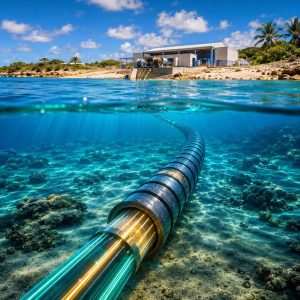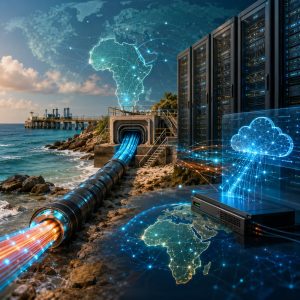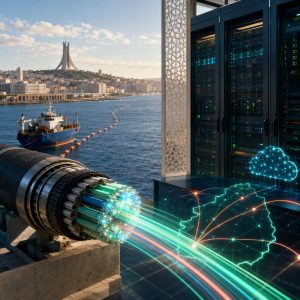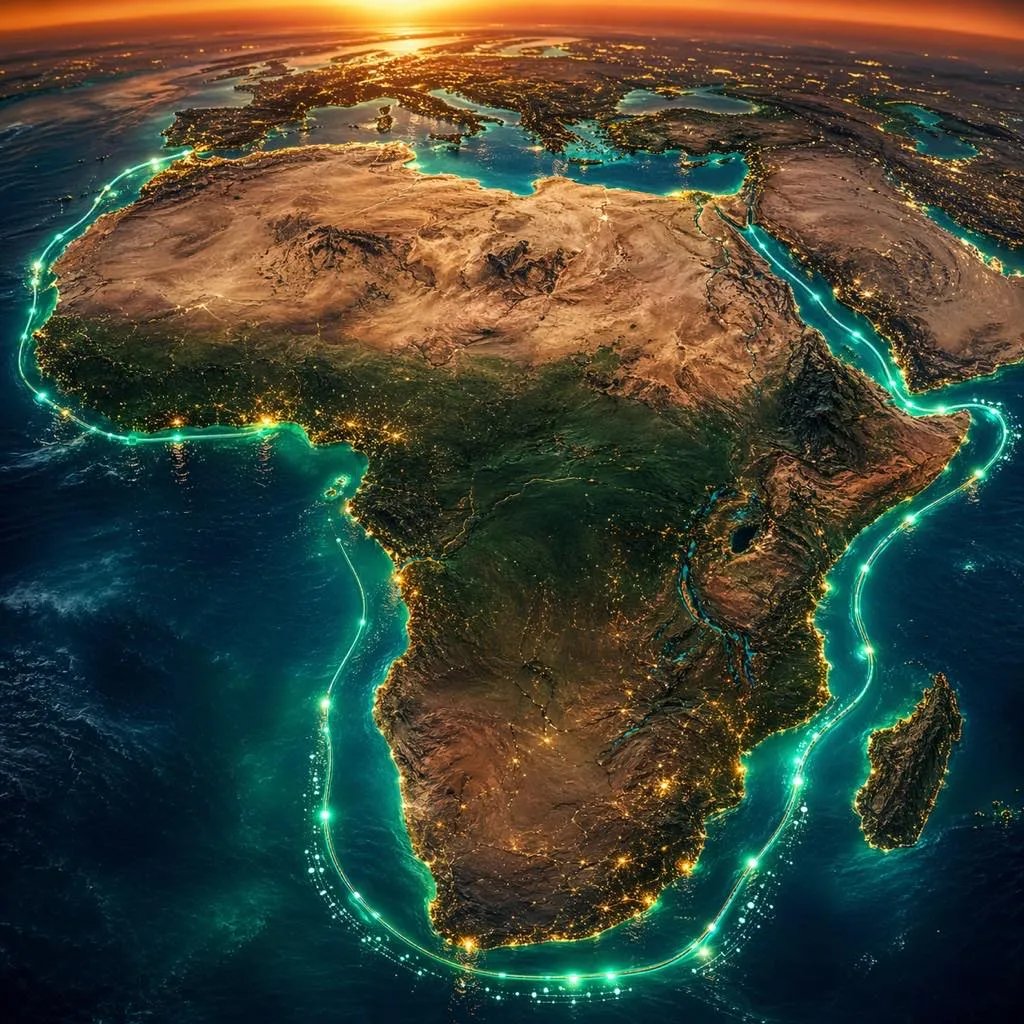
A Cable System That Rewrites the Map
The world’s longest subsea cable is live. Meta confirmed on November 17, 2025 that the core 2Africa system had been completed, after a six-year engineering program involving Meta, China Mobile International, MTN GlobalConnect, Orange, stc, Telecom Egypt, Vodafone, WIOCC, and Bayobab. The 2Africa Pearls extension — announced in 2021 with planned landings in Oman, the UAE, Qatar, Bahrain, Kuwait, Iraq, Pakistan, India, and Saudi Arabia — is scheduled to go live in 2026, bringing the full network to over 45,000 kilometers across 46 landing points in 33 countries.
That 45,000 km figure is longer than Earth’s circumference. For context, the full system connects approximately three billion people, running through Africa (encircling the continent), Europe (Italy, UK, Spain, France, Portugal, and more), and now Asia via the Pearls extension.
The Technical Specs That Matter
Raw capacity tells the story. According to Submarine Networks’ system analysis, the 2Africa trunk architecture is tuned differently by geography:
- Mediterranean segments: more than 30 Tbps per fiber pair, and with 16 fiber pairs, these segments deliver over 180 Tbps. That’s the densest region on the system because European interconnect and Middle Eastern traffic converge there.
- West segment (England to South Africa): 21 Tbps per fiber pair with 8 fiber pairs on the trunk — approximately 168 Tbps aggregate.
- Branching units: 2Africa uses switchable branching unit (SBU) technology, letting operators reroute capacity dynamically to any trunk fiber pair as traffic patterns shift.
What’s new technologically is not only the fiber count but the operational flexibility. SBUs let the system adapt as capacity demand grows or as a landing country’s usage pattern changes — without laying new cable.
Why Three Continents Needed This
The cable answers three problems that had been slowing AI-era internet growth:
Capacity. Cloud and AI traffic between Africa, Europe, and Asia had been constrained by older cable systems designed for 2010-era workloads. 2Africa’s 180 Tbps-class capacity in the Mediterranean absorbs multiple years of projected growth at current trajectories.
Resilience. Africa has experienced repeated outages when a single cable breaks — the 2024 Red Sea cable cuts and West African outages underscored the fragility. Adding a full ring around the continent with multiple landing points provides redundancy that the pre-2Africa map lacked.
Reach. Countries that were not primary landing points on prior systems now have direct access. The Pearls extension in particular gives South Asian hubs (Pakistan, India) and Gulf states a direct high-capacity link to Africa and Europe on a single operated system.
Advertisement
Landing Points Make Winners
Subsea cables matter for a country only when they land there — or when the domestic network connects efficiently to a nearby landing. 2Africa’s 46 landing points include key hubs across Africa: Egypt (Port Said, Ras Ghareb, Zafarana), South Africa (multiple landings), Kenya, Nigeria, Morocco (Casablanca), and several others. On the Mediterranean side, landings include Italy, France, Spain, Portugal, and the UK.
North African interconnect in particular gets a meaningful capacity uplift. Operators without a direct 2Africa landing can still benefit through cross-border connectivity via Morocco, Tunisia, or Italian landings, and through companion projects such as the Medusa Mediterranean cable and the Italy–Algeria link announced by Algérie Télécom and Sparkle in July 2025.
What 180 Tbps Unlocks for Cloud and AI
The practical implications for cloud and AI workloads are direct:
Data egress economics. Lower transmission cost per bit between Africa, Europe, and Asia makes multi-region cloud architectures more viable. Enterprises that had been constrained by expensive egress can now design cross-region replication and analytics pipelines that were previously cost-prohibitive.
Latency for AI inference. AI applications that serve users in Africa, the Middle East, or South Asia benefit from shorter, more predictable round-trips to European cloud regions. For real-time use cases — voice assistants, translation, agentic workflows — single-digit-millisecond improvements matter.
Edge and sovereign cloud viability. Edge locations and sovereign clouds only work if they can synchronize efficiently with upstream providers. 180 Tbps headroom in the Mediterranean is the plumbing that makes distributed, compliance-aware architectures plausible for a continent with 54 different regulatory regimes.
The Next Capacity Wave Is Already Planned
2Africa isn’t the end of the subsea build-out. Google’s Umoja cable (connecting Kenya to Australia), the Africa-1 cable (with a recent landing in Duba, Saudi Arabia), and multiple regional projects continue to add redundancy. The 2Africa system nonetheless sits as the central backbone — the one piece of infrastructure that hyperscalers, carriers, and regulators all orient around when planning 2026–2030 investments.
For enterprise technology leaders planning cross-border cloud architecture, the 2Africa Pearls activation is the signal to revisit network design assumptions that had been in place for a decade. The capacity ceiling has moved. The operational models should follow.
Frequently Asked Questions
What is 2Africa Pearls and when does it go live?
2Africa Pearls is the Gulf and South Asia extension of the 2Africa subsea cable system, with planned landings in Oman, the UAE, Qatar, Bahrain, Kuwait, Iraq, Pakistan, India, and Saudi Arabia. The core 2Africa system was declared complete in November 2025, and the Pearls extension is scheduled for activation in 2026. Once live, the full system spans more than 45,000 km across 46 landing points in 33 countries — the longest subsea cable ever built.
How much capacity does 2Africa actually deliver?
Capacity varies by segment. The Mediterranean trunk carries more than 30 Tbps per fiber pair with 16 fiber pairs, totaling over 180 Tbps in that region. The West segment (England to South Africa) runs 21 Tbps per fiber pair with 8 fiber pairs for approximately 168 Tbps aggregate. Switchable branching units let operators rebalance capacity across fibers as traffic patterns shift — a new level of operational flexibility compared to prior systems.
What does 2Africa change for AI and cloud workloads?
Three things. First, data egress economics improve for multi-region cloud architectures between Africa, Europe, and Asia. Second, AI inference latency drops for users accessing European-hosted models from Africa, the Middle East, and South Asia. Third, sovereign-cloud and edge architectures become more practical because the plumbing supports them at scale. For enterprises running distributed AI workloads, these aren’t incremental improvements — they lower the cost floor for architectures that were previously uneconomical.
Sources & Further Reading
- Announcing the Completion of the Core 2Africa System — Engineering at Meta
- 2Africa Cable Official Site — 2Africa Cable
- 2Africa System Overview — Submarine Networks
- World’s Longest Subsea Cable Completed — Capacity Media
- Meta Completes 2Africa Subsea Cable System Connecting 3 Billion People — Ecofin Agency
- 2Africa Completes a Six-Year Engineering Mission — Subsea Cables
- Mobily Lands Africa-1 Subsea Cable in Duba — Data Center Dynamics