Europe Gets Its First $14.6B AI Infrastructure Hyperscaler
London-based AI cloud infrastructure company Nscale closed a $2 billion Series C in March 2026 at a $14.6 billion valuation — by Nscale’s own claim, the largest funding round ever raised by a European startup. The round was led by Aker ASA and 8090 Industries, with participation from Astra Capital Management, Citadel, Dell, Jane Street, Lenovo, Nokia, NVIDIA, and Point72. Goldman Sachs and J.P. Morgan acted as joint placement agents.
The size of the round is significant, but the company profile is the story. Nscale is not a consumer AI product, not a model lab, and not an enterprise SaaS tool. It is pure AI infrastructure — GPU data centers built at frontier scale, sold as capacity to the hyperscalers, AI labs, and governments that cannot deploy their own.
The Deal Sheet
Key facts as announced:
- Round size: $2 billion Series C
- Valuation: $14.6 billion (post-money)
- Lead investors: Aker ASA, 8090 Industries
- Notable participants: NVIDIA, Dell, Lenovo, Nokia, Citadel, Jane Street, Point72, Astra Capital, Linden Advisors
- Board additions: Sheryl Sandberg (former Meta COO), Susan Decker (former Yahoo president), Nick Clegg (former UK deputy prime minister, ex-Meta)
- Placement agents: Goldman Sachs, J.P. Morgan
The previous round — a Series B of $1.1 billion — was itself the largest Series B in European history. The compounding pattern is deliberate: Nscale has raised ever-larger rounds to fund ever-larger data center commitments.
The Business: Infrastructure as a Service for Frontier AI
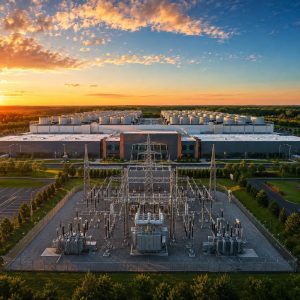
Nscale’s product is capacity. The company operates GPU-dense AI data centers across Europe and is extending into North America and Asia. The flagship project is Stargate Norway, a joint venture with Aker and OpenAI announced in July 2025 and sited in Kvandal near Narvik, Northern Norway. The facility is designed to deploy 100,000 NVIDIA GPUs by the end of 2026 on 230 MW of renewable hydro capacity, with expansion headroom to add another 290 MW.
The logic of Narvik is specific. The region has abundant hydropower, low local electricity demand, and limited transmission capacity — which means power prices well below the European average and a realistic path to net-zero AI compute. For hyperscalers worried about the carbon footprint of AI inference at scale, a Norwegian hydro-powered site is unusually valuable.
Advertisement
Why the Round Happened Now
Three market conditions explain the timing and size:
- European AI compute gap. Europe imports most of its frontier AI compute from US hyperscalers. Sovereign concerns and data-residency regulation have created demand for European-domiciled infrastructure that Nscale is directly positioned to serve.
- NVIDIA’s alignment strategy. NVIDIA is taking equity stakes in the large GPU buyers that anchor its long-term demand — Thinking Machines, Nscale, and others. An equity position aligns NVIDIA’s incentives with the buyer’s success and helps de-risk the massive capacity commitments these companies make.
- Hyperscaler offtake demand. Microsoft recently expanded its agreement with Nscale to take over 230 MW of Narvik capacity originally earmarked for OpenAI’s Stargate rollout, with a commitment to bring over 30,000 NVIDIA Rubin GPUs online at that campus. OpenAI shifted its compute acquisition to flow through Microsoft’s existing Azure contract. The hyperscaler customer base is both growing and reshuffling, which favors neutral infrastructure providers like Nscale.
The Stargate Rework and What It Reveals
The most interesting sub-plot in Nscale’s year is the reworking of Stargate Norway. Originally structured as a joint OpenAI-Aker-Nscale gigafactory, the compute is now flowing to Microsoft instead, with OpenAI accessing it through its existing Azure relationship rather than directly. Separately, OpenAI paused Stargate UK plans in April 2025 over regulatory and energy pricing concerns, and Nscale announced plans with Microsoft to build the UK’s largest AI supercomputer at its Loughton AI Campus.
Two implications:
- Neutral infrastructure wins. Nscale does not need to be the end customer’s preferred lab — it needs to be the preferred capacity owner for whoever ends up buying. The Stargate Norway rework shows the model working: OpenAI pulled back, Microsoft stepped in, Nscale kept the campus.
- Hyperscaler relationships matter more than model relationships. Microsoft is becoming a dominant buyer of European AI capacity, and providers like Nscale that can integrate tightly with Azure and Microsoft’s compute planning will capture disproportionate share.
What the $14.6B Valuation Is Priced Against
A $14.6 billion valuation implies expectations of durable cash flows at scale. Comparable AI infrastructure peers trade on contracted capacity, the quality of long-term offtake agreements, and access to low-cost power. Nscale’s Norway and Loughton buildout, plus its Series C investor roster, signals to the market that the company is positioning as a European AI-infrastructure hyperscaler on par with CoreWeave, Crusoe, and the regional subsidiaries of US cloud providers.
For emerging markets, including Algeria and the broader MENA region, Nscale’s ascent is a useful reference. It confirms that AI infrastructure is a winnable category for non-US players with access to cheap, clean power. Singapore and the UAE have both invested heavily in this direction. Algeria’s gas-powered generation base and stable electricity pricing could, in principle, support a similar thesis — though Algerian data center capacity remains in the tens-of-MW range today, one to two orders of magnitude below Narvik.
Frequently Asked Questions
How does Nscale differ from CoreWeave or Crusoe?
All three are AI-infrastructure pure-plays selling GPU capacity to hyperscalers and AI labs, but Nscale is the European market’s flagship whereas CoreWeave and Crusoe are primarily US-based. Nscale’s differentiation is its access to low-cost Norwegian hydropower (via the Stargate Norway facility) and its UK presence, both of which position it to serve European customers constrained by data-residency rules and carbon footprint targets.
What does Microsoft’s takeover of Stargate Norway capacity signal for OpenAI?
OpenAI is not losing compute — it is accessing the Narvik capacity through its existing $250 billion Azure contract rather than directly. Practically, this means Microsoft becomes the intermediary for OpenAI’s European compute, concentrating the hyperscaler’s influence over which AI labs can operate at scale in Europe. It also removes the financial risk of a direct OpenAI lease on a 230 MW facility during a period of OpenAI cost pressure.
Could an Algerian or MENA startup realistically build an Nscale-equivalent?
Not at Nscale’s scale today. The preconditions — several hundred megawatts of committed power, a hyperscaler offtake partner, billions in equity financing, and GPU-cluster engineering talent — are not currently accessible in any North African market. A realistic MENA strategy is a smaller, inference-focused facility (10–50 MW) serving regional customers, not a frontier-training hyperscaler clone.
Sources & Further Reading
- Nscale Raises $2 Billion in Series C — the Largest in European History — Nscale
- Nvidia backs AI data center startup Nscale as it hits $14.6 billion valuation — CNBC
- Nscale raises US$2 billion Series C at US$14.6 billion valuation — W.Media
- Nscale Raises $2 Billion, Valuation Soars to $14.6 Billion — Trending Topics
- Microsoft contracts 30,000 GPUs from Nscale at Norway data center — DatacenterDynamics