Why Human Inspection Has Reached Its Limit
Manufacturing quality control has been a human-intensive function since the beginning of industrial production. Quality inspectors visually examine products at line speed, rely on trained pattern recognition, and flag anomalies for rework or rejection. The system works — until it doesn’t. Human inspectors miss 20–30% of defects in production environments due to fatigue, lighting variation, and the fundamental limitation that the human visual system cannot sustain peak alertness across an eight-hour shift at high sampling rates.
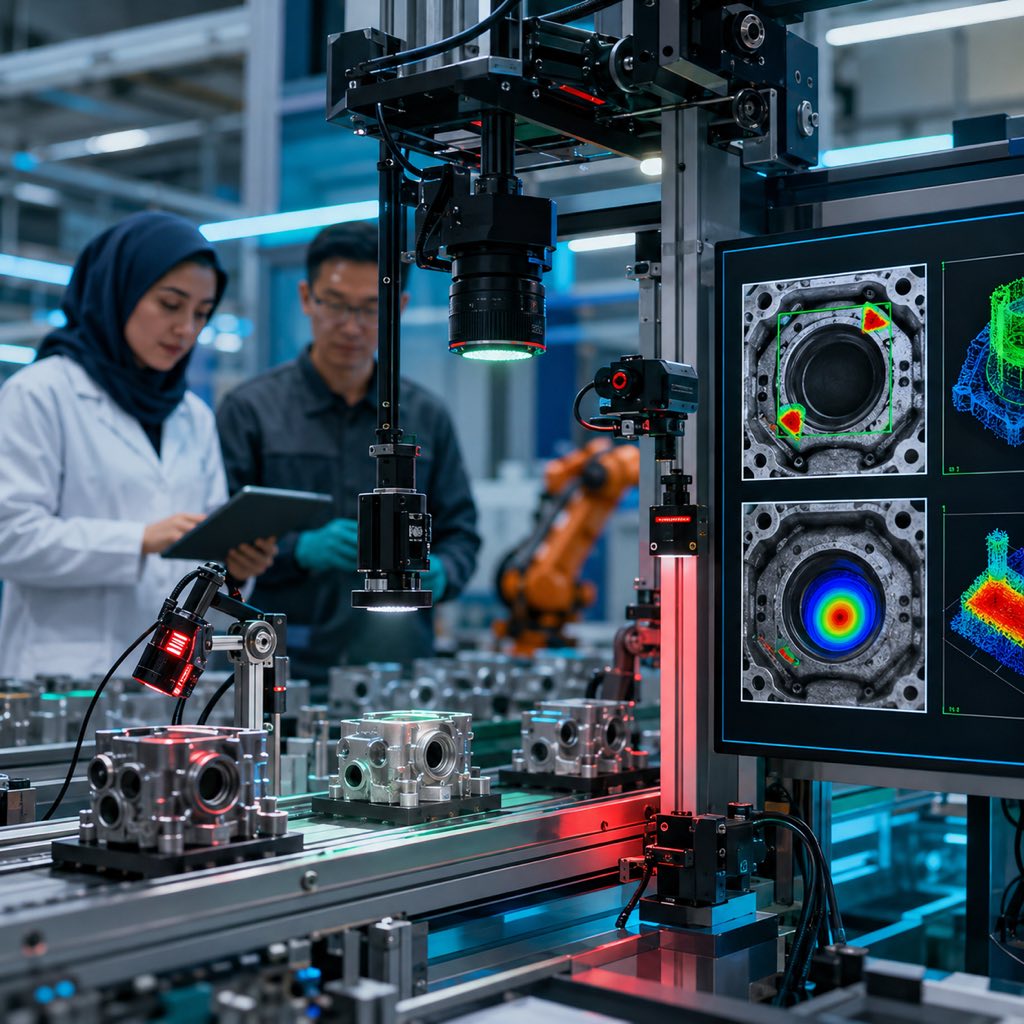
For the past decade, machine vision systems have addressed the fatigue problem with cameras and image processing software. But single-modality vision — a camera that looks at a product and checks it against a reference image — has its own limitations. A camera cannot detect an internal material flaw that looks perfect on the surface. A thermal sensor can detect a component running too hot, but cannot determine whether that heat signature indicates electrical failure or normal break-in variance. Neither tells you whether the production conditions that produced this batch — temperature, pressure, machine vibration, raw material lot — are drifting in ways that predict future defects before they appear.
Multimodal AI changes this by correlating defect patterns across multiple data streams simultaneously. As analyzed in recent manufacturing AI research, multimodal quality intelligence combines image data from cameras with sensor readings for temperature, pressure, torque, and vibration, cross-referenced with machine parameters, production logs, and historical inspection results. The result is a system that can identify hidden relationships across machines and production stages that no single-modality sensor can capture.
What the Numbers Say About Commercial Deployments
The performance data from production deployments of AI quality control systems is now detailed enough to make informed investment decisions. Before 2022, most published case studies came from tier-one automotive and aerospace manufacturers — large facilities with eight-figure capex budgets and dedicated quality engineering teams. The 2025–2026 data set is different: it includes mid-market manufacturers in food processing, electronics assembly, and pharmaceutical packaging, operating at scales that Algerian and similar-economy manufacturers can benchmark directly. According to industry data compiled from manufacturing case studies, the picture is consistent across sectors:
Defect detection accuracy in production deployments reaches 95–99%+ — compared to the 70–80% baseline for trained human inspectors. This is not a marginal improvement; it is a structural shift in quality confidence that has downstream implications for warranty reserves, customer satisfaction, and regulatory compliance.
BMW’s documented results show 30–40% reductions in defect rates within 12 months of AI vision system deployment, with $2 million or more in annual savings per facility and 15% improvement in customer satisfaction scores. Automotive components suppliers report 37% fewer defects reaching final assembly and 22% improvement in Overall Equipment Effectiveness (OEE).
Labor cost economics are compelling on their own: eliminating 2–3 full-time inspection positions per line generates $100,000–$150,000 in direct savings annually, with overtime reduction adding $20,000–$40,000 and supervisory overhead reduction contributing another $15,000–$25,000. Industry data aggregates this to $691,200 in annual labor savings per production line when all quality-related labor costs are included.
Payback periods average 7–8 months across manufacturing sectors, with consumer goods achieving payback in 6–12 months, automotive in 8–14 months, electronics in 6–10 months, and pharmaceuticals in 12–18 months. Entry-level systems start at $8,000–$20,000, mid-range at $20,000–$60,000, and enterprise-grade deployments at $100,000 or more — all well within the payback range given the labor savings.
System capability has also advanced dramatically. Modern AI quality systems train with as few as 5–20 images per defect type, complete initial training in under an hour, and retrain for new product lines in hours rather than weeks. Sub-100-millisecond inference times mean the system operates at full line speed without creating a bottleneck.
Advertisement
What Manufacturing Leaders Should Do
The performance data is now mature enough that the question for manufacturing leaders is not whether to deploy AI quality control but how to sequence the deployment to maximize return and minimize organizational friction.
1. Start With Your Highest-Cost Defect Category, Not Your Highest Volume Line
The instinct is to deploy AI quality control on the highest-volume production line to maximize coverage. The higher-ROI approach is to start with the product line where defects are most expensive — either because they are hard to detect at the production stage (requiring expensive rework or recall later) or because they generate significant warranty claims. For a pharmaceutical manufacturer, a single missed contamination event can trigger a recall costing tens of millions of dollars; for an automotive components supplier, defects reaching final assembly trigger warranty claims and customer satisfaction penalties. The payback calculation is more compelling — and the business case easier to fund — when the baseline cost of quality failure is high. Once the first deployment generates documented ROI, expanding to additional lines is straightforward.
2. Design for Multimodal Data Capture From Day One, Even If You Start Single-Modality
Many manufacturers begin AI quality deployments with a single camera system and plan to add sensors later. This creates a technical debt problem: sensor fusion architectures require that data streams be synchronized, calibrated, and labeled together from the beginning. Adding a thermal sensor to a camera system that was not designed for multimodal correlation requires re-labeling historical data and retraining the model — expensive and time-consuming. The better approach is to identify all the data streams that could be relevant — camera, thermal, vibration, process logs — instrument the line for all of them at system design time, and then train the initial model on camera data alone. The additional sensor data can be incorporated into model training in subsequent iterations without rebuilding the data infrastructure.
3. Build Defect-Pattern Libraries Before Replacing Human Inspectors
The most common AI quality deployment failure is replacing human inspectors before the AI model has been validated on the full range of defect types. Human inspectors, in the process of being replaced, are the primary source of labeled training data — they are the ones who can identify whether an anomaly is a true defect or an acceptable variation. A structured knowledge transfer process — three to six months of parallel operation during which human inspectors label defects that the AI system flags — produces a richer training dataset and catches edge cases that the initial model misclassifies. Manufacturers who skip this parallel operation phase deploy models that perform well on common defect types and fail on rare ones — precisely the ones where human expertise is hardest to replace.
The Bigger Picture
The convergence of sub-$20,000 entry-level systems, 5-to-20-image training requirements, and sub-100-millisecond inference means that AI quality control is no longer a technology reserved for tier-one automotive and aerospace manufacturers. Analysis of manufacturing AI adoption in 2026 shows deployment accelerating across food and beverage, pharmaceutical, electronics, and consumer goods sectors — industries where margins are tight enough that the labor savings alone justify the investment.
The more significant long-term implication is competitive. Manufacturing facilities with AI quality control can offer guaranteed defect rates that manual-inspection facilities cannot match. In global supply chains where buyers specify quality standards in contracts and audit them through third-party inspection, the ability to provide AI-verified quality metrics at line speed is becoming a supplier qualification criterion. Manufacturers who have not deployed AI quality systems by 2027–2028 will increasingly find themselves competing on price alone — against facilities that can offer both lower cost and higher quality assurance.
The broader quality economics data reinforces the urgency. For a manufacturer running $10 million in annual operations, defects reaching customers cause approximately 20% of total revenue loss through warranty claims, recalls, and rework — roughly $2 million annually lost to quality failures alone. According to the Rock and River manufacturing analysis, the payback calculation is straightforward: an entry-level AI quality system at $15,000 eliminates $135,000–$215,000 in annual labor costs per line and reduces defect-related revenue loss by 30–40%. Even at the conservative end, the economics produce a payback period well under 12 months and cumulative three-year returns that far exceed the system cost. The risk of not acting is not merely operational — it is financial. Every month of delayed deployment is a month of preventable quality costs running at full rate while competitors who have deployed are compounding their quality advantage.
Frequently Asked Questions
How many images does an AI quality control system need to learn to detect a new defect type?
Modern AI quality control systems can be trained to detect a new defect type with as few as 5–20 labeled images, with initial training completing in under an hour. This is a dramatic improvement over earlier deep learning approaches that required thousands of examples and days of training time. For manufacturers introducing new product variants or encountering new defect types from material supplier changes, this means the system can be retrained and re-deployed in hours rather than requiring production to wait days for a model update. The practical implication is that AI quality control systems can now keep pace with the product iteration speed of fast-moving consumer goods and electronics manufacturers.
What happens to human quality inspectors when AI systems are deployed?
The manufacturing industry pattern from documented deployments is redeployment rather than immediate elimination. Human inspectors in the parallel operation phase — typically three to six months — become the primary source of training data, labeling defects and edge cases that the AI model encounters. After successful deployment, the remaining human oversight role shifts to monitoring AI system performance, reviewing edge cases flagged for human judgment, maintaining the defect-pattern library, and managing the training data pipeline for new product lines. Some manufacturers have converted inspection roles to quality data analyst roles; others have reduced headcount through natural attrition rather than layoffs. The operational strategy varies by manufacturer, but the technical reality is that the supervisory and exception-handling role for AI quality systems is a new category of skilled work.
Can AI quality control systems work for small-batch or custom manufacturing?
Yes, with some caveats. The economic case is strongest for high-volume, repetitive production where defect rates and labor costs are large enough to generate compelling ROI within 12 months. For small-batch or custom manufacturing — artisanal food production, custom metal fabrication, bespoke electronics assembly — the training data challenge is harder, because each product variant requires its own defect-pattern library, and the number of items produced per variant may be too small to build a statistically robust dataset. However, modular AI quality platforms designed for flexible manufacturing are emerging that share defect pattern libraries across product families, reducing the per-variant training requirement. For Algerian manufacturers in sectors like artisanal food export or craft ceramics, the appropriate tool is a flexible vision platform rather than a fixed-line industrial system.
Sources & Further Reading
- AI for Manufacturing Quality Control — Azilen Technologies
- AI-Driven Quality Control: How Machine Vision Systems Cut Defects by 37% — Rock and River
- Multimodal AI in Manufacturing Quality Control — BlueBash
- AI Vision Inspection for Quality Control in Manufacturing — iFactory
- Computer Vision Applications in Manufacturing 2026 — AI Innovate
🔗 Related Intelligence

Multi-Agent AI in Production: Enterprise Patterns, Trust Gaps, and Deployment Realities

The AI Compliance Gap: 78% of Companies Unprepared for Regulations They Already Face

The Multi-Agent Trust Gap: Why Most Enterprise AI Pilots Never Reach Production

Smart Manufacturing Hits 47% Adoption: AI Cobots and Digital Twins Go Mainstream