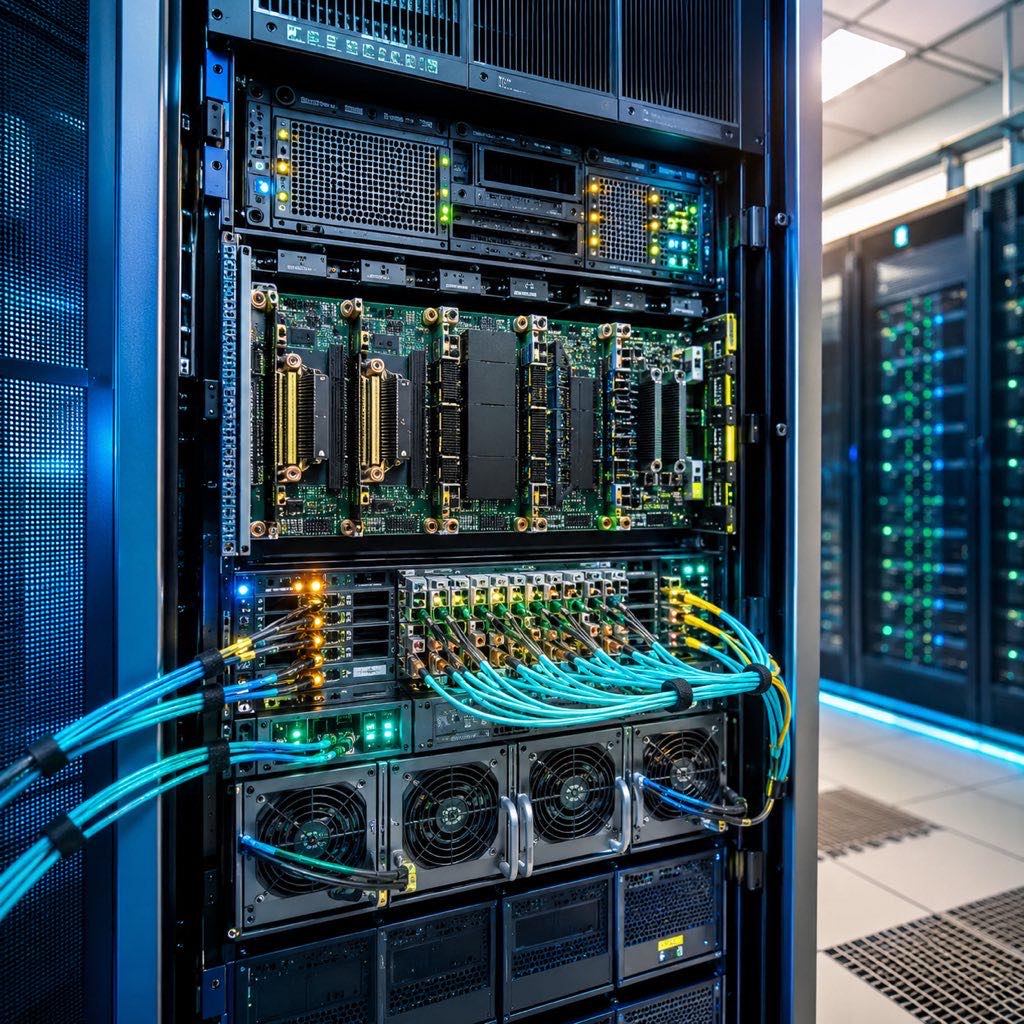
The GPU Blind Spot That IPUs Are Solving
The AI infrastructure conversation of 2023 and 2024 was almost entirely about GPUs: who had the most H100s, how fast the next Blackwell could be procured, what the price per GPU-hour was dropping to. That framing was not wrong — GPU compute was the dominant constraint for AI training. But it created a blind spot: as AI workloads shift from training toward inference, orchestration, and service operations, the bottleneck moves down the stack.
An AI inference rack running 8 GPUs at full utilization consumes enormous amounts of CPU capacity for networking — managing ingress/egress traffic, enforcing storage policies, handling encryption, coordinating tenant isolation. These are not AI compute tasks; they are infrastructure plumbing. On a standard server, the host CPU handles all of it. At scale, this means 20 to 30% of CPU capacity on a hyperscaler AI rack can be consumed by infrastructure overhead that has nothing to do with running model inference — CPU cycles spent shuffling packets rather than processing tensors.
Intel’s Infrastructure Processing Units are custom ASIC chips designed to absorb that infrastructure overhead. The IPU sits between the CPU and the network fabric, handling networking control, storage management, and security enforcement independently of the host CPU. The result: the CPU gets those 20 to 30% cycles back for application workloads, and the infrastructure functions run with more predictable performance because they are no longer competing with application code for CPU time.
This is the same architectural logic that DPUs (Data Processing Units) from NVIDIA (BlueField) and Marvell (LiquidIO) pursue. Intel’s differentiation is the depth of its Xeon integration and its long-standing relationship with Google Cloud. The April 9, 2026 announcement describes a multiyear collaboration that reinforces the role of “CPUs and custom IPUs in scaling modern, heterogeneous AI systems.”
Why the Timing Matters for Cloud Architecture Decisions
The shift from training-focused to inference-focused AI workloads is well underway. Training a foundation model happens once (or infrequently). Serving that model at production scale happens millions of times per day. Inference is latency-sensitive, throughput-demanding, and highly parallelized — it stresses the networking and memory subsystems of a server far more than training does. The infrastructure processing burden that IPUs address scales linearly with inference throughput.
The Register’s analysis of the Google-Intel deal notes that Google is tapping Intel “for another round of custom network chips,” emphasizing the custom-silicon dimension: these are not off-the-shelf components but jointly developed ASICs designed around Google Cloud’s specific workload profiles. That level of customization produces better performance per watt for Google’s exact traffic patterns — but it also means the architecture is deeply integrated into Google Cloud’s infrastructure in ways that other cloud providers will need to replicate with their own silicon partnerships.
Microsoft Azure uses FPGA-based SmartNICs (the Catapult/Azure Boost program). AWS has Nitro — a purpose-built infrastructure offload system that has been powering EC2 since 2017 and represents perhaps the most mature implementation of the concept. Google’s IPU program with Intel is in some ways catching up to Nitro’s architectural philosophy while using a different silicon partner. The competitive dynamic accelerates innovation: each hyperscaler is now investing in custom silicon for infrastructure offload, which means the per-unit cost of IPU-class chips will fall as production volumes scale.
Advertisement
What Enterprise Architects and Cloud Buyers Should Do About It
1. Prioritize IPU-Backed Instance Types for Latency-Sensitive Inference Workloads
Google Cloud’s C4 and N4 instance families run on Intel Xeon 6 with IPU offload. For enterprises deploying AI inference endpoints — model serving, embedding generation, retrieval-augmented generation pipelines — these instances provide more consistent, lower-variance latency than equivalent CPU-compute instances without IPU offload, because the host CPU is not competing with network processing for the same execution resources.
The practical test is a percentile latency comparison, not average latency. IPU offload typically reduces P99 latency (the worst 1% of response times) more than it reduces P50 (median) latency, because the worst-case latency spikes on non-IPU instances come from CPU scheduling collisions between application code and infrastructure processing. For applications where tail latency matters — customer-facing AI products, real-time recommendation systems, trading infrastructure — the P99 improvement is the metric that justifies the instance type premium.
2. Understand the AWS Nitro Equivalence When Comparing Cross-Cloud Architectures
AWS Nitro has provided infrastructure offload since 2017 across all modern EC2 instance types. When comparing Google Cloud IPU-backed instances against AWS equivalents, engineers should compare against Nitro-equipped instance families — not against older EC2 generation instances that predate Nitro. The architecture is now converging: all three major hyperscalers use some form of infrastructure offload silicon, which means the comparison point for enterprise workloads is the quality of the implementation, not the presence or absence of offload.
The Intel-Google announcement framed by Tom’s Hardware notes the multiyear deal also covers Intel’s Xeon roadmap alignment with Google’s compute requirements — which means the performance gap between Xeon-equipped Google Cloud instances and competing instance types is likely to narrow as Xeon 6 production matures and the next Xeon generation enters production planning for 2027-2028.
3. Evaluate On-Premise Infrastructure Refresh Decisions Through the IPU Lens
For enterprises with significant on-premise infrastructure — financial institutions, telecoms, energy companies — the Intel-Google IPU deal is a signal that the next server refresh cycle should evaluate IPU-capable configurations rather than defaulting to standard dual-socket Xeon servers. Intel’s SmartEdge Agile Platform and Ethernet 800 Series adapters bring IPU-class network offload to on-premise deployments without requiring a cloud migration. The same CPU cycle liberation that Google Cloud achieves on its inference racks is available to enterprises running private AI inference infrastructure.
The business case for on-premise IPU adoption in 2026 is strongest for organizations running high-throughput inference or database workloads on Linux servers where network processing saturation has been identified as a bottleneck. A capacity expansion decision that is already contemplating new server hardware should include the IPU-enabled NIC as a line item, because the compute-per-dollar improvement from offloading 20-30% of CPU cycles is equivalent to adding roughly 25% more cores for application workloads without adding CPUs.
The Antitrust Question
The Intel-Google collaboration raises a structural question that enterprise architects should keep in mind. Custom silicon partnerships between hyperscalers and chip vendors create infrastructure that is, by design, optimized for one cloud provider’s exact workload profile. Google Cloud instances running custom Intel IPUs will perform better on Google Cloud than the same Intel Xeon CPUs running generic firmware elsewhere. This is good for Google Cloud performance but it increases the switching cost for enterprises that optimize their architecture around Google Cloud-specific infrastructure behavior.
Google SVP Amin Vahdat’s comment — “Intel has been a trusted partner for nearly two decades, and their Xeon roadmap gives us confidence in meeting growing performance demands” — describes a relationship that, for an enterprise, translates into infrastructure optimization on one side of a cloud vendor relationship. AWS’s Nitro, Microsoft’s FPGA program, and Google’s Intel IPU partnership are all creating differentiated infrastructure moats. Enterprise cloud architects who understand these moats can make more informed decisions about workload placement — and more importantly, about when the performance advantage of a specific hyperscaler’s silicon justifies the portability cost of building deeply around that infrastructure.
Frequently Asked Questions
How should Algerian enterprises evaluate whether to build on-premise infrastructure or leverage cloud services?
The build-vs-buy decision in infrastructure should be driven by data sovereignty requirements, workload characteristics, and total cost of ownership over a 5-year horizon. For most Algerian enterprises, a hybrid approach — retaining sensitive data on-premise while using cloud for scalable, non-sensitive workloads — offers the best balance. The frameworks described provide evaluation criteria that apply to the Algerian context with minimal adaptation.
What is the realistic timeline for Algeria to close the infrastructure gap with regional peers like Morocco and Singapore?
Current investment trajectory suggests a 5-7 year timeline for Algeria to reach comparable enterprise cloud service availability, assuming continued investment in submarine cable connectivity, domestic data center capacity, and cloud provider market entry. The timeline could compress to 3-4 years with accelerated public-private investment in digital infrastructure as part of the national digital transformation strategy.
Which infrastructure technologies described here can be adopted immediately by Algerian organizations versus which require long lead times?
Software-defined networking, containerization, and cloud-native application architectures can be adopted immediately with existing talent and current cloud service availability. Hyperscale data center build-out, advanced edge computing networks, and submarine cable infrastructure require multi-year planning and significant capital investment. Algerian organizations should focus adoption efforts on the software and tooling layers where they can move quickly.
Sources & Further Reading
- Intel and Google Deepen Collaboration to Advance AI Infrastructure — Intel Newsroom
- Intel and Google Announce Multi-Year Chip Deal — Tom’s Hardware
- Google Taps Intel for Another Round of Custom Network Chips — The Register
- Intel Infrastructure Processing Unit — Intel Product Page
- Introducing C3 Machines with Google’s Custom Intel IPU — Google Cloud Blog
- AWS Nitro System — Amazon Web Services
🔗 Related Intelligence

Computex 2026 Reset: Disaggregated Inference Brings the CPU Back to the AI Stack

Arm’s AGI CPU: Breaking the x86 Monopoly in AI Data Centers

The AI Infrastructure War: Chips, GPUs, and the Race for Computing Power

Inference Is the New Training: How AI Is Forcing a Cloud Infrastructure Redesign