A $350 Million Bet on Speed
Hermeus, a Los Angeles-based defense startup, closed a $350 million Series C round on April 7, 2026, pushing its valuation to $1 billion and earning unicorn status. The round was led by Khosla Ventures, with participation from Founders Fund, Canaan Partners, RTX Ventures, and In-Q-Tel, the CIA’s venture arm. New investors including Cox Enterprises, Destiny Tech100, and Georgia Tech Foundation also joined.
The capital is structured as $200 million in equity and $150 million in debt, bringing the company’s total raised to $500 million since its founding in 2018. Hermeus plans to use the funds to transition from rapid prototyping to mission-ready aircraft development, scale manufacturing capacity, and integrate customer payloads onto its platforms.
The timing is not accidental. Just weeks before the raise closed, Hermeus flew its Quarterhorse Mk 2.1 supersonic demonstrator at Spaceport America in New Mexico on March 2, 2026, its second successful first flight in under nine months.
From Rocket Engineers to Aircraft Builders
Hermeus was founded in 2018 by AJ Piplica (CEO), Glenn Case (CTO), Mike Smayda, and Skyler Shuford. The founding team previously worked together at Generation Orbit, an aerospace company focused on air-launch systems. Case spent four and a half years as a propulsion design and development engineer at Blue Origin before co-founding Hermeus.
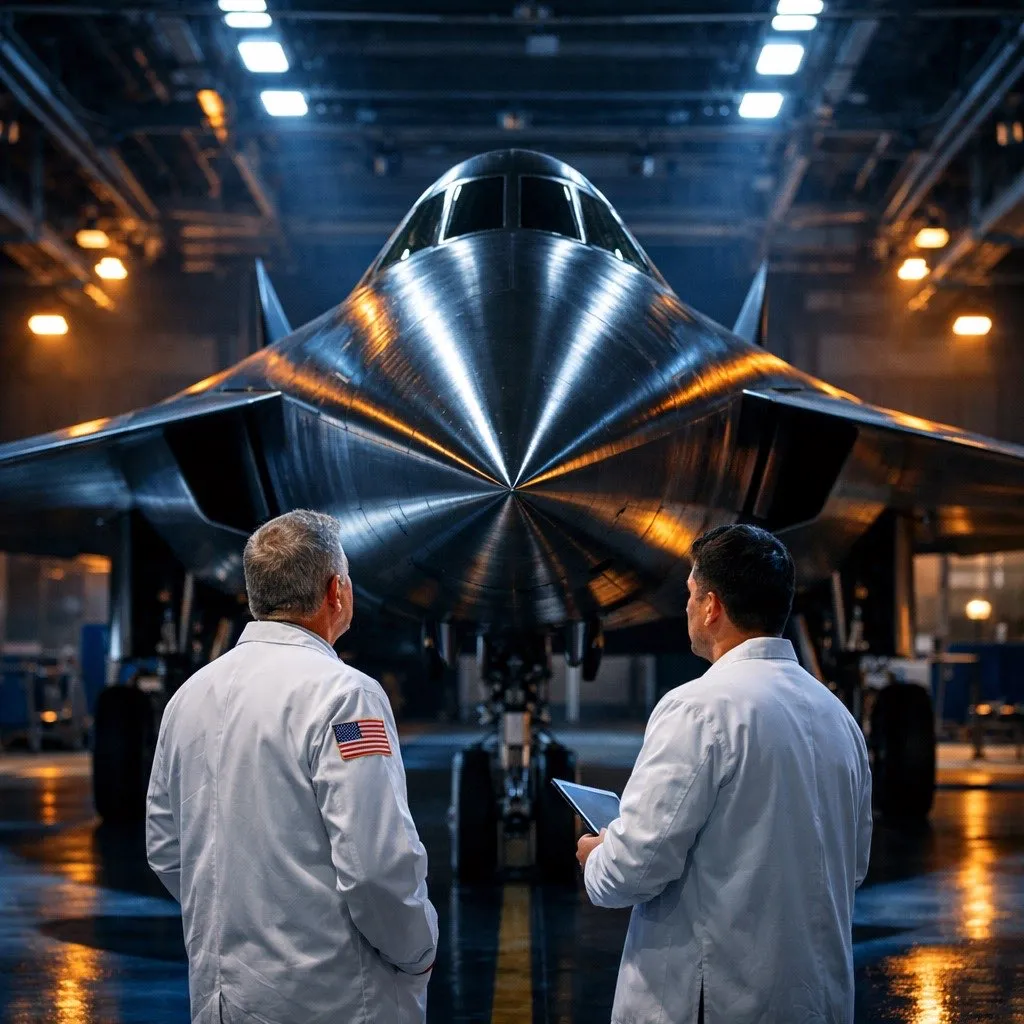
The company operates two parallel aircraft programs. The Quarterhorse series serves as a supersonic flight demonstrator, roughly the size of a General Dynamics F-16, powered by a modified Pratt & Whitney F100-229 engine fitted with a proprietary precooler to prevent overheating at high speeds. The Mk 2.1 is the first variant to use a delta-wing configuration optimized for supersonic aerodynamics.
The ultimate goal is Darkhorse, a multi-mission reusable hypersonic uncrewed aerial system (UAS) approximately 45 feet long. Darkhorse will be powered by Hermeus’s Chimera engine, a turbine-based combined cycle (TBCC) propulsion system that integrates a modified F100 turbofan with a ramjet. At lower speeds, the turbofan provides thrust. At approximately Mach 2.8, the system transitions to ramjet mode, enabling acceleration to Mach 5, five times the speed of sound.
Unlike rocket-powered hypersonic competitors, Darkhorse is designed for reusable operations from conventional runways, a significant operational advantage for military logistics.
Advertisement
Defense Tech’s Hardware Pivot
Hermeus’s raise reflects a broader transformation in defense technology venture capital. The sector raised a record $49.1 billion in 2025, nearly doubling the previous year’s $27.2 billion. American defense tech equity funding alone nearly tripled to $14.2 billion from $5 billion.
But the nature of that capital is shifting. Manufacturing-focused defense investment rose to $4.7 billion across 39 deals in 2025, up from $2.6 billion across 24 deals the year before. Venture capital is no longer just backing software platforms and AI layers sitting on top of existing military systems. Investors are now writing checks for companies that bend metal, build engines, and test fly aircraft.
The U.S. Department of Defense requested $6.5 billion specifically for hypersonic weapons in its FY2026 budget, signaling that speed is becoming a strategic priority. Hermeus already holds a $60 million Air Force partnership for its Quarterhorse flight test program, building on an initial $1.5 million AFWERX contract awarded in 2020 to study hypersonic Presidential airlift options.
What Makes Hermeus Different
Several factors set Hermeus apart in the crowded defense tech landscape. First, the TBCC engine approach. Most hypersonic programs rely on scramjets or rocket motors, which are either single-use or require specialized launch infrastructure. Hermeus’s Chimera engine enables runway takeoff and landing, making the aircraft operationally flexible.
Second, the iterative development pace. Hermeus flew two different aircraft variants in under nine months, a cadence more reminiscent of SpaceX’s build-test-break-rebuild philosophy than traditional aerospace programs that can spend a decade in development before a first flight.
Third, the investor roster signals deep institutional confidence. In-Q-Tel’s participation means the intelligence community sees operational potential. RTX Ventures, the venture arm of Raytheon parent RTX Corporation, brings integration pathways with existing defense prime infrastructure. Khosla Ventures, better known for climate and software bets, leading the round signals that top-tier Silicon Valley firms now view hardware-heavy defense as a fundable category.
The company also recently relocated its headquarters from Atlanta to El Segundo, Los Angeles, placing it closer to the Southern California aerospace cluster and the Pentagon’s West Coast procurement ecosystem.
The Road to Mach 5
Hermeus’s near-term roadmap centers on expanding the Quarterhorse flight envelope. The Mk 2.1 conducted its maiden flight as a subsonic validation mission. The next variant, the Mk 2.2, will attempt to break the sound barrier. Each increment pushes closer to the TBCC transition point and eventually to Mach 5 operations with Darkhorse.
The path is not without risk. Hypersonic flight introduces extreme thermal and structural challenges. The transition from turbofan to ramjet at Mach 2.8 is an engineering problem that has historically been difficult to solve reliably. And scaling from demonstrators to production-ready military platforms requires manufacturing capabilities that few startups have built.
But with $500 million in total funding, a proven engine partnership with Pratt & Whitney, and active Air Force contracts, Hermeus is better positioned than most to make the leap from prototype to production.
Frequently Asked Questions
What is Hermeus building and why does it matter?
Hermeus is developing Darkhorse, an autonomous hypersonic uncrewed aerial system capable of reaching Mach 5 using a turbine-based combined cycle engine. The aircraft is designed for multiple defense missions including strike, reconnaissance, and cargo transport. It matters because Darkhorse would be the fastest reusable unmanned aircraft in the world, operating from conventional runways rather than requiring specialized launch infrastructure.
How is Hermeus funded and who are its key investors?
Hermeus has raised $500 million in total funding, including a $350 million Series C closed in April 2026 that valued the company at $1 billion. The round was led by Khosla Ventures, with participation from Founders Fund, Canaan Partners, RTX Ventures, and In-Q-Tel (the CIA’s venture arm). The Series C is structured as $200 million in equity and $150 million in debt.
Why is defense tech venture capital shifting toward hardware startups?
Defense tech startups raised a record $49.1 billion in 2025, but investors are increasingly backing companies that build physical systems rather than software platforms. Manufacturing-focused defense investment grew from $2.6 billion to $4.7 billion in a single year. This shift reflects the Pentagon’s priority on fielding autonomous platforms and hypersonic systems, with the DoD requesting $6.5 billion for hypersonic weapons in its FY2026 budget.
Sources & Further Reading
- Hermeus Raises $350M to Build Unmanned Hypersonic Fighters — TechCrunch
- Hermeus Reaches $1 Billion Valuation with $350 Million Raise — Hermeus Newsroom
- Hermeus Quarterhorse Mk 2.1 Flight: Chasing the SR-71 Record — New Atlas
- Defense Tech Startups Had Their Best Funding Year Ever in 2025 — Defense News
- Hermeus Achieves First Flight of Mk. 2.1 Supersonic Aircraft — AIAA
- Darkhorse Multi-Mission Hypersonic UAS — Hermeus