When Google signed a deal to rent 110,000 Nvidia GPUs from SpaceX at $920 million per month, it sent a signal the AI industry had not yet fully absorbed: even the world’s most powerful technology company cannot build compute fast enough to satisfy its own AI demand. The $30 billion, 32-month agreement — disclosed in SpaceX’s amended S-1 filing ahead of its planned Nasdaq debut — is not a stopgap measure. It is a structural shift in how hyperscalers will source AI capacity for the foreseeable future.
The deal runs from October 2026 through June 2029. At full rate, Google will pay approximately $11 billion per year for access to Nvidia GPUs, associated CPUs, memory, and supporting infrastructure housed at the Colossus data center in Memphis — the facility formerly owned by xAI and absorbed into SpaceX via an all-stock merger in early 2026. For Google, this is about powering Gemini AI services for large enterprise customers. For SpaceX, it transforms a rocket-and-satellite company into one of the most significant AI infrastructure landlords on the planet.
Why Google Is Renting Instead of Building
The question that defines this story is not how much Google is spending — it is why Google cannot simply build the capacity itself.
Google has spent years and tens of billions on custom AI silicon. Its Tensor Processing Units (TPUs) power much of its internal AI workload. Its data center footprint spans continents. And yet, in 2026, Google is writing a $920 million monthly check to a company it once supplied with cloud computing resources for Starlink satellite operations. The reversal is striking and instructive.
Three structural bottlenecks explain it.
Power and permitting timelines. A hyperscale AI training cluster requires hundreds of megawatts of power. The Colossus Memphis facility is already capable of drawing over 300 megawatts. Getting equivalent permitted, energized capacity at a new site takes three to five years in most jurisdictions — years Google does not have as AI demand from enterprise customers accelerates.
Nvidia GPU allocation queues. Even a buyer with Google’s purchasing power faces constraints in acquiring cutting-edge Nvidia GPUs at scale. Nvidia’s supply chain is fully subscribed. Companies that built data centers early — xAI used its Colossus cluster to train Grok at record speed — now hold assets that buyers cannot replicate quickly regardless of budget.
Speed of AI product cycles. Google’s Gemini roadmap is driven by competitive pressure from OpenAI, Anthropic, and Meta. Waiting 36 months to build new compute is not viable when the product cycle demands capability upgrades every six to twelve months. Renting existing, operational GPU clusters delivers capacity immediately.
The result is a market structure where early movers in AI compute — companies that secured land, power contracts, and GPU allocations ahead of demand — can now sell access at rates that reflect scarcity, not just cost.
The SpaceX xAI Infrastructure Play
SpaceX’s merger with xAI in early 2026 was widely read as a consolidation play — Elon Musk bringing his AI venture under the SpaceX corporate umbrella ahead of the IPO. What became clear with the Google deal is that the merger also created an asset base with genuine commercial infrastructure value.
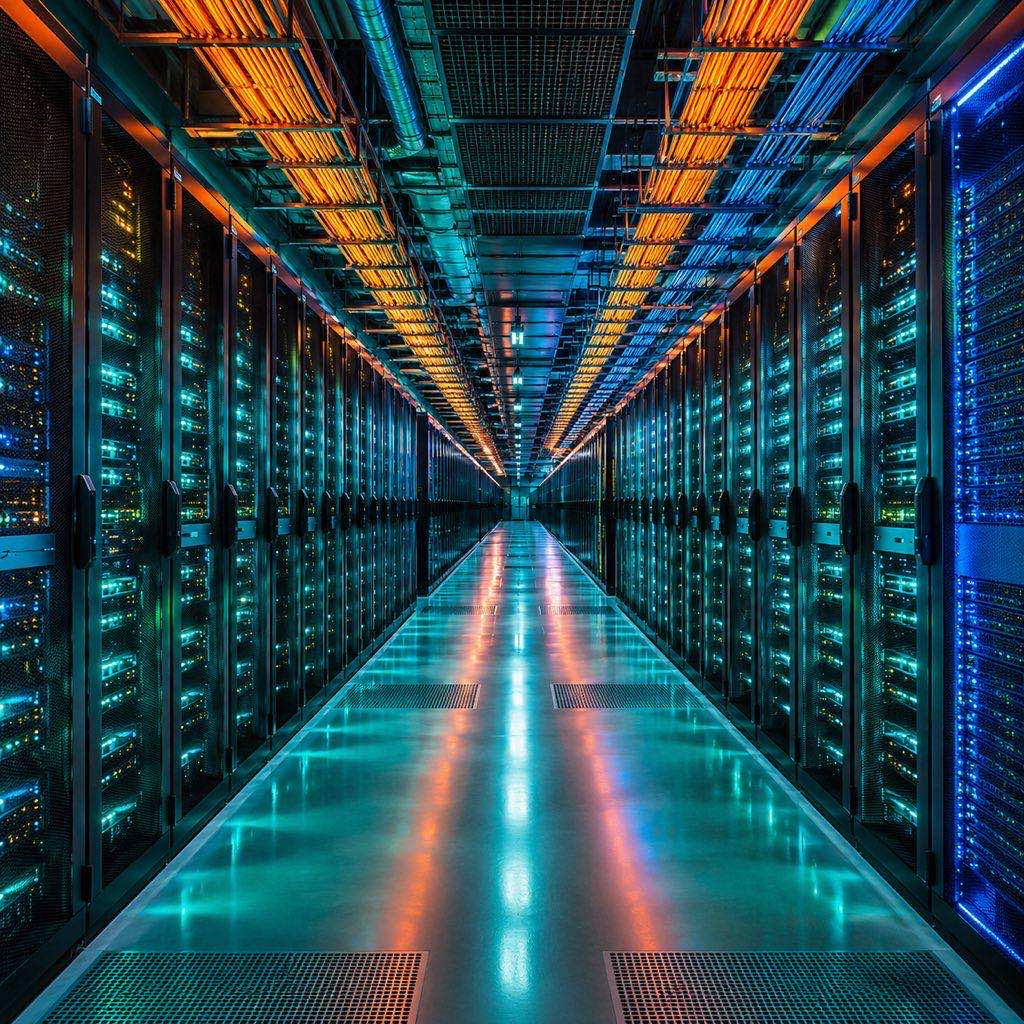
The Colossus facility in Memphis became the crown jewel. xAI built it at extraordinary speed — deploying 100,000 Nvidia H100 GPUs within months of groundbreaking in mid-2024 — using a construction methodology that compressed standard timelines by bypassing conventional permitting sequences and using temporary power sources during build-out. That speed-to-market advantage is now being monetized.
Before the Google agreement, SpaceX had already signed a similar arrangement with Anthropic — reportedly at $1.25 billion per month for the full capacity of Colossus 1. The Google deal, at $920 million per month for 110,000 GPUs, appears to tap Colossus 2 or an expansion of the Memphis footprint. Together, these contracts give SpaceX a recurring AI infrastructure revenue base at a scale comparable to mid-tier cloud providers.
The commercial structure is revealing. Unlike traditional cloud contracts, the Google agreement contains meaningful exit provisions: Google can terminate immediately if SpaceX fails to deliver committed GPU access by September 30, 2026. After December 31, 2026, either party can exit with 90 days’ notice. These terms suggest Google views this as a tactical bridge — a way to acquire capacity now while its own pipeline of permanent infrastructure catches up — rather than a permanent outsourcing of compute strategy.
Advertisement
What This Means for the AI Compute Market
The Google-SpaceX deal codifies a dynamic that has been building for two years: AI compute is becoming a commodity traded between specialized infrastructure operators and the AI product companies that need it.
This is a structural departure from the model that defined cloud computing for the past decade. In that model, hyperscalers — AWS, Google Cloud, Azure — were the landlords. They built the data centers, acquired the hardware, and sold access to everyone else. AI-scale GPU demand has created a parallel economy where the old landlords are becoming tenants.
Several second-order consequences follow from this shift.
The companies that control GPU-dense real estate — whether through early Nvidia relationships, fast construction capability, or geopolitical positioning — now hold a structural advantage that compounds over time. SpaceX monetizing Colossus at $11 billion per year from Google alone illustrates what that advantage is worth.
For enterprise AI buyers, this signals that GPU capacity will remain constrained and expensive through at least 2029. The market is not correcting toward abundance. Every major GPU cluster is already contractually committed. New capacity announcements — whether from CoreWeave, Lambda Labs, or sovereign AI funds — will face the same power and permitting bottlenecks that are driving Google to rent rather than build.
For AI model developers, the compute-cost floor is rising. Training runs that cost $100 million in 2024 may cost multiples of that by 2027, not because Nvidia chips are getting more expensive, but because the full-stack cost of secured, reliable, high-density GPU compute — power, cooling, networking, redundancy — is pricing in genuine scarcity.
What Technology and Infrastructure Leaders Should Do
1. Audit Your GPU Procurement Strategy Against a 36-Month Horizon
The Google-SpaceX deal makes explicit what procurement teams should already know: the gap between when you need compute and when you can build it is measured in years, not quarters. Technology leaders responsible for AI infrastructure should model their GPU needs through 2029 and identify the gap between projected internal capacity and projected demand. If that gap is significant — and for most enterprises it will be — the question is not whether to rent third-party GPU compute, but from whom and at what contract terms. The market is moving toward longer-duration GPU leases with exit provisions. Understanding what flexibility costs versus what lock-in saves is a decision that needs to be made before, not during, a capacity crunch.
2. Pressure-Test Your AI Product Roadmap Against Realistic Compute Availability
Product and engineering leaders building AI applications on top of hyperscaler infrastructure should stress-test their roadmaps against realistic capacity scenarios. Google paying $920 million per month to supplement its own GPU fleet is a data point that suggests even tier-one cloud capacity may not scale linearly with demand. For AI product teams, this means: build with efficiency as a first-class constraint, not a future optimization. Distillation, quantization, and mixture-of-experts architectures that reduce per-token inference cost are no longer just research priorities — they are supply-chain risk management.
3. Rethink How You Classify AI Infrastructure in Strategic Planning
Boards and executive teams should update how they classify and resource AI compute infrastructure. For the past decade, compute has been treated as an operating expense — a utility purchased as needed. The Google-SpaceX deal shows that securing AI compute capacity is now a capital allocation decision with strategic consequences. Companies that treat GPU access as a commodity they can acquire on demand will find themselves behind competitors who secured multi-year agreements when capacity was available. Infrastructure strategy for AI needs to look more like energy hedging than software procurement.
The Structural Lesson: Capacity Is the New Moat
The Google-SpaceX deal marks a turning point in how the AI industry thinks about competitive advantage. For the previous generation of technology competition, the moats were software — better algorithms, better user experience, better data network effects. Those moats still matter. But they are increasingly gated by a physical constraint: whether you can actually run your models at the scale your market demands.
SpaceX did not build Colossus to be an AI infrastructure landlord. It built it to train Grok. The fact that it can now earn $11 billion annually from Google alone — without ceding ownership of the hardware — illustrates that physical AI infrastructure is becoming one of the highest-value capital assets in the technology economy. The companies that move fastest to secure land, power, and GPU supply are creating advantages that will compound for years. The companies that wait are discovering that even $30 billion cannot instantly buy what they need.
The compute crunch is not a temporary bottleneck that better supply chains will resolve in 12 months. It is a structural feature of a period in which AI demand is growing faster than the physical world can provision the infrastructure to meet it. Understanding that — and building strategy around it — is the defining infrastructure challenge of the next three years.
Frequently Asked Questions
Q: Why is Google renting GPUs from SpaceX instead of buying its own Nvidia chips?
Google cannot acquire and deploy high-density Nvidia GPU clusters fast enough to match accelerating AI demand from enterprise customers. Building a new hyperscale data center — including land acquisition, power permitting, hardware procurement, and construction — takes three to five years. The Colossus Memphis facility is already operational with over 300 megawatts of capacity and 110,000-plus Nvidia GPUs. Renting it gives Google immediate access to compute that would take years to replicate, even with unlimited capital.
Q: What does the SpaceX-xAI merger have to do with this deal?
SpaceX acquired xAI in an all-stock merger in early 2026, absorbing xAI’s Colossus data center infrastructure in the process. xAI had built Colossus in Memphis at exceptional speed — deploying 100,000 Nvidia H100 GPUs in months — to train the Grok AI model. After the merger, SpaceX inherited both the physical infrastructure and the option to monetize it as a commercial AI compute service. The Google deal, along with a reported arrangement with Anthropic, represents SpaceX converting that inherited infrastructure into a multi-billion-dollar recurring revenue stream ahead of its planned IPO.
Q: Is this a long-term shift or a temporary bridge for Google?
The contract terms suggest a tactical bridge rather than a permanent strategy. The agreement runs from October 2026 through June 2029, and both parties can exit with 90 days’ notice after December 31, 2026. Google explicitly frames the arrangement as capacity to meet near-term demand while it scales its own infrastructure. However, the fact that a company with Google’s resources, procurement power, and internal TPU program needs to rent 110,000 GPUs from a competitor signals that the supply-demand imbalance in AI compute is structural, not transient — and that renting from specialized infrastructure operators will remain a feature of the market for years.
Sources & Further Reading
- Further Reading
- Google rents SpaceX/AI supercomputers for $920M a month, ahead of IPO — Euronews
- Google Will Pay SpaceX $920 Million/Month for Nvidia GPU Capacity at xAI Data Centers — TechTimes
- SpaceX Signs $30B Deal to Lease Computing Capacity to Google — CryptoBriefing
- SpaceX Signs $920M Monthly AI Compute Deal with Google Through 2029 — CryptoBriefing
- SpaceX to Provide Google with Nvidia GPUs in $30 Billion Agreement — FX Leaders
🔗 Related Intelligence

The $450B Treadmill: How GPU Obsolescence Is Rewriting Hyperscaler Economics

GPU Cloud Price War 2026: Specialised Providers Undercut Hyperscalers by 60-85%
The $112 Billion Quarter: Inside the Q1 2026 Hyperscaler AI Infrastructure Sprint

Sovereign GPU Cloud: The Enterprise Compliance Playbook for AI in Regulated Industries