One Contract, Five Times Bigger
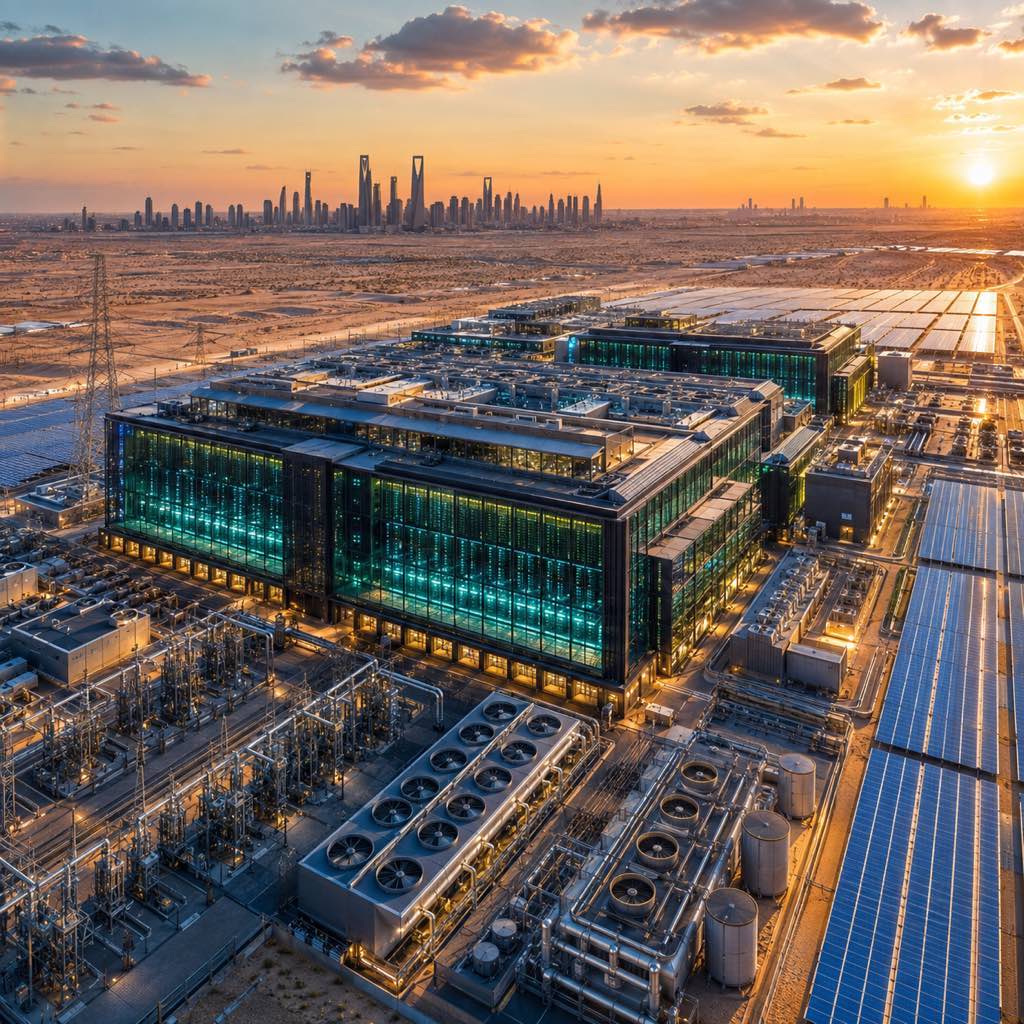
On August 26, 2026, Al-Moammar Information Systems Co. (MIS) — a Riyadh-listed IT and infrastructure contractor founded in 1979 — disclosed that it had received a letter of award from HUMAIN expanding an existing AI data center project from an initial 50 megawatts (MW) to 250MW. According to Bloomberg’s reporting, the enlarged contract is valued at more than 8.76 billion riyals ($2.34 billion) — a figure the company itself described as about seven times its 2025 revenue.
The scale of the jump is the story. In its own filing, MIS said the expanded contract “exceeds 689 percent of the company’s total revenue for 2025” of SAR 1.3 billion, per Asharq Al-Awsat. The additional 200MW is to be designed and built as new data centers in phases, with construction expected to start soon after the contract is signed. Trade outlet AGBI reported that the new capacity quadruples the footprint of HUMAIN’s engagement with MIS, taking one contractor’s slice of the program to a quarter-gigawatt.
Markets responded the way they have to almost every Saudi AI announcement this year. MIS shares are up 87% year-to-date, lifting the company’s market capitalization to roughly 9.75 billion riyals — a valuation now only marginally above the value of this single contract, per Bloomberg. Brothers Ibrahim and Khalid Al Moammar, who together own just over 50% of MIS, saw their combined fortune reach about $1.4 billion on the Bloomberg Billionaires Index — a vivid illustration of how the compute buildout is minting wealth well beyond the chipmakers.
Why HUMAIN Matters Beyond One Deal
HUMAIN is not a private startup chasing hype. It is the AI vehicle of Saudi Arabia’s Public Investment Fund (PIF), created to give the Kingdom sovereign control over the models, data centers, and cloud services that AI now runs on. The MIS award is one thread in a much larger tapestry: HUMAIN has been signing framework agreements and construction contracts across the Kingdom, and this expansion is best read as the program scaling from pilot to production.
The context makes the number less surprising. According to Arab News, an earlier MIS–HUMAIN engagement disclosed in late 2025 was already worth more than 155% of the company’s 2024 revenue — meaning the August 2026 award is not a one-off but a step-change on top of an existing relationship. HUMAIN’s broader plan pairs data centers with model development and a national cloud, part of PIF’s stated ambition to make Saudi Arabia a top-tier AI economy rather than a buyer of foreign compute.
For readers outside the Gulf, the significance is structural. When a sovereign fund commits gigawatt-scale power and multi-billion-dollar construction to domestic AI capacity, it changes where the region’s data — and eventually its AI workloads — physically live. That has downstream effects on latency, data residency, and who controls the infrastructure layer for an entire linguistic and economic bloc.
The Power Problem Hiding Inside the Megawatts
The headline unit here is not dollars but megawatts, and that is deliberate. AI data centers are measured in power because power — not floor space or even chips — is the binding constraint. A 250MW facility is an industrial-scale energy consumer: at full utilization, 250MW is enough to power hundreds of thousands of homes, and the Gulf’s advantage is precisely that it can supply that power cheaply and at scale.
This is why the Kingdom’s oil-and-gas endowment is quietly central to its AI strategy. Abundant, low-cost energy is the moat that makes a 50-to-250MW jump financeable in a single announcement. But it also imports a new class of risk: cooling a quarter-gigawatt of AI silicon in a desert climate is an engineering challenge, and the region’s grid, water, and construction supply chains all have to scale in lockstep. The megawatt figure is a promise; delivering it on schedule is the harder half.
Advertisement
The Analysis: A Real Buildout With Real Fragilities
Strip away the share-price theatrics and the underlying trend is genuine. HUMAIN’s expansion is not a memorandum of understanding or a non-binding pledge — it is a priced construction contract with a named contractor and phased delivery. That distinguishes it from the wave of headline “AI investment” announcements that never convert into poured concrete.
Yet three fragilities deserve a second read. First, concentration: a single contractor’s fortunes and a national program are now tightly coupled, so execution risk at MIS becomes execution risk for part of Saudi Arabia’s AI capacity. Second, the valuation signal is stretched — an 87% share run that leaves market cap barely above one contract’s value prices in flawless delivery of a project that has barely broken ground. Third, the chips: megawatts are worthless without the accelerators to fill them, and access to the highest-end AI silicon remains subject to export controls and allocation queues that no amount of Gulf capital fully removes.
The most defensible reading is neither “Saudi Arabia has won the AI race” nor “this is a bubble.” It is that a well-capitalized sovereign is converting energy wealth into compute infrastructure faster than almost anyone, while carrying real delivery and supply-chain risk. The megawatts are being contracted; whether they come online on time, cooled, powered, and filled with chips is the test that matters.
What This Means for African and MENA Tech Builders
For technology leaders across North Africa and the wider MENA-Africa corridor, the HUMAIN buildout is less a competitor to fear than a supply chain to understand and, where possible, plug into.
1. Map where your AI workloads will physically run before you commit
Gulf hyperscale capacity is coming online closer to North Africa than US or European regions. Evaluate latency, data-residency rules, and pricing for Gulf-hosted AI compute now, so procurement decisions in 2027 are not made blind.
2. Treat power, not price, as the real capacity question
When you assess any AI-hosting partner, ask about contracted power and cooling headroom, not just per-GPU pricing. The HUMAIN deal shows the industry now negotiates in megawatts — your capacity planning should too.
3. Position local talent for the construction-and-operations wave
A quarter-gigawatt of new data centers needs electrical engineers, cooling specialists, and data-center operators, not just ML researchers. Skills programs that target facilities and operations roles will find demand the pure-AI curricula miss.
4. Hedge the chip-allocation risk in your architecture
Because top-end accelerators remain scarce and queued, design AI systems that can degrade gracefully across chip generations and providers rather than betting on a single vendor or region delivering on schedule.
Where This Fits in 2026’s Infrastructure Race
The MIS–HUMAIN expansion is a single, verifiable window into a much larger shift: the center of gravity for AI infrastructure is diversifying beyond the United States, and the Gulf — powered by cheap energy and sovereign capital — is the most aggressive new entrant. For MENA and Africa, that proximity is an opportunity and a dependency at once. Gulf data centers could give the region lower-latency, more affordable, more data-sovereign AI than a US-only map allows. But leaning on a neighbor’s infrastructure means inheriting that neighbor’s construction timelines, chip constraints, and strategic priorities. The $2.34 billion number is real. The prudent response is not awe but planning: understand the supply chain now, because by 2027 the megawatts contracted in 2026 will be the compute your applications run on.
Frequently Asked Questions
How big is the HUMAIN AI data center deal with MIS?
On August 26, 2026, MIS said HUMAIN expanded a project from 50MW to 250MW under a contract worth more than SAR 8.76 billion ($2.34 billion) — roughly seven times MIS’s 2025 revenue, according to Bloomberg. The additional 200MW is to be built as new data centers in phases.
What is HUMAIN and who owns it?
HUMAIN is the artificial-intelligence company of Saudi Arabia’s Public Investment Fund (PIF), the Kingdom’s sovereign wealth fund. It was created to give Saudi Arabia domestic control over AI infrastructure, models, and cloud services rather than relying on foreign compute, and it has been awarding data-center construction contracts across the Kingdom.
Why does the deal matter beyond Saudi Arabia?
A 250MW facility is an industrial-scale compute hub. When a sovereign fund commits gigawatt-class power and billions in construction to domestic AI capacity, it shifts where the region’s data and AI workloads physically run — affecting latency, data residency, and infrastructure control for the wider MENA and Africa market, not just Saudi Arabia.
Sources & Further Reading
🔗 Related Intelligence

The Sovereign AI Race: Egypt’s Karnak, Saudi Arabia’s HUMAIN, and the MEA Strategy Model
AWS’s $5.3B Saudi Cloud Region: What Algerian Enterprises Must Know

Egypt’s $400M Data-Center License: A Homegrown Bet on Government Cloud

Consumer or Builder: Africa’s $1 Trillion AI Fork in the Road