

Why 500,000 Is the Number That Matters
The SNTN-2030 target of half a million ICT specialists is not symbolic — it is calibrated to Algeria’s demographic reality. With a population of 47.4 million and an internet penetration of 76.9%, the country is absorbing digital services faster than it is producing the engineers who build and maintain them. The gap is visible in every major public-sector project, from the national digital identity platform to Algérie Télécom’s fibre rollout.
The SNTN-2030 framing turns the gap into a hiring pipeline. Rather than treating ICT training as a single institution’s mandate, the plan distributes responsibility across three tracks: vocational training centres, private bootcamps, and higher education and remote-employment rails. Each track addresses a different segment of the workforce, and together they are designed to close the 500,000-specialist gap within the decade.
Track One — Vocational Training at Scale
The largest share of the target is handled by the Ministry of Vocational Training. In February 2026 the ministry opened 285,000 new vocational seats, with 40 new digital programs bringing the total enrollment above 670,000 learners. Programs cover cybersecurity operations, cloud administration, network engineering, full-stack development, and entry-level AI operations.
The expansion is reinforced by the Huawei ICT Academy partnership, which provides certification tracks (HCIA, HCIP) aligned with global industry benchmarks, and by new apprenticeship filières where employers receive tax incentives for hosting trainees. For candidates who are not pursuing university, this track is the fastest route to a certified technical role — typically 12-24 months to job readiness.
Track Two — Bootcamps Close the Applied-Skills Gap
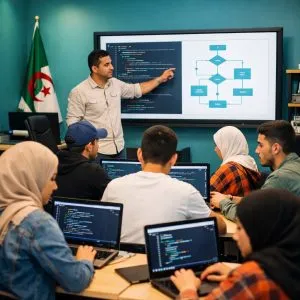
Bootcamps handle the segment the vocational system does not reach quickly enough: applied software engineering, modern JavaScript stacks, data science, and GenAI development. The bootcamp market in Algeria is still young but visibly maturing.
GoMyCode Algeria operates multiple hacker spaces in Algiers and is the country’s most-referenced coding bootcamp, with programs spanning web development, data science, and cybersecurity. Its newer 10-week GenAI Developer track is already producing graduates targeting junior AI-integration roles at regional companies. Course Report lists GoMyCode among the top bootcamps for Algiers on its city guide, and the Africa Tech Schools directory confirms it alongside a short list of alternatives on its Algeria bootcamp page.
Bootcamps compress the timeline dramatically: 10-16 weeks to first developer role, versus 3-4 years for a traditional degree. They also screen heavily for motivation, which is why conversion rates to first tech job are reportedly strong for completers. The trade-off is cost and selectivity — most candidates still self-finance, and cohort sizes are limited.
Advertisement
Track Three — Higher Education + The Remote Rail
The third track runs through universities and through a growing remote-work channel. Algeria’s tech ecosystem directory documents 2,300+ labelled startups and a visibly accelerating private tech sector — both absorbing university graduates at a faster rate than in past cycles.
Running parallel to this is the remote channel. An estimated 22% of Algerian tech professionals now work remotely for foreign employers, capturing compensation that is typically 3-5x local salary bands. The remote rail is not part of the SNTN-2030 plan on paper, but in practice it is one of the strongest pull factors for learners to invest in English-language skills, modern stacks, and international certifications.
How the Three Tracks Fit Together
The three tracks are not competing — they serve different learner profiles and different employer needs.
| Track | Duration to job | Typical learner | Typical first role |
|---|---|---|---|
| Vocational | 12-24 months | Post-secondary, non-university | Cloud technician, cybersecurity analyst, network admin |
| Bootcamp | 3-6 months | Career-changer or recent graduate | Junior full-stack dev, data analyst, GenAI developer |
| University + Remote | 3-5 years | STEM student | Software engineer, ML engineer, SRE |
For employers, the SNTN-2030 framework means that hiring strategies can now be segmented realistically: entry-level ops roles staffed from vocational centres, applied software roles from bootcamps, and senior engineering from universities and returning diaspora. This is a substantive change from the previous decade, when most tech hiring competed for the same narrow pool of computer-science graduates from the top three universities.
What Learners Should Actually Do in 2026
For someone deciding how to enter the ICT workforce this year, the pathway choice is largely a function of timeline, budget, and target role:
- Fastest path to income, limited budget: vocational track with a cybersecurity or cloud specialisation — look for Huawei Academy-affiliated centres
- 3-6 month pivot from another field: bootcamp, with GoMyCode as the dominant option in Algiers and Oran
- Long-term senior-engineer trajectory: university STEM programme combined with deliberate English fluency and GitHub portfolio work, aimed at remote employment post-graduation
- Already working in IT, want higher ceiling: stack a cloud certification (AWS Solutions Architect, Azure Administrator) and target the remote channel
The 500,000 number is a planning target, not a promise. What SNTN-2030 actually delivers is something more useful: a set of distinct, credible career entry points that did not all exist five years ago, each with a measurable timeline and an identifiable set of employers on the other side.
Frequently Asked Questions
What is SNTN-2030 and how does it relate to ICT training?
SNTN-2030 is Algeria’s national digital transformation strategy through 2030. A core pillar targets training 500,000 ICT specialists through a combination of vocational centres, private bootcamps, and higher-education programmes, each aligned to different labour-market segments.
How long does it take to land a first ICT job in Algeria under this framework?
Timelines depend on track: bootcamp graduates typically land entry-level developer or data-analyst roles in 3-6 months of study plus 1-2 months of job search, vocational-centre graduates in 12-24 months, and university STEM graduates in 3-5 years. The remote-employment channel is accessible from any of these paths.
Which Algerian cities have the strongest ICT training ecosystems in 2026?
Algiers concentrates the highest density of bootcamps and private coding schools, including multiple GoMyCode hacker spaces. Oran, Constantine and Sétif host strong university engineering programmes and expanding vocational centres. Smaller cities are catching up through Huawei ICT Academy partnerships at local institutions.