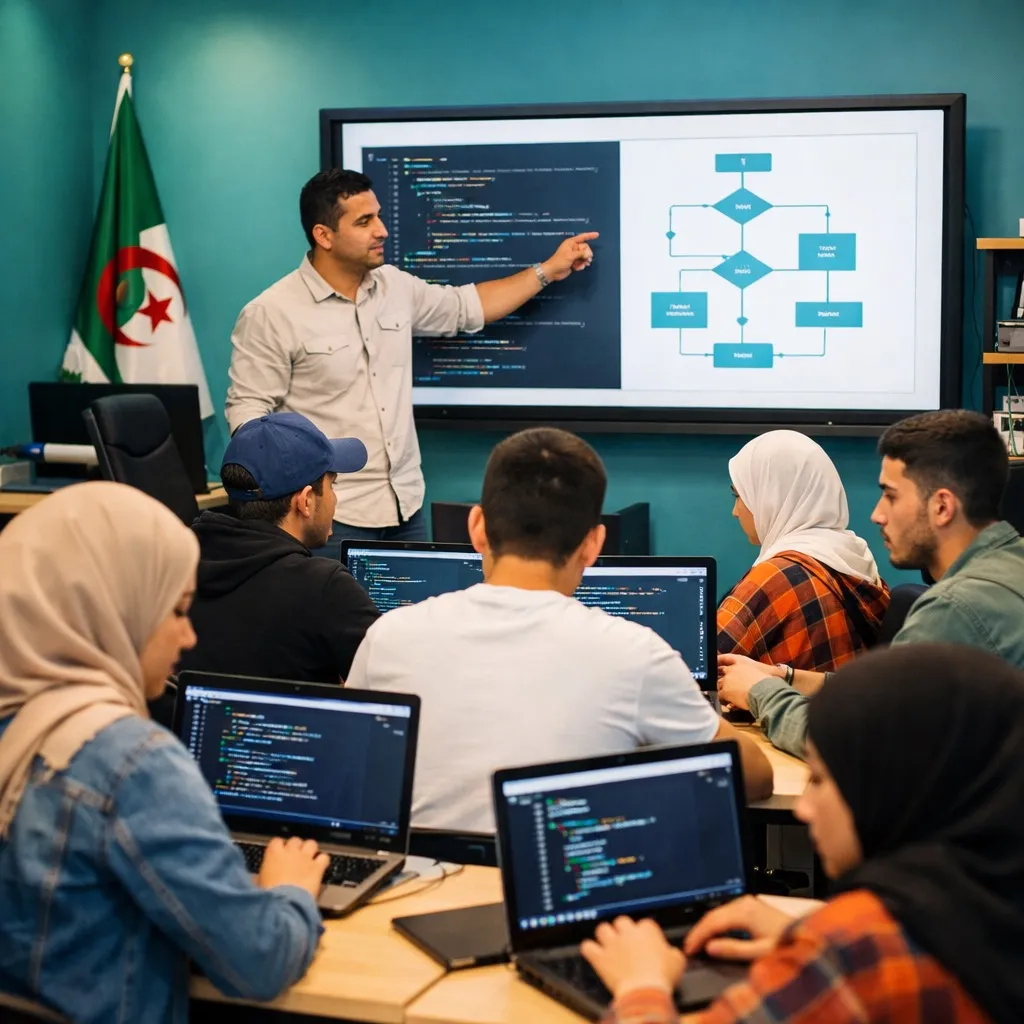
Why Vocational Training Matters for Algeria’s Digital Future
Algeria has a talent alignment problem. With a median age of 29 and youth unemployment at 29.7%, the country graduates tens of thousands of engineering students annually — yet employers report persistent gaps between academic preparation and job-ready skills. The vocational training system, historically geared toward construction and traditional trades, was never designed for a labor market where software development, cloud infrastructure, and cybersecurity drive growth.
In June 2025, the Ministry of Vocational Training and Education announced 40 new digital specializations integrated into the national vocational curriculum. The programs cover software development, cybersecurity, artificial intelligence, IoT, cloud computing, and digital marketing. By October 2025, the system enrolled 385,000 new trainees and apprentices, bringing total active learners nationwide above 670,000. A further 285,000 training places opened for the February 2026 session, including over 57,000 apprenticeship positions within companies.
The initiative is anchored to the National Digital Transformation Strategy 2030 (SNTN-2030), which targets 500,000 ICT specialists by the end of the decade, a 40% reduction in tech-talent emigration, and a digital sector contributing 20% of GDP.
What the 40 New Specializations Cover
The programs were developed collaboratively by a team of 70 educators and pedagogical experts working with GAAN (Groupement Algerien des Acteurs du Numerique), Algeria’s 1,500-member digital industry group, and a network of national and international technology companies. They are delivered through vocational training centers (CFPAs) and technical institutes (INSFPs) across all 58 wilayas.
Software development and web technologies form the largest cluster: full-stack web development, mobile application development for Android and iOS, database administration, and software testing. These 12- to 18-month programs use mandatory project-based assessments rather than traditional exam-only evaluation.
Cybersecurity and network defense tracks address Algeria’s escalating threat landscape. Kaspersky data recorded over 70 million cyberattacks targeting Algeria in 2024, including 13 million phishing attempts. New specializations cover SOC analyst training, ethical hacking fundamentals, and incident response — feeding the talent pipeline demanded by the National Cybersecurity Strategy 2025-2029 (Decree 25-321, signed December 2025).
AI and data science programs focus on practical tool usage — Python, TensorFlow, common ML libraries — rather than theoretical research. The goal is AI practitioners who can deploy and maintain systems, not design novel architectures.
Cloud computing and infrastructure specializations cover Linux administration, cloud service deployment, containerization, and DevOps fundamentals. With Algeria’s national data center operational at El Mohammedia and a second facility under construction in Blida, these tracks address an acute skill shortage.
IoT and digital marketing round out the offering, targeting learners who may not pursue traditional engineering paths but can contribute to Algeria’s digital economy through e-commerce, content creation, and connected-device programming.
Advertisement
The RNFC Competency Framework: From Hours to Skills
On March 16, 2026, Minister Nassima Arhab officially launched the Repertoire National des Formations par Competences (RNFC), replacing a system built around 400-plus specialties and rigid hour-based requirements across 23 sectors.
Under the old model, a trainee who completed 1,200 hours and passed a written exam received a diploma — whether or not they could perform the job. The RNFC shifts assessment to demonstrable competencies. Training is organized around units of competence that can be assessed and recognized independently. Trainees build portfolios of completed projects evaluated against industry-aligned criteria.
For digital specializations, this matters enormously. An employer hiring a junior web developer wants working applications, not a transcript. The modular structure also allows trainees to certify individual skills — such as configuring and securing a Linux web server — without completing an entire multi-year program, better matching the fast-evolving nature of technology careers.
Critical Gaps That Could Stall the Reform
Instructor Capacity
The most pressing bottleneck is instructor quality. Many existing vocational trainers were educated before cloud computing or modern cybersecurity existed as disciplines. The 70 professionals who designed the curriculum are not the same as a corps of classroom instructors capable of delivering it across 1,200-plus centers.
Scaling instructor capacity will require industry secondments (working professionals teaching part-time), structured online training programs for existing staff, and potentially recruiting diaspora Algerians with international tech experience. A Huawei-MFEP partnership signed in 2025 aims to modernize ICT training through AI and cloud integration, and the next step is to scale that template across additional industry partners to match national need.
Infrastructure and Connectivity
Teaching cloud computing demands reliable internet. Teaching cybersecurity requires virtual machine labs. Teaching AI requires adequate processing power. Centers in Algiers, Oran, Constantine, and Blida have better equipment and connectivity, but rural and southern wilayas face real gaps. The ministry has announced plans for smart classrooms and modern pedagogical tools, though implementation timelines for public infrastructure in Algeria historically slip.
Absorption Capacity of the Economy
Training 500,000 ICT specialists means little if the economy cannot employ them. Algeria’s domestic tech sector — Algerie Telecom, Mobilis, Djezzy, Ooredoo, and a growing startup ecosystem — is still small relative to the population. Public-sector digitization creates demand but often at salaries that struggle to compete with international remote work. Freelancing and remote work for international clients represent a promising channel but face their own legal and financial barriers.
Certification Recognition
A vocational diploma from a CFPA does not yet carry the weight of CompTIA, AWS, or Cisco credentials in employer eyes. Integrating international certification preparation into vocational tracks — structuring the network security program so graduates can sit for CompTIA Security+, for example — would give them both a domestic credential and global portability.
Regional Comparison: What Algeria Can Learn
Morocco launched its vocational digital push earlier through OFPPT’s Cites des Metiers et des Competences — 12 planned regional campuses with industry-standard equipment and international certification integration. The first opened in Souss-Massa in October 2022. Morocco invested in infrastructure before scaling enrollment, the reverse of Algeria’s approach.
Tunisia built a strong private-sector bootcamp ecosystem. Gomycode, founded in Tunis, now operates regionally and reports 95% job placement within six months. These intensive 3-6 month programs complement the formal system by targeting immediate employability.
Singapore’s SkillsFuture gives every citizen a credit for certified courses, including digital skills. Its success lies in flexibility, employer endorsement of courses, and cultural normalization of continuous reskilling — a model worth studying for Algeria’s longer-term strategy.
Frequently Asked Questions
What are Algeria’s 40 new digital vocational training programs?
In June 2025, the Ministry of Vocational Training and Education introduced 40 new specializations covering software development, cybersecurity, artificial intelligence, IoT, cloud computing, and digital marketing. Developed with GAAN’s network of 70 industry experts, the programs are delivered through CFPAs and INSFPs across all 58 wilayas using project-based assessment rather than traditional exams.
What is the RNFC and how does it change vocational training?
The Repertoire National des Formations par Competences (RNFC), launched in March 2026, replaces Algeria’s old hours-and-exams model with competency-based assessment. Trainees demonstrate specific skills through portfolios and project work rather than written tests, and can certify individual competency units independently — making the system more responsive to fast-changing technology careers.
Can vocational graduates compete with university-educated IT professionals?
Competency-based vocational graduates should have stronger practical skills than university graduates with purely theoretical training. However, employer bias toward degrees remains strong in Algeria, and vocational diplomas lack the global recognition of certifications like CompTIA, AWS, or Cisco credentials. Integrating international certification preparation into vocational programs would significantly improve graduates’ market position.
Sources & Further Reading
- Algeria Launches 40 New Digital Training Programs to Modernize Vocational Education — TechAfrica News
- Algeria Overhauls Training System With Shift to Skills-Based Model — Ecofin Agency
- Algeria Plans 285,000 New Vocational Training Places in 2026 — Ecofin Agency
- Algeria Aims for Full Digital Transformation by 2030 with New Strategy — WeAreTech Africa
- Algeria Adopts 2025-2029 National Cybersecurity Strategy — WeAreTech Africa
- Algeria and Huawei Forge Strategic Partnership for Vocational Training in ICT — SAMENA Council