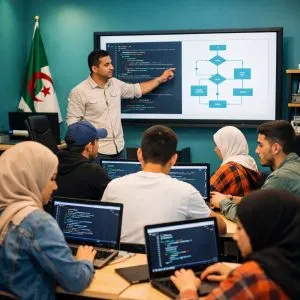
A Continental Call to Action from Tunis
At a high-level international meeting in Tunis on March 27, 2026, Algeria’s Minister of Vocational Training and Education, Nassima Arhab, delivered a forceful call for a “profound transformation” of training systems across Africa. The continent, she argued, needs flexible, high-value skills adapted to the rapid pace of labor market change, with innovation and excellence at the center of every reform.
The meeting was convened for the launch of the regional report “Learning Today to Build Tomorrow: Excellence and Equity through Youth Skills,” bringing together senior officials from across Africa alongside representatives from UNESCO and the International Labour Organization. Tunisia’s Minister of Employment and Training, Riadh Chaoud, co-hosted the event, which centered on strategic reflection about the future of educational systems and their role in strengthening national sovereignty and socio-economic stability.
Arhab used the platform to advocate for training systems that produce “high-level professional competencies,” emphasizing that static, outdated curricula cannot keep pace with the digital economy. She argued that African nations must pivot toward competency-based frameworks that are modular, measurable, and responsive to employer needs. The real challenge, she stressed, lies in “restructuring training systems” and moving from “classical models to approaches based on excellence and effective response to market needs.”
A Maghreb-focused session on the sidelines allowed representatives from North African countries to exchange national experiences and identify common challenges. Participants reached consensus on the urgent need to accelerate structural reforms, reinforce strategic partnerships, and develop more innovative and resilient training systems aligned with regional and international transformations.
The RNFC: Algeria Walking the Talk
What gives Algeria’s advocacy real credibility is that Arhab arrived in Tunis fresh from launching a concrete domestic reform. On March 16, 2026, she presided over the official launch of the Referentiel National de Formation et de Competences (RNFC) — Algeria’s new National Training and Skills Framework — in Algiers.
The RNFC represents a fundamental shift in how Algeria approaches vocational education. The previous system organized training around more than 400 fixed specialties across 23 professional sectors. The new framework abandons that rigid structure in favor of competency units that can be individually assessed, certified, and stacked. This modular approach means workers can upskill incrementally, employers can find candidates with verified capabilities, and the training system can adapt quickly when new technologies create new skill demands.
The ministry described the RNFC as “a central pillar of the sector’s ongoing reform, aimed at building a more modern and effective training system that can better respond to the needs of the national economy and the rapid evolution of jobs and technologies.” The reform addresses a persistent skills-employment mismatch: Algeria’s unemployment rate stood at 9.7% in 2024 despite more than 450,000 job creations that year, with youth unemployment reaching approximately 29.7%.
The Numbers Behind the Ambition
Algeria’s training expansion is not rhetoric alone — the numbers are substantial. For the February 2026 intake alone, the ministry opened approximately 285,000 new training positions, including more than 57,000 apprenticeship slots embedded directly within companies. The preceding October 2025 cycle had already enrolled 672,000 trainees and introduced 40 new specialties, with particular emphasis on digital fields such as software development, cybersecurity, data science, artificial intelligence, and digital marketing.
Combined, the two consecutive intakes represent nearly 957,000 new training positions — a scale few African nations can match.
New certificate-oriented qualification programs based on the Competencies Approach were launched alongside the February intake. One priority area is cybersecurity, where Algeria is building dedicated training tracks to meet surging demand for security professionals — a need amplified by the country’s exposure to over 70 million cyber attacks in 2024 alone, ranking it 17th globally among the most targeted nations.
Advertisement
Bilateral and Multilateral Momentum
Algeria’s training diplomacy extends beyond the Tunis conference. During the same period, Algeria and Tunisia formalized deeper cooperation on vocational training by establishing a joint sectoral technical committee. The committee will prepare annual action plans, monitor implementation, and evaluate outcomes. Both countries agreed to activate cooperation agreements between specialized training institutions, particularly in trainer training and training engineering — recognizing that the quality of instructors is the bottleneck in any skills transformation.
In late March 2026, Minister Arhab also received Amandeep Singh Gill, the UN Secretary-General’s Under-Secretary-General and Special Envoy for Digital and Emerging Technologies. The meeting focused on integrating artificial intelligence and modern technologies into Algeria’s training systems, with discussions on digitization, innovation, and entrepreneurship. Gill’s visit to Algeria — where he also participated in the Global Africa Tech 2026 summit and met Minister of the Knowledge Economy Noureddine Ouadah — underscored the country’s growing visibility as a serious interlocutor on digital workforce policy.
At Global Africa Tech 2026, held in Algiers from March 28-30, African ministers adopted the Algiers Declaration on African Telecommunications Sovereignty (2026-2030). The 14-article declaration establishes commitments in universal connectivity, protection of critical digital infrastructure, data sovereignty, and human capital development — aligned with both the Sustainable Development Goals and the African Union’s Agenda 2063. Algeria’s President Abdelmadjid Tebboune emphasized the country’s ambition to serve as Africa’s digital innovation hub.
Why Algeria’s Approach Matters for Africa
Africa faces a critical digital skills gap. A joint African Union-UNESCO study found that only 10-15% of young Africans have access to structured digital education, with fewer than 5% trained in advanced skills like programming, data analysis, or cybersecurity. The Brookings Institution’s “Foresight Africa 2025-2030” report estimates that 230 million jobs will require digital skills by 2030, creating up to 650 million digital training opportunities representing an economic potential of $130 billion — but only if governments build the policy frameworks and institutional capacity to capture it.
Algeria’s combination of a concrete domestic framework (the RNFC), massive enrollment numbers, bilateral cooperation mechanisms, and active engagement with international organizations like UNESCO, the ILO, and the UN positions it as one of the few African nations translating workforce development rhetoric into actionable policy. By championing the competency-based approach at the Tunis conference, Algeria is not just reforming its own system — it is offering a replicable model for the continent.
The Execution Test Ahead
The real test will be execution. Launching a framework is one thing; embedding it across hundreds of training centers, retraining thousands of instructors, and maintaining alignment with private sector needs is another. But with nearly 957,000 new training positions opened in just two intake cycles, active bilateral cooperation with Tunisia, direct engagement with the UN on AI integration, a continental platform in the Algiers Declaration, and a General Secretariat for Follow-up and Coordination now being established, Algeria has assembled the building blocks for a workforce transformation that extends well beyond its borders.
Frequently Asked Questions
What is Algeria’s RNFC and how does it change vocational training?
The Referentiel National de Formation et de Competences (RNFC) is Algeria’s new National Training and Skills Framework, launched on March 16, 2026. It replaces the previous system of 400+ fixed specialties across 23 professional sectors with modular competency units that can be individually assessed, certified, and stacked. Training is now organized around measurable, practical skills rather than rigid academic programs, allowing faster adaptation to labor market changes.
How many new training positions has Algeria opened in 2025-2026?
Algeria opened approximately 285,000 new training positions for the February 2026 intake, including more than 57,000 apprenticeship slots within companies. Combined with the October 2025 cycle that enrolled 672,000 trainees, the two consecutive intakes represent nearly 957,000 new training positions, with strong emphasis on digital fields like cybersecurity, AI, software development, and data science.
Why does Algeria’s training reform matter for the rest of Africa?
A joint African Union-UNESCO study found that only 10-15% of young Africans have access to structured digital education, and the Brookings Institution estimates 650 million digital training opportunities worth $130 billion could emerge by 2030. Algeria’s combination of a concrete national framework (RNFC), massive enrollment scale, bilateral cooperation with Tunisia, and continental advocacy positions it as one of the few African nations converting workforce development rhetoric into operational policy that other countries can replicate.
Sources & Further Reading
- Tunisia: Algeria Advocates for Overhaul of Training Systems to Foster High-Value Skills — Africa News DZ
- Algeria Overhauls Training System With Shift to Skills-Based Model — Ecofin Agency
- Algeria Plans 285,000 New Vocational Training Places in 2026 — Ecofin Agency
- Tunisia and Algeria Step Up Vocational Training Cooperation — News Tunisia
- Africa Adopts Algiers Declaration to Strengthen Telecom Sovereignty — TechAfrica News
- Algeria Expands Vocational Training to Meet Growing Cybersecurity Demand — TechAfrica News
- The Algerian Minister of Vocational Training Receives the UN Secretary-General’s Envoy on Technology — Algerian Radio
- Africa Faces Critical Digital Skills Gap as Youth Population Booms — Ecofin Agency
- Africa Could Create 650 Million Digital Training Opportunities by 2030 — Ecofin Agency