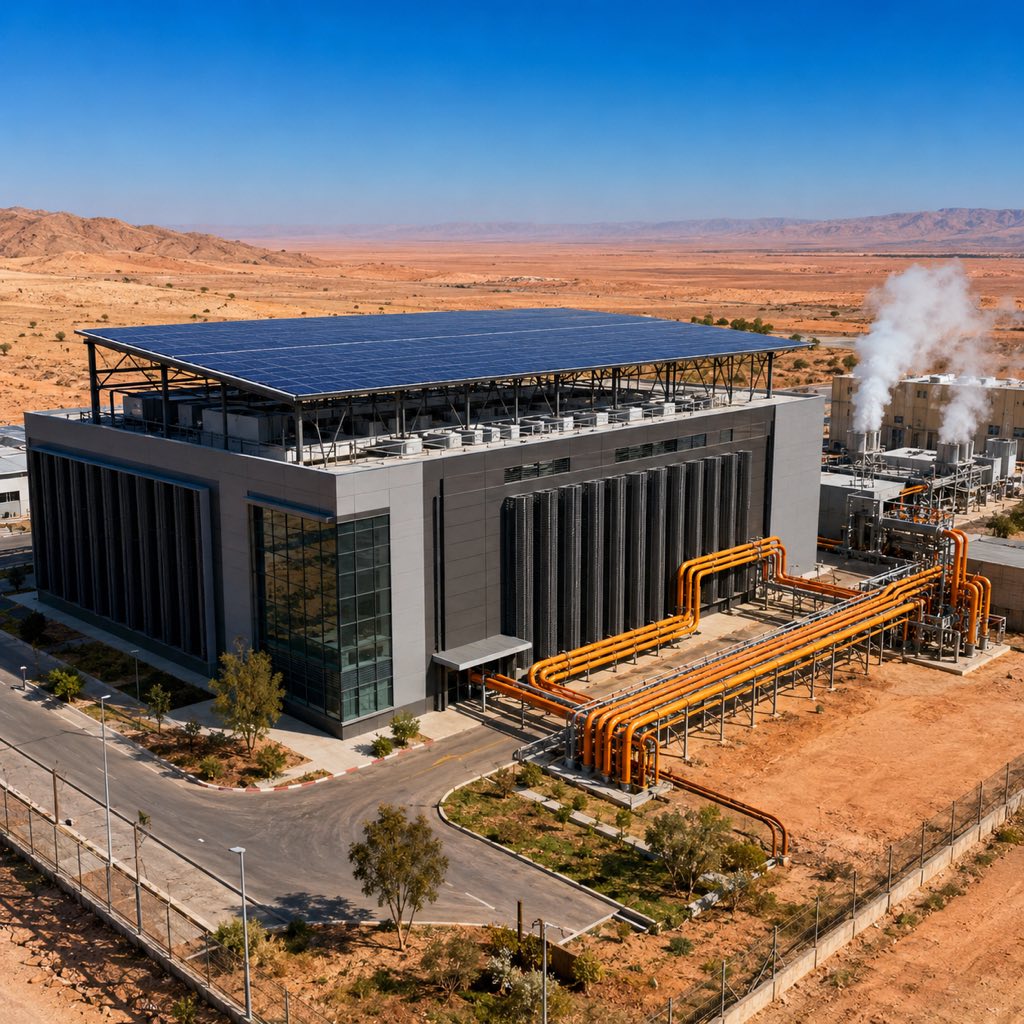
Why Waste Heat Is a Strategic Asset, Not a Byproduct
Every server rack in a data center converts electricity into two things: computation and heat. For every watt delivered to a processor, approximately one watt leaves as thermal exhaust. In a 10 MW data center — the scale of Algeria’s national data center — that means 10 MW of heat is continuously generated and must be removed. In cooler European climates, this heat has become a sought-after resource. In Algeria’s warmer Saharan and Mediterranean climate, it has historically been seen only as a problem to solve with energy-intensive cooling systems.
That framing is changing globally, and Algeria’s data center operators have an opportunity to capture the transition. Under the EU Energy Efficiency Directive (EED 2023/1791), data centers above 1 MW are required from October 2025 to technically assess waste heat utilization possibilities and submit annual cost-benefit analyses. Germany’s Energy Efficiency Act goes further, requiring new data centers from July 1, 2026, to utilize at least 10% of generated waste heat, rising to 20% by 2028. While Algeria is not subject to EU directives, this regulatory trajectory reflects an economic reality that applies regardless of jurisdiction: waste heat has measurable market value, and operators who capture it reduce operating costs while operators who don’t continue paying to dispose of it.
The economics are concrete. Liquid-cooled and high-efficiency air-cooled data centers connected to low-temperature district heating can export 70–90% of consumed electricity as usable heat, with delivered heat costs of 12–30 EUR/MWh. European benchmarks include: Microsoft and Fortum in Finland, where new data centers will supply approximately 40% of district heating demand serving 250,000 people by 2026; Meta’s Odense campus in Denmark, where waste heat serves up to 11,000 households; and Deutsche Telekom’s Berlin data center now supplying heat to 500 apartments through the district heating grid.
Algeria’s Climate: A Different Problem, the Same Physics
Algeria’s Mediterranean north has winters cold enough to justify district heating connections for industrial parks and residential complexes in Algiers, Annaba, and Constantine. The central and southern regions present a different opportunity: industrial processes that require process heat — food processing, textile manufacturing, ceramics, and most relevantly, seawater desalination pre-heating.
Desalination plants operating on the Algerian coast — Algeria operates several multi-stage flash (MSF) and reverse osmosis (RO) facilities — require significant thermal input for pre-heating feed water. A co-located or pipeline-connected data center can supply low-grade heat (40–60°C) that reduces the energy load on the desalination plant’s primary heating system. This circular infrastructure model has been piloted in the Gulf states and is increasingly discussed in North African energy planning circles, precisely because it solves two problems simultaneously: data center cooling cost and desalination energy cost.
Algeria’s data center market is still nascent, currently showing fewer than 10 facilities from five operators. The Africa-wide market is projected to grow from $1.94 billion in 2025 to $4.36 billion by 2031 at a 14.46% CAGR, according to Mordor Intelligence’s Africa Data Center Market report. Algeria’s sovereign cloud infrastructure expansion — the national data center and Djezzy Cloud, with AventureCloudz, a developer cloud platform, running on Djezzy Cloud’s infrastructure — will add significant new capacity over the next three to five years. The design decisions made today for these facilities will lock in their heat management architecture for their entire operational lifetime.
Advertisement
What Algerian Data Center Operators and Planners Should Do
1. Design New Facilities with Waste-Heat Capture Infrastructure from Day One
Retrofitting a data center for waste-heat recovery is significantly more expensive than building in the capability from the start. Algerian data center operators planning new construction or major expansions should include heat exchanger infrastructure in the facility design: a hot-water loop connected to the cooling system’s heat rejection stage, with external pipe connections sized for potential offtake connections. The incremental cost of including this infrastructure during construction is typically 3–8% of the cooling system cost. The incremental cost of adding it post-construction is 40–80% of the original cooling system cost. The key specification is the output temperature: industrial and desalination applications require 50–80°C supply water, which liquid-cooled data centers can achieve directly; air-cooled facilities may need heat pumps to upgrade the temperature, adding cost but remaining viable for large installations.
2. Identify Anchor Offtake Partners Before Breaking Ground
A waste-heat recovery system without a committed offtake partner is an asset without revenue. Algerian data center developers should conduct a systematic survey of potential anchor customers within 5 km of planned facility locations: industrial parks (Sidi Bel Abbès, Oran industrial zone, Annaba steel complex), food processing facilities, textile manufacturers, and coastal desalination plants. A 5 km pipeline radius for hot-water distribution is the practical limit without significant heat loss penalties. The engagement strategy should target facility managers who already pay for process heat — they have immediate financial motivation to enter a heat purchase agreement. Pricing models from European deployments suggest data center operators can charge 15–25 EUR/MWh for heat that would otherwise require 30–50 EUR/MWh of gas to produce, creating a shared savings arrangement that motivates both parties.
3. Calculate PUE Improvement as the Primary Financial Justification
Power Usage Effectiveness (PUE) is the standard metric for data center energy efficiency: total facility power divided by IT equipment power. A PUE of 1.5 means 50% overhead energy for cooling, power distribution, and lighting per unit of IT load. European regulations now require new data centers to achieve PUE ≤ 1.2 by 2026. Algerian facilities operating at typical regional PUE levels of 1.4–1.7 have significant room for improvement. Waste-heat recovery, by definition, converts the cooling system from a pure cost center into a partial revenue generator, which allows operators to justify more sophisticated (and efficient) cooling infrastructure that improves PUE. The financial model works as follows: a 10 MW facility running at PUE 1.5 spends 5 MW on non-IT loads. Upgrading to a waste-heat recovery system that achieves PUE 1.2 while generating heat revenue reduces non-IT power consumption to 2 MW — saving 3 MW of electricity cost — while adding heat sale revenue. In Algeria, where electricity is subsidized for industrial users, the pure electricity savings may be modest, but the combined efficiency gain plus heat revenue creates a compelling business case.
4. Engage SONALGAZ and SEAAL as Infrastructure Partners
Waste-heat district heating requires pipeline infrastructure that individual data center operators cannot build alone. The appropriate partners are the state utility networks: SONALGAZ for gas distribution infrastructure that already runs alongside industrial zones (the same corridors are candidates for hot-water pipelines), and SEAAL (the Algiers water utility) for connections to desalination pre-heating loops. Algeria’s broader digital-physical infrastructure integration agenda — the 500+ digital transformation projects announced for 2026 — creates a political and programmatic window to propose co-investment in data center heat recovery infrastructure as a sustainability component of the national digital sovereignty strategy. Early operators who bring a technically detailed proposal to the Ministry of Energy and Mines and the High Commission for Digitization will be positioning themselves as strategic infrastructure partners, not just technology tenants.
Where This Fits in Algeria’s Circular Economy Ambitions
The waste-heat opportunity sits at the intersection of three national priorities that are otherwise rarely connected: digital sovereignty (building domestic cloud infrastructure), energy efficiency (reducing the energy intensity of data processing), and water security (reducing the energy cost of desalination through process heat recovery). No single ministry owns all three — which means the opportunity requires cross-agency coordination that is admittedly difficult but creates durable competitive advantages for the operators who navigate it.
The strongest parallel is the model being built in Finland, where data centers have become explicit elements of urban heating infrastructure, valued by municipalities and supported by national energy policy. Algeria’s equivalent integration point is the desalination-industrial complex corridor along the Mediterranean coast, where data center heat supply creates synergies that pure-play technology operators miss.
The practical horizon is three to five years for a first operational waste-heat recovery loop at a sovereign cloud facility. The design window is now — the facilities being planned today will be operational through the 2030s. A data center designed in 2026 without waste-heat capture infrastructure is effectively locking in higher operating costs and missed revenue for its entire lifetime.
Frequently Asked Questions
What temperature does waste heat from data centers typically reach?
Waste heat from server cooling systems is typically low-grade heat at 35–60°C for air-cooled facilities and 50–80°C for liquid-cooled systems. Liquid cooling is preferred for waste-heat recovery because it provides higher output temperatures without requiring additional heat pump upgrading. Industrial process heating and desalination pre-heating can typically use 50–80°C supply water directly, making liquid-cooled data centers the most effective configuration for waste-heat reuse in Algeria’s industrial and coastal contexts.
How does PUE compare between Algeria and European data centers?
European regulations now require new data centers to achieve PUE ≤ 1.2. Typical Algerian and North African data centers currently operate at PUE levels of 1.4–1.7, reflecting less mature cooling infrastructure and the additional energy load of operating in a warm climate. A PUE of 1.5 means half of the facility’s power is consumed by cooling, power distribution, and other overhead — versus only 20% overhead at PUE 1.2. Closing this gap through waste-heat recovery and modern cooling architecture can reduce operating costs by 15–25% for a comparable facility.
Are there examples of waste-heat recovery near desalination plants outside Europe?
Gulf state operators have the most relevant experience. Several data center projects in the UAE and Saudi Arabia have incorporated heat supply agreements with industrial desalination facilities and petrochemical processors. While specific contract figures from these arrangements are not publicly disclosed, the technical feasibility is established and the economic rationale — reducing both data center cooling cost and desalination thermal energy cost — applies equally in Algeria’s Mediterranean and northern Saharan contexts.
Sources & Further Reading
- EUDCA Technical Viewpoint: Data Centre Waste Heat and PUE Updates — EUDCA
- Data Center Waste Heat 2026: Selling Excess Joules to District Heating — Energy Solutions
- Africa Data Center Market Report — Mordor Intelligence
- AventureCloudz: Algeria Builds Its Own Cloud for Developers — El Watan
- Year of the African Sovereign Cloud — ATPS Net
- Algeria Data Centers: Facilities from 5 Operators — Data Center Map
🔗 Related Intelligence
Data Center Cooling in a Desert Nation: Algeria’s Unique Infrastructure Challenge
M’Sila Solar and Algeria’s Data Centers: A Sustainable Digital Bet

Algeria’s Gas Grid: A $60B Energy Base That Could Anchor Africa’s First Hyperscale Hub
Green Data Centers: Can Solar-Powered Computing Become Algeria’s Next Competitive Advantage?