Algeria’s Solar Buildout and the Data Center Timing Window
Algeria holds one of the world’s most advantageous solar resource endowments. The Saharan plateau averages 3,000-3,500 hours of sunshine annually, with direct normal irradiance levels that rival the best solar sites in Saudi Arabia and Chile. That resource has been notoriously under-monetized: Algeria’s National Renewable Energy Programme initially targeted 22 GW of renewable capacity by 2030 before being revised down to 15 GW by 2035, with an interim target of approximately 10 GW by 2030.
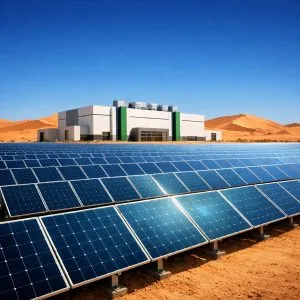
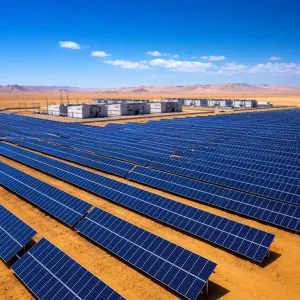
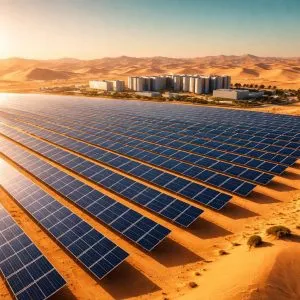
The pace is accelerating. Algeria plans to commission nine photovoltaic power plants with a combined capacity of 1,480 MW by August 2026 — the largest single-year solar deployment in the country’s history. This tranche represents a structural shift: state-owned utility Sonelgaz and its renewable subsidiary SHAEMS are moving from pilot-scale projects to utility-scale procurement, with the reverse auction PPA model replacing ad-hoc bilateral contracts.
The timing intersects critically with Algeria’s data center investment cycle. The SNTN-2030 strategy calls for five or more national data centers. The Mohammadia facility in Algiers (developed with Huawei) is operational; Blida and additional regional sites are in development. A typical hyperscale data center consumes 20-100 MW of power continuously. The power source decision made at project inception — grid-connected standard tariff, or PPA-backed renewable — determines the facility’s operating economics for 20 years.
How Algeria’s PPA Framework Actually Works
The Algerian electricity and gas regulator (CREG) finalized the Power Purchase Agreement templates for solar PV and wind projects, publishing the complete renewable regulatory package alongside the associated tariff decisions. The framework establishes:
Contract duration: 20 years from commercial operation date — long enough for solar project developers to secure project finance, and long enough for data center operators to model levelized cost of energy (LCOE) with confidence.
Procurement mechanism: Reverse tender (competitive auction) in which PPAs go to the developer offering the lowest per-kWh tariff. This competitive pressure has driven solar tariffs in comparable North African markets to $0.015-0.025 per kWh at utility scale — dramatically below the regulated grid tariff for industrial consumers.
Counterparty structure: SHAEMS (the national renewable energy company) and Sonelgaz act as the off-take counterparties. For a data center operator, this means the PPA is effectively backed by a state-owned utility counterparty — reducing offtaker credit risk compared to a corporate PPA with a private buyer.
Corporate PPA pathway: The framework also permits corporate PPAs — direct agreements between a renewable generator and a large electricity consumer — under CREG oversight. This is the mechanism that enables a data center operator to contract directly with a solar developer for behind-the-meter or wheeled renewable power, rather than routing through Sonelgaz’s grid tariff structure.
Algeria’s data center market was valued at $217.87 million in 2025 and is projected to reach $447.27 million by 2035. At even 20 MW average power draw per planned facility, the cumulative power demand across five national data centers is 100+ MW continuously — a meaningful off-take volume that justifies dedicated renewable generation.
Advertisement
The Cost and Carbon Case for Solar-Powered Compute
The economics of solar-backed data center power in Algeria are more compelling than in most comparable markets, for three compounding reasons.
Resource advantage: Algeria’s solar irradiance levels mean a given installed capacity generates 30-40% more annual energy than an equivalent installation in Germany or France. For a data center signing a 20-year PPA, the effective LCOE is lower per kWh of delivered energy from the same capital investment.
Grid tariff trajectory: Algeria’s subsidized electricity tariffs for industrial consumers have historically been below cost-recovery levels, creating fiscal pressure on Sonelgaz. The IMF and World Bank have consistently flagged energy subsidy reform as a structural fiscal risk. Any upward normalization of industrial power tariffs — which multiple analysts expect within the 2026-2030 window — would disproportionately benefit organizations that locked in long-term PPA rates before reform.
ESG and international financing: Algeria’s data center buildout will increasingly require international development finance — from IFC, AfDB, Arab Fund for Economic and Social Development (AFESD), or similar institutions. These lenders increasingly apply green finance standards that require renewable power sourcing or credible transition plans. Data centers financed with solar PPA backing qualify for green bond structures and ESG-linked financing, reducing blended cost of capital by 50-150 basis points compared to standard commercial lending.
What Data Center Developers and Public Agencies Should Do
1. Structure the PPA Before Finalizing Site Selection
Power availability and cost are the dominant variables in data center OPEX — more than land, labor, or even connectivity in most models. The site selection decision and the power sourcing decision should be made simultaneously, not sequentially. In Algeria’s geography, this means identifying sites within wheeling distance of planned solar farms: the Hauts Plateaux region (Sétif, M’Sila, Bordj Bou Arréridj) and sites in the pre-Saharan zone (Biskra, El Oued, Laghouat) combine reasonable road and fiber access with exceptional solar resource. Structure the PPA term sheet — even a non-binding indicative term — before signing a land lease, not after.
2. Engage CREG Early to Validate Corporate PPA Eligibility
The CREG renewable regulatory package enables corporate PPAs, but the implementation procedures for large industrial off-takers are newer and less tested than the standard Sonelgaz utility PPA pathway. A data center operator planning to contract directly with a solar developer should engage CREG’s technical directorate at project inception — not at financial close. Key questions to resolve early: wheeling charges for power transmitted over Sonelgaz’s distribution network, grid connection standards for solar generators at the relevant voltage level, and metering and settlement procedures for net-metering or virtual net-metering configurations.
3. Use the 20-Year PPA as a Green Finance Anchor
International development finance institutions — IFC, AfDB, AFESD — apply environmental and social standards (IFC Performance Standards, AfDB Integrated Safeguards System) to infrastructure investments. A data center project with a signed or term-sheet-stage solar PPA qualifies for green project classification under the IFC’s Climate Finance framework, unlocking concessional lending rates and potentially green bond structuring. The 150 basis point financing cost reduction on a $50M data center project saves $750,000 annually in debt service — a material offset against the administrative cost of structuring the PPA properly.
The Bigger Picture: Clean Compute as a Competitive Signal
Algeria is competing with Morocco, Egypt, and eventually sub-Saharan African hubs for international cloud infrastructure investment. Morocco’s 52.8% renewable electricity penetration and its track record of Moroccan Agency for Solar Energy (MASEN) projects have made it the preferred location for several international data center operators evaluating North African expansion. Algeria’s solar resource is superior, but its policy execution has lagged.
The 1,480 MW commissioning program and the CREG PPA framework represent Algeria’s most credible opportunity in a decade to close that gap. A national data center strategy that systematically pairs compute infrastructure with solar PPA contracts — producing verifiable renewable energy certificates (RECs) and audit-ready sustainability reporting — would differentiate Algeria’s cloud offering internationally in a way that tariff subsidies alone cannot. The operational data centers of 2030 are being planned and financed in 2026. The power sourcing decisions being made now are the ones that will define Algeria’s clean cloud narrative for the next generation of infrastructure.
Frequently Asked Questions
What is a Power Purchase Agreement (PPA) and why does it matter for data centers?
A Power Purchase Agreement is a long-term contract between an electricity generator (typically a solar or wind farm operator) and a large power consumer (like a data center), fixing the price per kilowatt-hour for the duration of the contract — typically 15-25 years. For data centers, PPAs convert volatile grid electricity costs into predictable OPEX, enable renewable energy certification (crucial for ESG reporting and green finance eligibility), and protect against future grid tariff increases. Algeria’s CREG framework enables 20-year PPAs for solar PV projects, with competitive reverse-auction pricing that has driven tariffs in comparable markets to $0.015-0.025 per kWh.
How does Algeria’s solar resource compare to other North African markets for data center power?
Algeria’s Saharan plateau averages 3,000-3,500 hours of annual sunshine and direct normal irradiance levels comparable to Saudi Arabia and Chile — among the best in the world. Morocco, currently the benchmark for North African data center renewable power, achieves approximately 2,900-3,200 sunshine hours. The resource advantage means Algerian solar PPAs generate more energy per installed MW, producing a lower effective cost per kWh for data center operators over the PPA’s 20-year term. The constraint has been policy execution speed, which the 2026 commissioning program of 1,480 MW directly addresses.
What international financing is available for Algerian data centers with solar PPA backing?
Data center projects with signed or term-sheet-stage solar PPAs qualify for green project classification under IFC Performance Standards and the AfDB Integrated Safeguards System, enabling access to concessional lending from IFC, AfDB, AFESD (Arab Fund for Economic and Social Development), and IsDB (Islamic Development Bank). Green bond structuring is also available for qualifying projects. Concessional rates typically represent a 50-150 basis point reduction versus commercial bank lending — on a $50 million project, that translates to $250,000-750,000 in annual debt service savings over a 10-15 year loan term.
Sources & Further Reading
- Renewables in Algeria: Overview of the New PPA for Solar PV and Wind — vLex Algeria
- Algeria to Commission 1.48GW of Solar Capacity by August — ESI-Africa
- Solar Contracts Shift Algeria Towards a More Renewable Future — African Energy
- Algeria Renewable Energy Guide — U.S. Commercial Service / trade.gov
- Do PPAs Have a Future in the Data Center Sector? — Data Center Dynamics
- Algeria Data Center Market Forecast 2035 — DC Market Insights
- Development of Solar Energy: A New Turning Point for Algeria — Africa Energy Portal