Why SMS OTP Has Already Lost
SMS-based one-time passwords are the current backbone of Algerian mobile banking: log into CPA Mobile, BNA Direct, or Baridi Pay and the final authentication step is a six-digit code sent to the phone number on file. It works, but globally it is being retired for three documented reasons.
First, SIM-swap and push-bombing fraud are cheap and industrialized. Second, SMS costs scale linearly with transaction volume, and telecom delivery delays create customer-support load every time a code is late. Third, major regulators have started saying so explicitly. Japan's Financial Services Agency, as reported by Corbado, stated that "ID/password-only authentication and even email/SMS one-time passwords are not sufficient" after a rise in unauthorized access incidents across Japanese financial institutions.
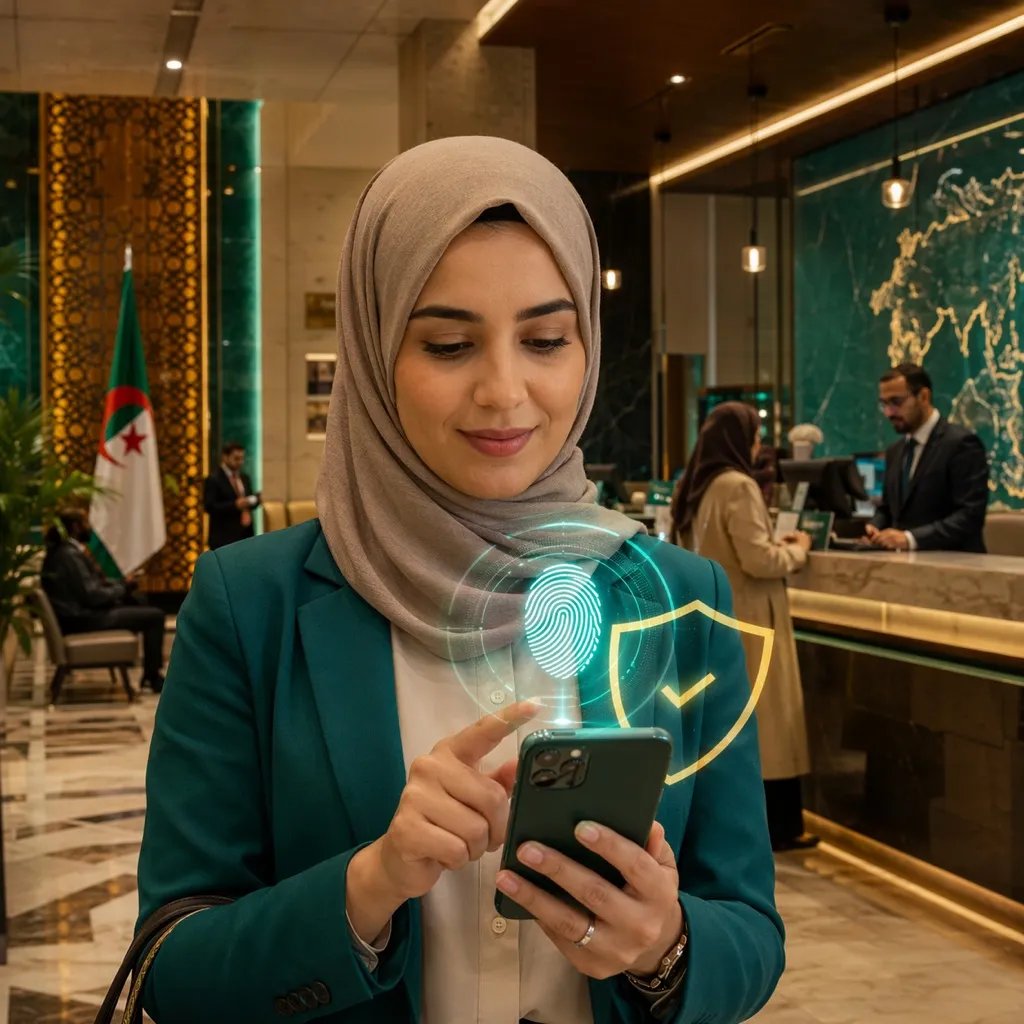
The replacement gaining traction is FIDO2 and its consumer-friendly variant, passkeys. A passkey is a public/private cryptographic key pair bound to the user's device and unlocked with biometrics (fingerprint, Face ID) or a local PIN. There is no shared secret travelling over SMS, no phishable code, and no cross-app password to reuse.
What the Rollouts Already Working Globally Look Like
Three concrete banking rollouts inform what a realistic Algerian path looks like.
- China Bank (Philippines), March 2026. According to Philstar, China Bank became the first bank in the Philippines to launch FIDO2 passkey authentication in its "My CBC" app. Critically, they ran a grace period where passkeys were optional until end of March 2026, then transitioned to mandatory passkey authentication for all users. That two-step rollout (opt-in, then default-on) is the pattern most banks now follow.
- First Credit Union (US). The FIDO Alliance published a detailed case study describing how First Credit Union, working with vendor Authsignal, deployed FIDO-certified passkeys across mobile and web. The documented outcomes: reduced password-reset support tickets, lower fraud on account-takeover vectors, and measurably better login completion rates.
- Japan banking sector, 2025. After a wave of unauthorized account access, Corbado's Japan overview reports that regulators pushed major banks toward passkeys as the primary second factor, with several institutions launching passkey-only login flows during 2025.
These are three different regulatory and technical contexts — the Philippines, the United States, Japan — and they converge on the same blueprint.
The Practical Blueprint for an Algerian Bank
This is a realistic rollout plan for a mid-sized Algerian bank — BNA, CPA, CNEP, Trust Bank, Al Salam — on the assumption that the mobile app is the primary channel and SMS OTP is the current second factor.
Phase 0 — Inventory (1 month). Audit every authentication surface: mobile app login, mobile app transaction confirmation, internet banking web login, internal staff portals, call-center identity verification. Classify each by current method (password, SMS OTP, token). This map is what the CISO uses to sequence the rollout.
Phase 1 — Mobile app passkey enrollment, opt-in (3 months). The fastest win is adding passkey enrollment to the existing mobile app as an alternative to SMS OTP. Users who opt in use Face ID or fingerprint for both login and transaction confirmation. SMS OTP stays available as a fallback. No regulator approval is needed because the second factor has gotten stronger, not weaker.
Phase 2 — Web banking with cross-device passkeys (3 months). Using the W3C WebAuthn standard, web banking can accept passkeys stored on the phone by showing a QR code that the user scans. This is how Google, Microsoft, and most modern consumer passkey flows work today. Vendor support for this in the identity platforms already used by Algerian banks (Microsoft Entra, Okta, Ping Identity, ForgeRock) is mature.
Phase 3 — SMS OTP sunset plan (6 months). Announce an end-of-support date for SMS OTP on mobile app login (not transaction confirmation yet — that can lag by another quarter). Start excluding SMS OTP from high-risk transactions first: large transfers, beneficiary changes, device registration. China Bank's documented approach — opt-in grace period, then mandatory — is the conservative template.
Phase 4 — Hardware security keys for privileged staff (ongoing). Treasury operators, core-banking administrators, SWIFT teams, and fraud investigators should all move to hardware FIDO2 keys (YubiKey, Feitian, Token2) as their only permitted authentication for privileged access. This is inexpensive, widely deployed at peer banks abroad, and removes the most dangerous internal attack path: a phished admin credential.
The entire sequence is realistically 12–15 months for a bank already running a mature mobile app. The FIDO Alliance maintains the reference architecture, and most major identity vendors offer pre-integrated passkey SDKs that drop into an existing authentication service.
Advertisement
What Algerian Banking Regulators Should Prepare For
The Banque d'Algérie and ARPCE do not yet mandate phishing-resistant authentication, but three parallel pressures are worth anticipating.
- Correspondent bank expectations. As Algerian banks expand SWIFT, trade finance, and correspondent relationships with European and Gulf institutions, those partners increasingly require strong authentication on admin channels. FIDO2 is the default answer.
- National Cybersecurity Strategy alignment. Algeria's 2025–2029 cybersecurity strategy lists critical-infrastructure protection and sector-specific regulations as priorities. Banking is the textbook sector for a phishing-resistant authentication mandate.
- Consumer fraud trajectory. Account-takeover via SMS-OTP interception is a tractable, measurable problem. When fraud numbers are reported, regulators respond. Banks moving to passkeys preemptively are better positioned when the rule lands.
What Fintechs and Smaller Institutions Can Do Today
Baridi Mob, Yassir Pay, and the emerging fintech layer have an advantage here: smaller code bases, newer architectures, and often Firebase or AWS Cognito as the identity substrate — all of which support passkeys with modest integration work. For these players, the question is not whether to add passkeys, but whether to lead with them at onboarding. A fintech that launches with passkey-first, SMS-OTP-fallback positioning signals a maturity that distinguishes it from legacy competitors.
Where This Leaves Algerian Banks
The technical, vendor, and regulatory pieces for FIDO2 passkeys are all commoditized. The remaining blockers in Algeria are executive sponsorship, a defensible rollout plan, and the willingness to sunset SMS OTP on a published timeline. The roadmap above is deliberately conservative — it keeps SMS OTP available throughout the transition — but it produces a bank that, by the end of 2026, has measurably reduced phishing exposure, support cost, and fraud without betting on a vendor lock-in or a regulatory change.
Frequently Asked Questions
Are passkeys compatible with the smartphones Algerian customers actually use?
Yes. Android 9 and above (2018+) and iOS 16+ (2022+) support FIDO2 passkeys natively. That covers the overwhelming majority of active devices in Algeria, including mid-range Android phones that dominate the market. Older devices can continue using SMS OTP as a fallback during the transition period.
Do passkeys work if a customer loses their phone?
Yes, and this is actually a rollout advantage over SMS OTP. Passkeys stored in iCloud Keychain or Google Password Manager sync across the customer's devices, so losing one phone does not lock them out. For users who use a single device, the bank's account recovery flow (ID verification plus branch visit or video KYC) is the documented fallback — the same recovery flow that already exists for locked accounts today.
What about customers who do not use biometrics on their phone?
Passkeys can be unlocked with a local device PIN, not only biometrics. That covers customers who have disabled Face ID or fingerprint scanning. For customers without a lock screen at all, banks should keep SMS OTP available as a fallback through the transition, with gentle prompts encouraging passkey setup during subsequent logins.
Sources & Further Reading
- FIDO Alliance — Passkeys Overview
- First Credit Union: Transforming Digital Banking with Passkeys — FIDO Alliance Case Study
- Chinabank to launch FIDO2 Passkey security — Philstar
- Passkeys Japan: An Overview 2026 — Corbado
- Which banks offer passkeys? — Corbado FAQ
- W3C WebAuthn Specification
- What Is FIDO2? — Microsoft Security
- Algeria National Cybersecurity Strategy 2025–2029 Analysis — AlgeriaTech