A Grid Under Pressure from Both Sides
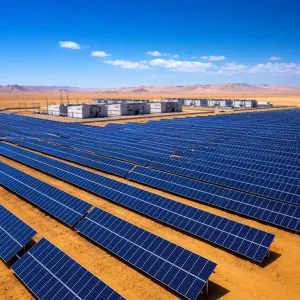
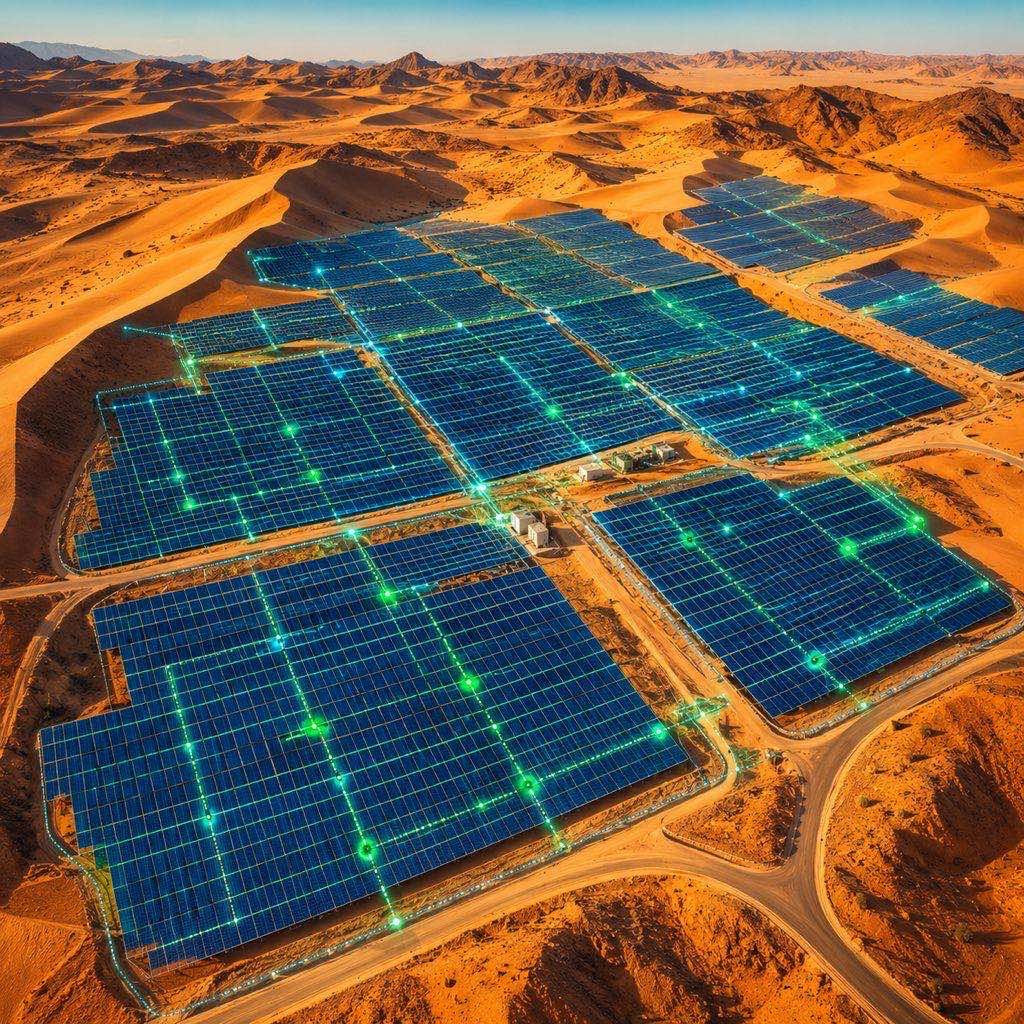
Algeria’s electricity grid is caught between two simultaneous transformations. On the supply side, solar capacity is being added faster than any prior decade in the country’s history: Algeria plans to commission nine photovoltaic plants totaling 1,480 MW by August 2026 as phase one of a buildout that targets 15,000 MW by 2035. On the demand side, electrification of heating, transport, and industrial processes is pushing peak load higher each year.
Managing that tension — high variable supply from solar, rising and increasingly unpredictable demand — is precisely the problem that AI-driven grid optimization tools were built to solve. And it is a problem Algeria will face at increasing urgency over the next 36 months.
Algeria’s 15 GW solar program operates in two phases: Phase 1 delivers 3,000 MW across 20 projects in 12 provinces by 2026; Phase 2 adds 12,000 MW between 2030 and 2035. There are currently 45 active solar projects valued at approximately $6.1 billion in development. At this deployment pace, the grid’s complexity management challenge is not hypothetical — it is already arriving.
The Three AI Opportunity Gaps in Algeria’s Energy Grid
1. Build AI-powered solar output forecasting for grid operators
The most immediate operational challenge Sonelgaz faces is variability. Solar panels generate based on cloud cover, atmospheric dust, temperature, and angle — all of which fluctuate in ways that are partially predictable from meteorological data but require machine learning to forecast accurately at the minute-level resolution that grid operators need.
In comparable deployments, AI-based solar forecasting tools reduce prediction error by 20-40% versus conventional models, allowing grid operators to hold less spinning reserve and reduce costly peak-demand backup activation. Algeria’s grid serves approximately 47.4 million people across a territory of 2.38 million km² — one of the largest national grids in Africa in geographic footprint — and its solar installations are geographically dispersed across 12 provinces. This creates natural demand for multi-site, coordinated forecasting tools that aggregate output projections across the national portfolio.
The technical components exist: satellite irradiance APIs, open-access NWP (Numerical Weather Prediction) data, and transformer-based forecasting architectures tested in comparable Saharan climates (Morocco’s NOOR complex, UAE’s Sweihan plant). What does not yet exist is a company building this product specifically for the Algerian grid’s data environment and Sonelgaz’s operational protocols.
2. Develop predictive maintenance AI for solar plant equipment
Algeria’s solar plants will collectively include tens of thousands of inverters, tracking systems, junction boxes, and panel arrays across sites from Adrar to Annaba. Inverter failures — the most common cause of generation loss in utility-scale solar — are expensive when unscheduled: a single failed string inverter on a 100 MW plant can reduce output by 2-4% until a technician is dispatched. Across a portfolio of 3,000 MW operating plants, unscheduled maintenance incidents at industry-average rates represent tens of millions of dinars in lost generation annually.
Algeria’s AI market is projected to grow at 27.67% annually through 2030, and predictive maintenance is one of the most commercially validated AI use cases in industrial settings globally. The architecture is straightforward: time-series sensor data from inverters and trackers feeds into anomaly detection models trained on historical failure patterns, producing work orders before failure occurs.
For an Algerian startup, the initial go-to-market is simpler than it appears: partner with one of the 45 active solar project developers to instrument a single plant, demonstrate a 15-20% reduction in unscheduled maintenance incidents over one year, and expand from there. The unit economics favor the customer: predictive maintenance typically delivers 3-5x ROI in the first year of deployment in industrial solar settings.
3. Create demand-side AI tools for industrial and commercial energy users
Grid stabilization under high solar penetration requires not just smarter supply management, but smarter demand management. When solar output spikes midday and demand is low, grid operators face overproduction — the same problem California, Germany, and Australia have spent billions managing. When solar output drops unexpectedly and demand peaks, they face the reverse.
Demand Response Management Systems (DRMS) powered by AI can shift flexible industrial loads — aluminum smelters, cement kilns, water pumping stations, cold storage facilities — to match the solar generation curve. Algeria’s energy sector AI is already being piloted in oil and gas applications, but the expansion to grid-level demand management is nascent.
A startup building a DRMS platform for Algeria’s industrial sector would initially target large industrial consumers concentrated in the manufacturing, cement, and aluminum sectors — the energy-intensive facilities whose load flexibility is most impactful for grid balancing — with an automated load-shifting service that earns revenue sharing from the grid operator when they successfully defer peak loads.
Advertisement
What This Means for Algerian Energy Startups
1. Position as a Sonelgaz technology partner, not a disruptor
Algeria’s energy sector does not respond well to disruptive narratives. Sonelgaz is the state utility with operational control over the national grid, and it is the necessary partner for any startup deploying AI in grid operations. The path is not to compete with Sonelgaz — it is to become the technology vendor that helps Sonelgaz manage a grid transformation it does not have internal digital capacity to handle alone.
Algeria’s Digital Strategy 2030 includes “over 500 digitalization projects planned for 2025-2026” across government and state enterprises. Energy sector AI tools that embed into Sonelgaz’s SCADA layer (or provide a complementary intelligence layer above it) are in direct alignment with this priority. Approaching via the Ministry of Energy or through Algeria Digital’s procurement channels is the correct entry path.
2. Start with data, not algorithms
The primary barrier to AI deployment in Algeria’s grid is not algorithmic capability — it is data availability and standardization. Plant operators across Algeria’s 45 active solar projects likely use different SCADA systems, different data formats, and different telemetry sampling rates. A startup that builds the data infrastructure layer first — a unified telemetry ingestion and normalization platform — creates the prerequisite for every AI application that follows.
This sequencing is deliberate: the data platform generates early revenue from integration services and data management fees while building the proprietary dataset that training proprietary models requires. Global energy AI companies like Grid4C and AutoGrid have followed exactly this architecture in comparable emerging grid markets.
3. Leverage Algeria’s engineering talent base
Algeria’s 30,000 engineering graduates annually and 57,702 computer science students represent a talent pool that energy AI startups elsewhere would spend heavily to recruit. The combination of electrical engineering expertise (trained in Algeria’s strong technical university system) with software engineering capability (produced by 74 AI master’s programs across 52 universities) is the right profile for building energy AI tools.
The domestic talent advantage is real: Algerian engineers with combined electrical/software skills working at local salary scales represent a cost structure that allows an energy AI startup to run a meaningful R&D operation on capital that would sustain only a small team in Western Europe.
The Structural Lesson
Algeria’s solar program is one of the most aggressive national renewable energy buildouts on the continent — 15 GW by 2035 represents a 30-fold increase from the country’s current installed solar capacity. Programs of this scale generate acute operational needs that the commissioning agencies (CREG, Sonelgaz) are not equipped to handle with existing digital tools.
In Morocco, which is roughly 18 months further along a comparable solar transition, the first wave of energy AI startups emerged in 2023-2024 as Noor project operational complexity made manual grid management untenable. Algeria’s equivalent inflection point arrives in 2026-2027 as Phase 1’s 3,000 MW comes fully online. The founders who build the tools before that inflection point — when the customers are still writing RFPs rather than running emergency procurement — capture the first and most defensible market positions.
The opportunity is not speculative. Algeria has committed $6.1 billion in active solar project capital, a government digitalization agenda, a trained engineering workforce, and a grid operator that will need AI tools as surely as it will need inverters. The missing piece is the startup that chooses to build them.
Frequently Asked Questions
Why is AI necessary for Algeria’s solar grid and not just conventional engineering?
Algeria’s solar expansion introduces variability that conventional grid management tools cannot handle at scale. Solar output fluctuates based on cloud cover, dust storms, and temperature across geographically dispersed sites — creating supply uncertainty at multiple timescales simultaneously. AI-based forecasting reduces prediction error by 20-40% versus conventional models, allowing Sonelgaz to hold less costly spinning reserve and avoid grid instability events as solar penetration grows from under 5% today toward the 20%+ targets of 2030. Conventional engineering cannot produce minute-level, multi-site coordinated forecasts at the accuracy AI models achieve.
What is the business model for selling AI tools to a state utility like Sonelgaz?
The proven model in comparable emerging-market grids is a Performance-Based Contract (PBC): the startup installs software on a pilot plant at low or no upfront cost, and revenue is earned as a percentage of documented operational savings (reduced maintenance costs, avoided penalty charges for grid imbalances, or reduced backup generation activation). This removes Sonelgaz’s procurement risk and aligns incentives. After a 12-18 month pilot demonstrating documented ROI, expansion to the broader plant portfolio is typically negotiated at a fixed annual software license fee. The approach mirrors how Grid4C and AutoGrid entered comparable state utility markets in Morocco, Jordan, and South Africa.
Does Algeria have the technical talent to build energy AI tools domestically?
Yes. Algeria produces 30,000 engineering graduates annually, runs 74 AI master’s programs across 52 universities, and has a large pool of electrical engineering graduates from institutions like USTHB, ENP Algiers, and University of Tlemcen. The challenge is not talent availability but talent organization — these graduates currently seek careers in banking, telecoms, or international remote work rather than energy tech startups. An energy AI startup that offers equity compensation, meaningful technical problems, and competitive salaries (even at domestic scales) can recruit from this pool effectively.
—
Sources & Further Reading
- Algeria to Commission 1.48 GW of Solar Capacity by August 2026 — ESI-Africa
- Algeria Accelerates Solar Power Ambitions with 15-GW Target by 2035 — Industrial Info Resources
- Algeria Ranks Among Africa’s Leading Solar PV Markets in 2025 — Ecofin Agency
- Why Algeria Is Positioned to Become North Africa’s AI Leader — New Lines Institute
- Algeria’s AI Ecosystem Deep Dive — TechaHub
- Algeria Unveils AI Strategy to Boost Digital Transformation — Ecofin Agency
- Top 5 Solar Projects to Watch in Algeria — Energy Capital Power
🔗 Related Intelligence
Algeria Solar Week 2026: 1,480 MW of Clean Energy Meets Digital Infrastructure Ambitions
Algeria’s 1,480MW Solar Push: Nine Plants Powering the Digital Economy

Algeria’s 1.48 GW Solar Wave: What It Means for Data Center Power Supply
Green Data Centers: Can Solar-Powered Computing Become Algeria’s Next Competitive Advantage?