
The Continent That Defends Itself With One Hand Tied
Africa’s digital economy is growing fast. Cloud adoption in Sub-Saharan Africa has reached 61%, and 85% of African organisations are investing in or planning to invest in AI over the next three to five years. According to PECB’s 2026 cybersecurity analysis, 78% of those organisations view AI as strategically essential.
But the talent infrastructure to defend this digital expansion does not exist at the required scale.
IT News Africa’s 2026 threat landscape analysis documents the asymmetry precisely: 3,153 cyberattacks per week targeting African organisations — 60% more than the global average — while the continent faces more than 200,000 unfilled cybersecurity roles. The World Economic Forum’s Global Cybersecurity Outlook 2026 finds that 63% of Sub-Saharan African organisations lack adequate cybersecurity professionals. Cybersecurity spending across Africa totals USD 15.3 billion annually against estimated cybercrime losses of USD 5 billion — a 3:1 spend-to-loss ratio that suggests the spend is not efficiently targeted.
The skills gap is not a future problem. Financial services, government institutions, and telecommunications — the three most targeted sectors — are operating today with teams that are significantly understaffed.
Algeria’s Structured Response
Algeria’s national response is more advanced than most of its regional peers, and it is worth examining in detail — both for what it has achieved and for where the gaps remain.
In early 2026, the Ministry of Formation and Vocational Education, coordinating with ASSI (Agence de la Sécurité des Systèmes d’Information), launched a National Conference to Strengthen Capabilities in Cybersecurity. TechAfrica News reported that Minister Arhab announced new certificate-oriented qualification programmes based on the Competencies Approach, beginning with the current training cycle.
Three dimensions distinguish Algeria’s approach from ad-hoc training initiatives:
Institutional coordination: the Ministry of Formation and ASSI are co-designing the curriculum, ensuring that what vocational graduates learn maps to the actual threat landscape that ASSI manages — not a generic international certification syllabus disconnected from Algerian operational reality.
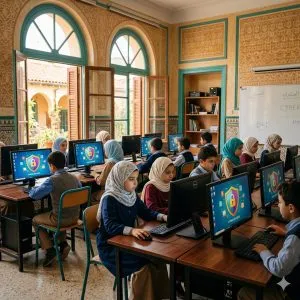
Infrastructure investment: smart classrooms and remote configuration labs are being deployed to increase practical hands-on training — a critical gap in traditional vocational education, where students learn theory but never touch live equipment.
Presidential mandate: the initiative is framed as aligning with presidential directives to enhance cybersecurity as a national and economic security priority, giving it a level of institutional backing that ministry-level programmes often lack.
The ComplianceHub 2026 review of African cybersecurity notes that the number of national CERTs on the continent grew from 13 to 19 between 2018 and 2021, but that only 15 of 55 African Union member states had ratified the Malabo Convention on cyber security and personal data protection as of 2024 — highlighting that institutional capacity at the CERT level is ahead of the legal framework in most countries.
Advertisement
What Algeria’s Talent Pipeline Strategy Should Include
1. Scale the Vocational Curriculum to Cover the Four Critical Specialisations
The World Economic Forum’s 2026 talent data, echoed by TechTrends Kenya’s analysis, identifies the most acute shortage areas in Africa as: network security, cloud security, ethical hacking/penetration testing, threat intelligence, digital forensics, and incident response. Algeria’s vocational expansion should explicitly map certificate tracks to these six domains — not as a single omnibus “cybersecurity” credential, but as six distinct specialisation tracks with corresponding competency assessments. Each track should have a defined industry partner: for instance, a network security track in partnership with a major Algerian ISP or telecom, a cloud security track with a hyperscaler operating in the region, and a digital forensics track with ASSI or the national judicial police. The ASSI coordination in the current expansion is the right model — it should be formalised as a standing curriculum council with industry seats.
2. Establish a Practical Lab Network Accessible to Remote Learners
One of the most significant barriers to cybersecurity skill development in Algeria is geographic: the best institutions are concentrated in Algiers, Oran, and Constantine, while the majority of the population — and much of the industrial and critical infrastructure that needs defending — is distributed across the country. IT News Africa notes that approximately 60% of cybersecurity incidents now stem from configuration errors and permission management rather than sophisticated malware — a category of error that can only be reduced by hands-on practice. A cloud-based cyber range (a virtualised environment where learners practice attack and defence scenarios) accessible over broadband eliminates the geographic barrier. The Ministry of Formation should partner with an international cyber range provider (such as Cyberbit, RangeForce, or SANS NetWars) to deploy a nationally accessible practise environment that all enrolled vocational students can access remotely.
3. Create an Employer Recognition Framework That Values Vocational Credentials
The single largest obstacle to scaling vocational cybersecurity training in Algeria is not supply — it is demand. Employers, particularly in the private sector and state-owned enterprises, default to university degree requirements when hiring for security roles, even when the degree is irrelevant to the specific technical competency needed. PECB’s analysis of African cybersecurity trends confirms that Managed Security Service Providers (MSSPs) are becoming essential infrastructure — and MSSPs are precisely the employers who need network security, monitoring, and incident response technicians that vocational programmes can produce. ASSI and the Ministry of Formation should co-develop an employer recognition framework: a published endorsement of specific vocational cybersecurity credentials as meeting the competency standards for defined junior and mid-level security roles. When ASSI formally states that the national vocational Cybersecurity Certificate (Level 2) meets the technical standards for a Security Operations Centre analyst role, employers will hire accordingly.
4. Launch a Women-in-Cybersecurity Track to Expand the Addressable Talent Pool
The global cybersecurity talent shortage — estimated at five million professionals worldwide, of which Africa’s 200,000+ unfilled roles are a significant component — is structurally exacerbated by the low representation of women in the pipeline. Globally, women represent approximately 24% of the cybersecurity workforce. In Africa, the figure is lower. A women-focused entry track — with dedicated mentoring from senior female security professionals, flexible scheduling compatible with family responsibilities, and a clear pathway from Level 1 vocational credential to ASSI-recognised certification — can meaningfully expand the talent pool within two to three training cycles. Morocco and South Africa have both launched targeted women-in-cybersecurity initiatives in the past two years; Algeria’s larger vocational training infrastructure gives it the capacity to do this at greater scale.
5. Build a Regional Exchange Programme With Other African CERTs
The ComplianceHub data showing 19 national CERTs across Africa (up from 13 in 2018) suggests that a regional talent exchange is now operationally feasible. Algeria’s DZ-CERT has bilateral cooperation relationships with several African and MENA counterparts. Formalise these into structured annual exchanges: six-month rotations where two to three junior Algerian cybersecurity professionals join a partner country’s CERT (for example, Kenya’s KE-CERT or Egypt’s EG-CERT), and equivalent professionals from those countries join DZ-CERT. The exchange serves dual purposes: it accelerates skill development through exposure to different threat landscapes and operational models, and it builds the inter-CERT trust relationships that are essential for coordinated cross-border incident response when a regional attack campaign targets multiple countries simultaneously.
The Bigger Picture: Regional Talent Infrastructure Is a Security Asset
Algeria’s vocational training expansion is not primarily a workforce development story — it is a national security investment. The 3,153-attacks-per-week figure is not an abstraction: it represents attempts against Algerian banks, government systems, telecoms, and industrial infrastructure every week, prosecuted by adversaries whose tooling and sophistication are improving faster than the continent’s defensive capacity.
The WEF Global Cybersecurity Outlook 2026 finding — 63% of Sub-Saharan organisations lack adequate cybersecurity professionals — suggests that most African organisations are not losing the cyber battle because of poor technology choices. They are losing it because there are not enough trained humans to operate the technology they already have.
Algeria’s national vocational initiative, if scaled with the five strategies above, can produce several thousand job-ready cybersecurity technicians over the next three to five years — a number large enough to change the ratio for Algerian organisations and to position the country as a regional training hub that exports credentialed talent to sub-Saharan African partners. The investment is modest relative to the strategic return: a larger trained security workforce reduces incident response times, lowers breach costs, and makes Algeria a more attractive destination for foreign technology investment.
Frequently Asked Questions
What is the scale of Africa’s cybersecurity talent shortage in 2026?
The World Economic Forum’s Global Cybersecurity Outlook 2026 finds that 63% of Sub-Saharan African organisations lack adequate cybersecurity professionals. Africa faces more than 200,000 unfilled cybersecurity roles — part of a global five-million-person deficit. The shortage is most acute in financial services, government, and telecommunications, which are also the three most frequently targeted sectors. African organisations absorb 3,153 cyberattacks per week, 60% above the global average, according to IT News Africa’s 2026 analysis.
What is Algeria doing to address the cybersecurity skills shortage?
The Ministry of Formation and Vocational Education, coordinating with ASSI, launched a National Conference to Strengthen Capabilities in Cybersecurity in early 2026, announcing new certificate-oriented qualification programmes based on the Competencies Approach. The initiative includes smart classrooms, remote configuration labs, and a mandate to align training with national cybersecurity priorities identified by ASSI. The programme is backed by presidential directives positioning cybersecurity as a national and economic security priority.
What specialisations are most in demand for cybersecurity in Africa?
The most acute shortage areas identified by the WEF Global Cybersecurity Outlook 2026 and regional analyses include: network security, cloud security, ethical hacking and penetration testing, threat intelligence, digital forensics, and incident response. The shift toward cloud-based infrastructure — where 60% of incidents now stem from configuration errors rather than malware — means that cloud security and secure configuration specialisations are the fastest-growing demand areas for 2026-2027.
Sources & Further Reading
- Critical Cybersecurity Skills Gaps Threatening Africa’s Digital Growth — TechTrends Kenya
- 8 Key Trends That Will Define Africa’s Cybersecurity Landscape in 2026 — IT News Africa
- Cybersecurity and AI Trends for 2026 in Africa — PECB
- Algeria Expands Vocational Training to Meet Growing Cybersecurity Demand — TechAfrica News
- Cybersecurity in Africa: Navigating Threats, Trends and the Tech Landscape — ComplianceHub
🔗 Related Intelligence

Africa’s Cyber Skills Crisis: How Algerian Companies Can Close the Gap Faster

Africa’s 3,153 Attacks Per Week: Building Continental Cyber Defenses

Africa’s Managed Security Services Surge: How the Continent Is Outsourcing Its Way to Cyber Resilience in 2026
The Global Cybersecurity Skills Crisis: What Algeria Must Teach Now