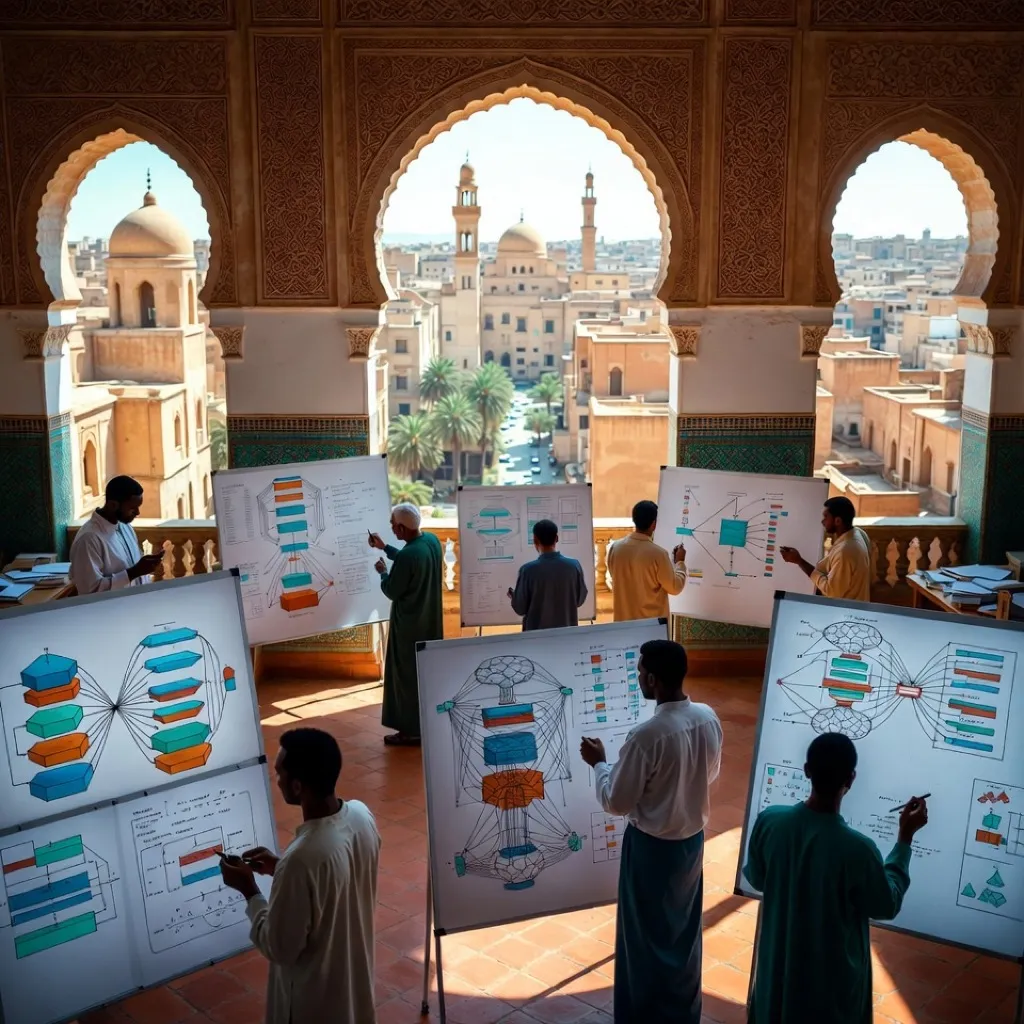
The next frontier in large language models (LLMs) is not English. It is not even Mandarin. For a growing cohort of researchers and entrepreneurs, the greatest untapped opportunity in AI lies in the 400+ million speakers of Arabic and its regional dialects — and Algerian researchers are quietly staking a claim to this territory.
Algeria, with nearly 48 million people, is the largest Arabic-speaking country by land area and the third largest by population. Its linguistic landscape is unusually complex: Modern Standard Arabic (MSA) serves as the official language, but daily communication happens overwhelmingly in Darija (Algerian Arabic) — a spoken dialect with heavy Berber, French, and Ottoman Turkish influence that is largely absent from written digital text. Alongside Darija, Tamazight (the Berber language recognized as a national and official language since 2016) is spoken by an estimated 25-30% of the population across multiple regional variants including Kabyle, Chaoui, Mozabite, and Tuareg. This linguistic diversity creates both a unique challenge and a unique opportunity for AI.
The Arabic NLP Gap
Modern AI assistants like ChatGPT, Gemini, and Claude perform significantly worse in Arabic than in English. The root cause is data: the models were trained primarily on English-language content from the internet. Arabic, despite being the fifth most spoken language globally, accounts for less than 1% of training data in most major LLMs. The problem compounds when you consider dialectal Arabic: Darija and Tamazight are barely represented at all.
Research published in Communications of the ACM in 2025 confirms that existing Arabic LLMs exhibit significant performance gaps on dialectal Arabic tasks compared to Modern Standard Arabic, and that North African dialects are particularly underserved. A separate evaluation study on arXiv found that even Arabic-focused models struggle with tasks requiring dialectal understanding, sentiment analysis in regional varieties, and code-switching between Arabic and French — a phenomenon that defines everyday Algerian digital communication.
The global context is shifting rapidly, however. Major regional players are investing heavily in Arabic AI: the UAE’s Technology Innovation Institute developed Jais 2, a bilingual Arabic-English model; Saudi Arabia’s SDAIA created ALLaM for Arabic language understanding; and academic efforts like AceGPT (from Hong Kong) have targeted Arabic instruction-following. But none of these models adequately serve Algerian Darija or Tamazight — they are optimized for Gulf Arabic or MSA, leaving a significant gap for North African dialects.
Hadretna: Algeria’s LLM Pioneer
The most significant effort to address this gap is the Hadretna project (“Our Dialect” in Arabic). Launched by Algerian-French startup Fentech in partnership with AI scientist Professor Merouane Debbah — president of Algeria’s National AI Council and founding Director of the 6G Research Center at Khalifa University in Abu Dhabi — Hadretna has:
- Pre-trained an LLM on 2 billion tokens of Darija and Tamazight data — the first model of its kind targeting Algerian Arabic specifically
- Launched a public crowdsourcing initiative to gather conversational Algerian Arabic data from native speakers
- Positioned itself as a foundation model for applications in customer service, education, government services, and media
The implications are substantial. Any company that wants to deploy AI-powered customer service or chatbots across Algeria needs a model that understands how Algerians actually speak — not classical Arabic written for formal texts. The gap between MSA and Darija is often compared to the gap between Latin and modern Italian: the written standard and the spoken reality are fundamentally different languages for AI purposes.
Hadretna’s crowdsourcing approach is particularly important. Unlike English, where billions of words of web text exist for training, Darija is overwhelmingly oral. Social media provides some written Darija content (often in a mix of Arabic script, Latin script, and “Arabizi” — Arabic written with Latin characters and numbers), but this data is noisy, inconsistent, and requires substantial cleaning. Building high-quality training datasets demands deliberate human effort.
Nojoom.ai: Commercial AI, Made in Algeria
Running parallel is Nojoom.ai, which describes itself as “the first 100% Algerian generative AI platform.” Its products include:
- Thuraya: An AI-powered Arabic search engine designed to compete with Google Search in Arabic-language markets
- Suhail: A document analysis and summarization tool targeted at corporate and government users
- Nitaq: A contextual AI assistant for enterprise workflows
Nojoom.ai is among the most watched Algerian AI startups heading into 2026, with backing from private investors and growing interest from public sector clients. The company’s focus on enterprise and government use cases — rather than consumer chatbots — reflects a pragmatic understanding of where revenue exists in Algeria’s current market.
Advertisement
The Academic Engine: From University Labs to Open-Source Tools
Algeria’s universities are not passive observers. The country has produced several foundational contributions to Arabic NLP:
Dr. Taha Zerrouki at the University of Bouira leads one of the country’s most respected NLP research programs, producing open-source Arabic language tools including the Mishkal text vocalizer (automatic diacritization of Arabic text) and the Tashaphyne morphological analyzer — tools used by developers and researchers worldwide. These libraries address a core challenge in Arabic NLP: Arabic text is typically written without short vowel marks (diacritics), creating massive ambiguity that models must resolve.
In the dialect-specific space, DziriBERT — developed by researchers from Algeria and France — represents the first Transformer-based language model specifically pre-trained on Algerian Arabic (Dziri). Built on the BERT architecture and trained on a corpus of Algerian dialect text from social media and web sources, DziriBERT demonstrated significant improvements over standard Arabic models on Algerian dialect tasks including sentiment analysis and topic classification. The companion chatbot project DziriBOT explored conversational AI in Algerian Arabic.
Beyond Algeria, important Arabic NLP building blocks include CAMeL Tools (an open-source Arabic NLP toolkit from NYU Abu Dhabi) and AraBART (an Arabic sequence-to-sequence model for text summarization). These tools provide infrastructure that Algerian researchers can build on rather than starting from scratch.
With 74 AI-related master’s programs across 52 universities and approximately 57,700 students enrolled, Algeria has the raw academic pipeline. The National School of Artificial Intelligence (ENSIA) at Sidi Abdellah specifically trains engineers in NLP, speech processing, and computer vision. The challenge is connecting academic research to commercial application — a gap that Skills Centers, the Algerie Telecom AI fund (1.5 billion DZD), and the DjazairIA incubator are designed to bridge.
Why This Matters for Global Tech Companies
For international technology companies, Algeria’s Arabic AI development represents a signal worth heeding:
- First-mover advantage: The Algerian Arabic AI market is almost entirely uncontested. A well-positioned product in 2026 could dominate by 2030.
- Regional spillover: Models trained on Algerian Arabic transfer partially to Moroccan, Tunisian, and Libyan dialects — opening a North African market of over 100 million people. The Maghreb dialects share significant vocabulary and grammatical structures that Gulf Arabic models simply do not capture.
- Government demand: Algeria’s public sector is actively digitizing over 342 services through the Bawabatak portal across 25 ministerial departments. AI-powered Arabic interfaces for citizen services represent a procurement market measured in hundreds of millions of dollars. The SNTN-2030 strategy explicitly plans 500+ digital projects for 2025-2026.
- Talent availability: Unlike Saudi Arabia or UAE, Algeria has a large pool of AI researchers who remain cost-competitive while possessing strong mathematical foundations. A 2024 survey of Algerian developers found that 60% of those working for Algerian companies already have remote work options — an ecosystem ready for cross-border collaboration.
The Risks: Data Scarcity and Compute Access
Building Arabic AI is not without obstacles. The fundamental bottleneck is data. Unlike English-language internet content, Darija is rarely written — it is spoken. Creating training datasets requires expensive human annotation, audio recording, and transcription. The code-switching problem (Algerians freely mixing Arabic, French, and Tamazight in a single sentence) makes data collection and annotation even more complex.
GPU access for training large models remains limited in Algeria due to import restrictions and cost, though the AI Supercomputing Center under construction in Oran — with GPU clusters for AI workloads — will partially address this when operational. In the meantime, research teams rely on cloud-based compute, itself constrained by Algeria’s currency controls and international payment barriers. The PSP regulation (Bank of Algeria Instruction No. 06-2025) and its restriction to Algerian dinars adds friction to purchasing cloud GPU time from international providers.
Tamazight presents an additional challenge: as a language family with multiple regional variants and only recent standardization efforts (the creation of IRCAM’s standard Tifinagh script and the Algerian HCA’s work on a unified grammar), the training data available is a fraction of what exists even for Darija. Any Tamazight AI model will require deliberate corpus-building efforts, likely with institutional support.
Nevertheless, the direction is set. Algeria is building the infrastructure — human, institutional, and technical — to become a leading center for North African Arabic language AI. The organizations that recognize this trajectory now will be best positioned when the market fully opens.
Frequently Asked Questions
Why are Darija and Tamazight valuable for AI development?
These languages represent a massive underserved market. Algerian Darija alone has 40+ million speakers with almost no digital tools, creating opportunities for NLP, speech recognition, and content generation that global AI companies have not addressed.
What technical challenges exist for building Algerian Arabic AI models?
The main challenges are lack of labeled training data, code-switching between Darija/French/MSA in natural speech, dialectal variation across regions, and limited computational resources for training large language models locally.
How can Algerian developers contribute to the Darija AI ecosystem?
By building open-source datasets (speech corpora, text collections, parallel translations), creating evaluation benchmarks for Algerian Arabic, developing practical applications like voice assistants and translation tools, and contributing to international projects like Mozilla Common Voice.
Sources & Further Reading
- The Landscape of Arabic Large Language Models — ACM
- North African AI Large Language Model Data — Middle East AI News
- Evaluating Arabic LLMs — arXiv
- AI & Data/ML in Algeria — State of Algeria Dev
- DziriBERT: a Pre-trained Language Model for the Algerian Dialect — arXiv
- CAMeL Tools: An Open Source Python Toolkit for Arabic NLP — LREC 2020
- Taha Zerrouki — Arabic NLP Open Source Tools
- New Lines Institute — Why Algeria Is Positioned To Become North Africa’s AI Leader