📚 Part of the Open Innovation in Algeria series — the complete framework for corporate-startup-university collaboration.
Open innovation does not happen in a vacuum. It requires physical infrastructure — places where corporations, startups, and researchers collide, share expensive equipment, and stumble into collaborations that no committee would have planned. Algeria’s flagship answer to that need is Cyberparc Sidi Abdellah, the country’s first dedicated technology park. Launched over a decade ago with ambitious blueprints, the campus in Rahmania has become both a symbol of Algeria’s digital aspirations and a case study in the gap between masterplan and execution.
The question in 2026 is no longer whether Algeria needs innovation hubs. It clearly does — the country now has more than sixty of them, alongside 124 university-based incubators engaging some 60,000 students. The question is whether Cyberparc and its peers can evolve from office parks with good branding into genuine ecosystems that produce globally competitive technology companies. The answer depends on infrastructure completion, cloud sovereignty, corporate engagement, and whether the hub explosion reaches beyond Algiers.
Cyberparc by the Numbers
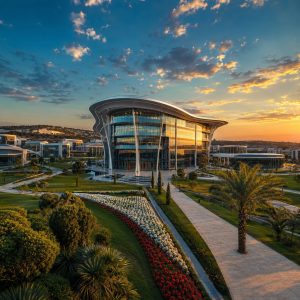
Cyberparc Sidi Abdellah sits on a 92-hectare campus in Rahmania, roughly 25 kilometers west of central Algiers. It is managed by ANPT (Agence Nationale de Promotion et de Développement des Parcs Technologiques), the national agency responsible for Algeria’s technology park strategy. The campus includes a 9,800 m² incubator facility designed to house early-stage startups and a 5,400 m² research and technology transfer center intended to bridge the gap between university laboratories and commercial products.
Two business towers — a business center and corporate hotel spanning 20,000 m², including a 600-seat auditorium and 192 hotel rooms — have welcomed approximately 30 early tenants, though the facilities have not yet reached the full occupancy and programming envisioned in the original masterplan. Their slow ramp-up has been one of the more visible bottlenecks, limiting the park’s ability to attract the large-scale corporate presence that drives demand for startup services and talent pipelines.
Despite the gradual pace, Cyberparc has established itself as a convening point for Algeria’s technology community. The campus regularly hosts national innovation events and served as the venue for the Algeria 2.0 conference in late November 2025, alongside an Agriculture Hackathon (November 27-29) and the closing ceremony of the national Tech Innov hackathon on November 23. These events generate short bursts of energy and media attention, but the real measure of a technology park is what happens on the quieter days between hackathons — whether resident companies are growing, hiring, and shipping products.
The Innovation Hub Explosion
Cyberparc is no longer alone. Algeria’s innovation hub count surged from 14 to over 60 between 2020 and 2023, a fourfold increase that reflects both government policy and genuine grassroots demand. The broader ecosystem now includes 124 university-based incubators. As for startup numbers, more than 2,300 companies hold the official Startup label as of mid-2024, with the wider ecosystem — including unlabeled ventures and pre-label companies — estimated to be considerably larger.
The ecosystem includes a mix of public and private actors. Algeria Venture operates as the country’s first state-owned accelerator, channeling public funding and mentorship into high-potential startups. On the private side, IncubMe — a pan-African incubator founded in 2018 by Algerian entrepreneurs — continues to operate alongside newer entrants like Cap Cowork, which partners with UNDP on social entrepreneurship programs, and Leancubator, which focuses on human capital development and open innovation through initiatives like the Algeria Startup Challenge.
International frameworks have also taken root. The Founder Institute launched its Algiers chapter, connecting local founders to a global network spanning more than 200 cities and 100 countries. Meanwhile, Digital Innovation Caravans — traveling hackathons organized across multiple provinces including Annaba, Bejaia, Oran, Mostaganem, and Ghardaia — attempt to spread the innovation culture beyond the capital. These caravans are particularly important in a country where economic activity and talent have historically concentrated in a narrow coastal corridor.
The sheer number of hubs is encouraging, but quantity alone does not create an ecosystem. Many of Algeria’s newer hubs operate as coworking spaces with modest programming budgets. The challenge now is depth: turning shared desks into shared learning, shared infrastructure, and shared deal flow. As explored in the broader Open Innovation Framework emerging across Algeria, the most effective hubs are those that deliberately engineer collisions between corporates and startups — not merely rent space to both.
Advertisement
Sovereign Cloud: The Infrastructure Layer
A technology park without cloud infrastructure is a building with fast Wi-Fi. Genuine innovation hubs need compute power, and Algeria is building it.
CERIST (Centre de Recherche sur l’Information Scientifique et Technique) operates a cloud computing platform built on a Linux, OpenStack, and Kubernetes stack — a credible, open-source foundation that avoids vendor lock-in. On March 25, 2025, Minister Kamel Baddari presided over the launch of three new CERIST digital platforms: a cloud computing service, a drone research and development system, and a business incubator targeting more than 20 startups by year-end, with the goal of supporting 100 new companies annually by 2027. These platforms represent a deliberate effort to give researchers and entrepreneurs access to computational resources without depending on hyperscaler data centers located thousands of kilometers away in Europe.
On the data center side, Algeria’s sovereign infrastructure is advancing rapidly. The national data center at Mohammedia became the first in the country to receive Tier III Design certification from the Uptime Institute in February 2026 — a milestone for digital sovereignty. A second national data center is under construction in Blida, with Tier III certification procedures already underway. Separately, Icosnet operates a commercial data center in Cheraga (Algiers), and these facilities are beginning to offer startup-friendly pricing tiers. Algeria’s data protection framework — anchored by Law 18-07 (2018) and strengthened by the July 2025 amendment (Law 25-11) introducing DPO requirements and data protection impact assessments — is driving demand for local hosting as data locality obligations become concrete.
Digital transformation is also reaching Algeria’s energy sector. Sonatrach and its partners have been upgrading SCADA systems, deploying fiber-optic sensors, and working with Honeywell and Emerson on industrial digitization at remote well sites. As these upgrades mature, the infrastructure could eventually support broader use cases: precision agriculture in the Saharan oases, remote healthcare diagnostics, or environmental monitoring. Sovereign cloud is not just a policy preference — it is becoming an economic necessity.
What Makes a Tech Park an Innovation Hub
The difference between a technology park and a genuine innovation hub is not square meters or architectural renderings. It is the density and quality of interactions between residents. The academic literature and international case studies point to three factors that separate productive hubs from glorified office parks.
Proximity is the first. Co-locating corporations, startups, and researchers in the same physical space creates serendipitous collaboration — the unplanned hallway conversation that turns into a pilot project, as detailed in emerging Corporate AI Open Innovation models. Tunisia’s El Ghazala technopark, Rwanda’s Kigali Innovation City, and Dubai Internet City all demonstrate that physical density accelerates partnership formation.
Shared infrastructure is the second. Expensive equipment — GPU clusters for AI training, IoT testing laboratories, cybersecurity sandboxes — becomes accessible to startups when the cost is spread across a campus. No seed-stage company can afford its own compute cluster, but a tech park can offer one.
Programming is the third. Hackathons, demo days, corporate-startup matching events, and structured mentorship programs transform a real estate asset into a community. Without active programming, even well-designed campuses devolve into quiet office blocks.
By these measures, Cyberparc Sidi Abdellah has promising raw ingredients but critical gaps. It needs more corporate anchor tenants to create the demand signal that attracts startups. It needs better transport links — the Rahmania location, while spacious, remains difficult to reach by public transit. And it needs its business towers to reach full occupancy and programming to unlock the corporate office space that would house the partners startups most need to access.
The 58-Province Challenge
Algeria’s most ambitious infrastructure bet is not in Algiers. The National Venture Studio Program — a partnership between the Algerian Startup Fund (ASF), CERIST, and DeepMinds — targets all 58 provinces with over $600 million in public-private capital, aiming to launch more than 1,000 tech ventures over five years. The first concrete result appeared on February 20, 2025, when Minister Zerrouki inaugurated a Skills Center in Setif inside former Algerie Telecom premises, offering free training in AI, cloud computing, IoT, and cybersecurity. The model has since expanded, with additional Skills Centers now operational in Annaba, Chlef, and Oran.
Regional startup ecosystems are emerging independently as well. Oran is developing an industrial technology cluster leveraging its port and petrochemical base. Constantine’s university-driven tech scene produces engineering talent that increasingly stays local. Annaba’s proximity to mining and metallurgy creates niche opportunities in industrial automation and environmental monitoring.
But the connectivity gap remains a structural obstacle. According to DataReportal, approximately 10.9 million Algerians remained offline as of January 2025 — roughly 23 percent of the population — and rural broadband penetration lags far behind urban areas. Distributed innovation requires distributed connectivity. A startup in Ghardaia cannot leverage CERIST’s cloud platform if its internet connection cannot sustain a video call. Building Innovation Manager capabilities across the provinces matters little if the digital backbone is not there.
The hub explosion is real, the cloud infrastructure is expanding, and the political will is evident. What remains is execution — finishing what has been started, connecting what has been built, and ensuring that Algeria’s innovation infrastructure serves all 58 provinces, not just the first one.
For a broader perspective on how Algeria’s largest companies are structuring their engagement with the innovation ecosystem, see Corporate Open Innovation in Algeria.
Frequently Asked Questions
What is from office parks to innovation hubs?
From Office Parks to Innovation Hubs: The Reinvention of Cyberparc Sidi Abdellah covers the essential aspects of this topic, examining current trends, key players, and practical implications for professionals and organizations in 2026.
Why does from office parks to innovation hubs matter?
This topic matters because it directly impacts how organizations plan their technology strategy, allocate resources, and position themselves in a rapidly evolving landscape. The article provides actionable analysis to help decision-makers navigate these changes.
How does the innovation hub explosion work?
The article examines this through the lens of the innovation hub explosion, providing detailed analysis of the mechanisms, trade-offs, and practical implications for stakeholders.
Sources & Further Reading
- ANPT — Agence Nationale de Promotion et de Développement des Parcs Technologiques — Official agency managing Cyberparc Sidi Abdellah
- Algeria Launches Cloud, Drone, and Incubator Platforms — WeAreTech.Africa — CERIST platforms launch, March 2025
- Algeria Launches Three New Digital Platforms — MEA Tech Watch — CERIST platforms detail and incubator targets
- ASF, CERIST, DeepMinds Unite to Build 1,000 Tech Ventures — DeepMinds — National Venture Studio Program
- Algeria Launches Setif Skills Center — WeAreTech.Africa — Skills Center inauguration, February 2025
- Mohammedia Data Center Obtains Tier III Design Certification — Algerie Eco — First Tier III certification in Algeria
- Digital 2025 Algeria — DataReportal — Internet penetration and connectivity statistics
- Algeria’s Startup Accelerator Ecosystem — Sramana Mitra — Ecosystem overview and hub growth
- Founder Institute Algiers Chapter Launch — International accelerator expansion
- Academic Assessment of Cyberparc Incubator — RTU Engineering Economics — Incubator infrastructure analysis, 2010-2020