📚 Open Innovation Series
This is the hub article for ALGERIATECH’s Open Innovation in Algeria series. Explore the deep-dives:
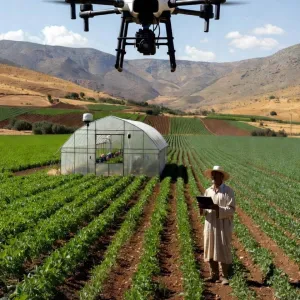
- Agritech: How Precision Agriculture Could Transform Algeria’s Farms
- Corporate Accelerators: Beyond the Demo Day in Algeria
- Diaspora Reverse Innovation: Algeria’s 7 Million Untapped Innovators
- Energy Open Innovation: How Sonatrach Can Open Its R&D
- Hackathons as Open Innovation: Real Ventures or Just PR?
- Living Labs: Citizen Innovation Beyond Tech Parks
- Patent & IP Landscape: The Trust Infrastructure Algeria Needs
- University Tech Transfer: Building the Bridge from Lab to Market
In 2003, Henry Chesbrough published a book that changed how the world thinks about corporate R&D. His thesis was deceptively simple: companies that rely solely on internal research will lose to those that systematically absorb external ideas and release internal innovations outward. He called it open innovation. Two decades later, Algeria is attempting to build an entire economic transition on this principle — moving from a resource economy that exports hydrocarbons to a knowledge economy that exports ideas, software, and deep-tech ventures.
The ambition is real. Algeria now has a dedicated Ministry of the Knowledge Economy, Startups and Micro-Enterprises (MKESM), a legal framework offering 30% R&D tax deductions for open innovation projects, a $600 million venture studio programme targeting 1,000 ventures across all 58 provinces, and more than 2,300 labeled startups out of 7,800+ registered on the national startup.dz platform. Yet the execution remains uneven. University researchers report near-zero formal industry linkages. R&D spending sits at a fraction of global benchmarks. Innovation management as a recognized profession barely exists.
This article maps the complete open innovation ecosystem in Algeria — every player, every funding mechanism, every policy lever, and every gap. It is the reference framework for CTOs, R&D directors, startup founders, and university researchers who want to understand what exists, what works, and what remains to be built.
Algeria’s Open Innovation Ecosystem Map
Government Architecture
Algeria’s open innovation infrastructure begins at the top of government. The MKESM serves as the primary institutional driver. Its portfolio includes the national startup labeling system, incubator accreditation, and the innovation.gov.dz portal — the official digital platform where companies and startups claim R&D tax incentives and register collaborative innovation projects.
Running parallel to the MKESM is the High Commission for Digitalization (HCN), which oversees Algeria’s broader digital transformation strategy. The HCN focuses on infrastructure, e-government, and the national data strategy, while the MKESM concentrates on the startup ecosystem and innovation policy. In practice, their mandates overlap, particularly in areas like AI strategy and digital skills. The Innovation Policy Scorecard provides a detailed assessment of how these institutions perform against international benchmarks.
Funding Mechanisms
Three major public funding channels now support open innovation:
The Algerian Startup Fund (ASF) is the centerpiece. Capitalized at 2.4 billion DZD in partnership with six public banks including BADR, CPA, and BEA, ASF has reviewed more than 350 applications, processed 139 funding requests across 20 sectors in 22 provinces, and funded over 100 startups since its launch in October 2020. It operates as an equity investor, taking minority stakes in labeled startups across sectors ranging from agritech to cybersecurity, with tickets of up to 150 million DZD per project. ASF’s mandate explicitly includes co-innovation projects where startups develop solutions for corporate partners — a direct embodiment of the Chesbrough model. Its first exit came in December 2025 when travel-tech startup VOLZ raised $5 million in a Series A round, earning ASF a 3.35x return on its initial investment.
The FCPR framework, established by Cosob regulation no. 24-02 of 23 October 2024 and published in the Journal Officiel on 7 May 2025, creates a pooled venture capital structure. FCPRs (Fonds Communs de Placement à Risque) allow institutional investors, banks, and private actors to pool capital into managed VC funds, with a minimum threshold of 50 million DZD. Afiya Investments became the first approved FCPR, pioneering this new vehicle. FCPR units can be listed on the stock exchange for liquidity, with a minimum pre-liquidation period of six years. This matters for open innovation because it creates a mechanism for corporate venture capital — companies can participate in FCPRs alongside ASF and private investors, gaining exposure to startup innovation without managing direct investment operations.
Algerie Telecom’s 1.5 billion DZD innovation fund (approximately $11 million), announced in February 2025 at the third edition of Algeria’s CTO Forum, targets AI, cybersecurity, and robotics ventures. This is notable because it represents a state-owned enterprise acting as a venture client — purchasing innovation outputs from startups rather than building everything in-house. Fintech Open Innovation explores how financial institutions are following a similar model, with banks like BDL and BEA purchasing BNPL and digital payment modules from labeled fintech startups.
Programs and Platforms
The most structured open innovation program operating in Algeria today is the Algerian Open Innovation Program (AOIP), run by Hadina Tech. AOIP operates as a matching platform connecting corporations with startup solutions across multiple industry sectors including Fintech, Insurtech, GreenTech, AgriTech, DigitalTourism, FoodTech, LogisticTech, and HealthTech. The model is straightforward: corporations post innovation challenges, startups propose solutions, and AOIP facilitates the matchmaking, mentorship, and piloting phases. The platform has engaged over 500 startups and more than 200 ecosystem actors. The AOIP Playbook provides a detailed operational guide for companies considering participation, while AgriTech Open Innovation examines how precision agriculture ventures are leveraging these platforms.
Beyond AOIP, several corporate-led programs have emerged. The Djezzy Open Innovation Challenge (2025 “Impact Challenge” edition, in partnership with the Algeria Startup Challenge) offers 200,000 DZD in prizes plus mentorship for startups developing solutions for digital inclusion and connectivity. The Algeria Startup Challenge, now in its seventh edition and supported by the MKESM, runs annual competitions across multiple verticals. Samsung’s Innovation Campus and Huawei’s ICT Academy represent international corporate partnerships that embed skills training within Algeria’s university system — feeding the talent pipeline that open innovation depends on. Hackathons and Innovation Challenges provides a comprehensive analysis of how these competition-based formats are driving startup formation.
Physical Infrastructure
Algeria’s innovation infrastructure has expanded rapidly. The flagship is Cyberparc Sidi Abdellah, a 92-hectare technology park south of Algiers managed by ANPT (Agence Nationale de Promotion et de Développement des Parcs Technologiques). The park houses a 9,800 m² incubator that has supported over 500 project holders, a 5,400 m² R&D center operated by CERIST (the national center for scientific and technical information), and a growing cluster of tech companies. Cyberparc innovation hubs details the park’s infrastructure capabilities and tenant ecosystem.
Beyond Cyberparc, Algeria now counts more than 60 innovation hubs nationwide — up from just 14 three years ago. This fourfold expansion reflects deliberate government policy to decentralize innovation away from Algiers. The higher education system alone now operates 124 active incubators, engaging 60,000 students whose final-year projects focus on launching startups, micro-enterprises, or patent applications. Hubs in Oran, Constantine, Annaba, and Setif now host local startup ecosystems, though Algiers still accounts for a disproportionate share of venture funding and corporate partnerships. Living Labs and Citizen Innovation explores how some of these hubs are evolving beyond traditional incubation into community-driven innovation spaces.
The Education Pipeline
Algeria’s universities produce talent at scale. The higher education system enrolled 57,702 students across 74 AI-focused master’s programs at 52 universities as of the latest count. Each year, more than 340,000 students pass the baccalaureate exam, feeding a university system that is among the largest in Africa by enrollment. The National Artificial Intelligence Strategy, officially adopted in December 2024, targets AI contributing 7% of GDP by 2027, with the broader AI market projected to grow from $498.9 million in 2025 to $1.69 billion by 2030.
The problem is not quantity. It is what happens after graduation — or more precisely, what does not happen between universities and industry during the research phase. This gap is the single biggest structural weakness in Algeria’s open innovation ecosystem.
The Policy Framework: Legal and Fiscal Enablers
Algeria’s open innovation push rests on a concrete legal foundation, not just rhetorical ambition. The key policy interventions:
R&D Tax Incentives
The Finance Laws of 2023 and 2025 together created Algeria’s most significant innovation incentive. Companies investing in R&D can now deduct up to 30% of R&D expenditure from taxable profits, up from 10% under earlier provisions. The deduction is capped at 200 million DZD annually. Critically, the 2025 amendment explicitly extended this benefit to open innovation projects conducted in partnership with certified startups, incubators, or university labs. This means a corporation that co-develops a product with a labeled startup can claim the same tax benefit as one running an internal R&D lab.
KPMG’s Open Innovation bulletin for Algeria noted that the country has established a legislative framework aimed at stimulating open innovation, placing it among the more progressive regulatory environments in the MENA region for collaborative R&D. The bulletin highlighted the explicit extension to open innovation partnerships as a distinguishing feature compared to neighboring markets.
The Startup Labeling System
The startup.dz platform administers Algeria’s national labeling system. More than 7,800 companies have registered on the platform, with approximately 2,300 holding the official “startup” label as of early 2026. The label unlocks a package of benefits: free intellectual property registration through INAPI (the national industrial property institute), access to ASF equity funding, eligibility for public procurement set-asides, and inclusion in the AOIP matching platform. Labeled startups also benefit from stock exchange fee waivers through 2028. The label serves as a quality signal for corporate partners — when a company enters an open innovation partnership with a labeled startup, both parties can claim R&D tax benefits.
The innovation.gov.dz Portal
The MKESM’s innovation.gov.dz portal is the administrative backbone. Companies register open innovation projects here, submit documentation for R&D tax claims, and access the directory of certified incubators and startup partners. The portal also publishes sectoral innovation priorities, signaling to the ecosystem where government wants collaborative R&D to focus.
Advertisement
The $600M Venture Studio Programme
The most ambitious initiative in Algeria’s open innovation landscape launched in late 2025: a $600 million, five-year venture studio programme uniting ASF as anchor investor, CERIST deploying through its network of incubators and university partnerships, and international expertise from DeepMinds — a MENA-based decentralized venture studio (not to be confused with Google DeepMind). The programme aims to create more than 1,000 deep-tech ventures across all 58 provinces, mobilizing blended public-private capital.
The venture studio model differs from traditional incubation. Instead of supporting existing startups, venture studios create new companies from scratch — identifying market opportunities, assembling founding teams, providing initial capital, and offering shared operational infrastructure. The studios will focus heavily on AI-agent systems and deep-tech domains where Algeria can build sovereign, localized solutions rooted in deep-tech capabilities.
A critical design feature is geographic distribution. The programme explicitly prevents concentration in Algiers by mandating venture creation across all provinces, ensuring nationwide participation. This addresses a persistent criticism of Algeria’s startup ecosystem: that funding, talent, and opportunity cluster overwhelmingly in the capital. Algeria’s $600M Venture Studio provides a detailed analysis of the programme’s structure, funding mechanics, and province-level targets.
The University-Industry Gap: Algeria’s Critical Weakness
For all the policy ambition and funding mechanisms, open innovation in Algeria confronts a structural barrier: the near-total disconnect between universities and industry.
The Evidence
A survey conducted by researchers at the University of Biskra, based on 138 responses from a sample of 406 members across all university departments, found that the majority of Algerian academics have zero formal linkages with industry. No joint research projects. No consulting contracts. No technology licensing agreements. No spin-off companies. The relationship between university labs and corporate R&D departments, which forms the backbone of open innovation in countries like South Korea, Germany, and Singapore, barely exists in Algeria.
This is not because Algeria lacks scientific output. The country ranks among the top five African nations for scientific publications. Algerian researchers publish prolifically in international journals. But the publications remain academic outputs — they do not flow into patents, prototypes, or commercial products through the technology transfer mechanisms that open innovation requires.
The Numbers
Algeria’s gross expenditure on research and development (GERD) tells the story in quantitative terms. At approximately $2.8 billion — representing 0.48% of GDP as measured in the most recent comprehensive assessment — Algeria’s R&D spending is well below the global average and far below the 2-3% benchmarks typical of innovation-driven economies. The 2026 national budget allocates just 51.9 billion DZD (approximately $346 million) to scientific research and technological development — only 0.29% of the total budget.
Compare this with the education pipeline: 340,000+ baccalaureate graduates annually, 57,702 students in AI master’s programs alone, and a university system that produces thousands of PhD graduates each year. The inputs are substantial. The conversion mechanism — turning research outputs into commercial innovation — is where the system breaks down.
Why the Gap Persists
Several structural factors explain the disconnect:
Technology transfer offices (TTOs) at Algerian universities are either nonexistent or severely understaffed. In mature innovation ecosystems, TTOs serve as the bridge — they identify commercially viable research, manage patent filings, negotiate licensing deals, and incubate spin-offs. Algeria’s universities, modeled historically on the French academic tradition, were not designed with this function in mind. University Tech Transfer Offices examines the current state of TTOs across Algeria’s university system and the models that could transform them.
Innovation management as a profession barely exists in Algeria. The Innovation Manager career examines this gap in detail: there are few dedicated innovation management roles in Algerian corporations, limited training programs for the discipline, and no professional community of practice. Without people whose explicit job is to manage the boundary between internal and external innovation, open innovation partnerships remain ad hoc.
Open data remains limited. CERIST maintains Algeria’s primary research data portal, but its scope focuses on cultural and academic datasets rather than the industrial and economic data that fuels open innovation in other contexts. Companies cannot easily access the research outputs of universities, and universities cannot easily identify the innovation needs of companies.
Incentive structures within universities reward publication over commercialization. Promotion criteria for Algerian academics weight journal publications heavily and give little or no credit for patents, industry consulting, or spin-off creation. Until these incentives change, the most talented researchers will continue optimizing for academic metrics rather than commercial impact.
Corporate Open Innovation in Practice
Despite the structural barriers, open innovation is happening in Algeria — driven primarily by large corporations and telecommunications operators that have the resources and motivation to seek external innovation. Corporate Open Innovation in Algeria profiles the specific strategies these companies are deploying.
Telecommunications and Digital
Djezzy’s Open Innovation Challenge, now in multiple editions, represents the most visible corporate open innovation initiative. The 2025 “Impact Challenge” edition, run in partnership with the Algeria Startup Challenge, offered 200,000 DZD in cash prizes plus structured mentorship for startups developing solutions for digital inclusion and connectivity across Algeria. The challenge model follows a classic open innovation pattern: the corporation defines the problem, external innovators propose solutions, and the best proposals receive funding and a path to pilot deployment.
Algerie Telecom’s approach is different — and potentially more impactful. Rather than running a challenge, AT committed 1.5 billion DZD in February 2025 to directly fund AI, cybersecurity, and robotics ventures. This venture-client model positions AT as both a funder and a first customer, reducing the market risk that kills many startups. The first Skills Center was also inaugurated in Setif in February 2025 at former AT premises, offering free training in AI, cloud, IoT, and cybersecurity. Corporate AI Open Innovation examines how this model is playing out in practice, while Corporate Accelerator Programs profiles the structured accelerator formats through which Algeria’s largest companies are systematically engaging with startups.
Energy and Industrial
Sonatrach, Algeria’s hydrocarbon giant and the largest company in Africa by revenue, has traditionally relied on internal R&D and technology partnerships with international oil majors. But its October 2024 memorandum of understanding with Spain’s Cepsa on green hydrogen development signals a shift toward more open collaboration models. The MoU, signed at the Oran Convention Center and presided over by Minister of Energy and Mines Mohamed Arkab, envisions a two-phase approach: feasibility studies followed by development of an integrated green hydrogen production facility including electrolysis plants, solar and wind energy, and methanol or green ammonia production.
Green hydrogen — where Algeria has natural advantages in solar irradiance and gas infrastructure — requires cross-disciplinary innovation that no single company can deliver alone. The Sonatrach-Cepsa MoU is significant because it demonstrates that even Algeria’s most resource-dependent corporation recognizes the need for external innovation partnerships. If Sonatrach scales this approach beyond bilateral MoUs to systematic engagement with Algeria’s startup ecosystem, the impact on open innovation could be transformative. Energy and Oil & Gas Open Innovation provides a deeper analysis of how Algeria’s hydrocarbon sector is adopting open innovation across exploration, production, and the green transition.
Financial Services
Algeria’s banking sector, long characterized by conservative, state-dominated institutions, is emerging as an unexpected open innovation participant. Banks including BDL (Banque de Developpement Local) and BEA (Banque Exterieure d’Algerie) have begun purchasing fintech modules from labeled startups — particularly in buy-now-pay-later (BNPL), digital payment processing, and KYC automation. This “venture clienting” model, where established institutions become early customers for startup products, is one of the most effective open innovation mechanisms globally. Fintech Open Innovation analyzes the specific mechanisms and regulatory enabling conditions.
Cybersecurity
Open innovation in cybersecurity deserves special mention because of its inherently collaborative nature. Effective cyber defense requires shared threat intelligence — no single organization can see the entire threat landscape. Collaborative Cyber Defense documents how Algeria is building cross-sector information-sharing mechanisms, with CERT-DZ (the national computer emergency response team) at the center and corporate participants contributing and consuming threat data. This is open innovation in its purest form: organizations sharing proprietary intelligence for collective security benefit.
International Collaboration
Algeria’s open innovation ecosystem does not operate in isolation. Several international partnerships extend its reach and capabilities.
European Union
Algeria participates in PRIMA (Partnership for Research and Innovation in the Mediterranean Area), which funds collaborative research projects between European and Mediterranean institutions. Algerian universities and research centers are eligible for Horizon Europe funding through specific association mechanisms, though participation rates remain low compared to Morocco and Tunisia. The EU-Algeria relationship in innovation is complicated by broader diplomatic dynamics, but the institutional frameworks for collaboration exist.
China
The most operationally significant international partnership is with China. In July 2023, Algeria and China signed a memorandum of understanding to establish a Joint AI Lab for applied artificial intelligence research. Huawei has trained 8,000 Algerian students and professionals through its ICT Academy programme, embedding advanced telecommunications and AI skills into the local talent pool. A Digital Economy Cooperation Deal signed in May 2024 will extend this further, with vocational training in cloud computing, cybersecurity, and AI beginning in September 2026. These partnerships are transactional rather than philanthropic — Huawei gains market access and trained customers, Algeria gains skills and technology transfer.
Africa
Algeria hosted the 4th African Startup Conference from December 6-8, 2025, drawing more than 25,000 participants including 35 ministerial delegations, 200 exhibitors, 300 international experts, and 150 investors. The conference, held at the Abdelatif Rahal International Conference Center with Rwanda as guest of honor, produced the Algiers Declaration — a commitment by African ministers to support continental startups in expanding into regional and international markets. This positions Algeria as a hub for African innovation networking, though the country’s startup ecosystem remains smaller and younger than those of Nigeria, Kenya, Egypt, and South Africa.
United States
The US-Algeria Science and Technology Cooperation Agreement provides a framework for research collaboration, though active projects remain limited. The most impactful US connection is indirect: many Algerian researchers and engineers in the diaspora work at US technology companies and universities, creating informal knowledge transfer channels that formal agreements struggle to replicate. Diaspora Reverse Innovation maps these channels in detail, documenting how Algeria’s global talent network is formalizing knowledge transfer and investment pathways.
What’s Missing: An Honest Assessment
Mapping Algeria’s open innovation ecosystem reveals as much about what is absent as what exists. Five critical gaps demand attention:
1. Innovation management as a profession. Algeria has startup founders, it has corporate executives, it has university researchers. What it lacks is a professional cadre of innovation managers — people specifically trained to manage the boundary between internal and external innovation, to structure corporate-startup partnerships, to negotiate technology licensing, and to run portfolio approaches to R&D. Without this profession, open innovation remains dependent on individual champions rather than institutional capability.
2. Systematic technology transfer. The infrastructure connecting university research to commercial application is embryonic. Technology transfer offices need staffing, training, and institutional authority. Patent evaluation and licensing protocols need standardization. University spin-off policies need clarity on intellectual property ownership and equity splits. Patent and IP Landscape examines Algeria’s intellectual property filing trends and how the IP regime could better support open innovation.
3. Open data for innovation. Corporate open innovation depends on access to data — market data, technical data, regulatory data. Algeria’s open data infrastructure is limited. Government datasets are fragmented across ministries. CERIST’s focus on academic and cultural data, while valuable, does not serve the commercial innovation use case. An open data strategy specifically designed to enable innovation would accelerate corporate-startup collaboration.
4. R&D spending. At 0.48% of GDP, Algeria’s GERD is insufficient to support a knowledge economy transition. The 30% tax deduction is a welcome incentive, but it only works if companies are spending on R&D in the first place. Increasing the national R&D budget and creating matching-fund mechanisms where government co-invests alongside corporate R&D spending would have a multiplier effect.
5. Monitoring and evaluation. Algeria has launched numerous innovation programs, but systematic data on their outcomes is scarce. How many startups funded by ASF have achieved commercial sustainability? How many AOIP matches have resulted in signed contracts? How many R&D tax deductions have been claimed? Without this data, policymakers cannot iterate on what works and abandon what does not.
Frequently Asked Questions
What is open innovation in algeria?
Open Innovation in Algeria: The Complete Framework for Corporate-Startup-University covers the essential aspects of this topic, examining current trends, key players, and practical implications for professionals and organizations in 2026.
Why is open innovation in algeria important for Algeria?
This topic is significant for Algeria because it intersects with the country’s digital transformation goals, economic diversification strategy, and growing technology ecosystem. The article provides specific context for Algerian stakeholders.
How does algeria’s open innovation ecosystem map work?
The article examines this through the lens of algeria’s open innovation ecosystem map, providing detailed analysis of the mechanisms, trade-offs, and practical implications for stakeholders.
Sources & Further Reading
- KPMG Open Innovation Bulletin — Algeria — KPMG Algérie
- innovation.gov.dz — Algeria’s Official Innovation Portal — MKESM
- AOIP — Algerian Open Innovation Program — Hadina Tech
- Algerian Startup Fund (ASF) — ASF
- startup.dz — National Startup Labeling Platform — MKESM
- Algeria Startup Ecosystem: Mechanisms and Support Programs — Leancubator
- Why Algeria Is Positioned To Become North Africa’s AI Leader — New Lines Institute
- University-Industry Linkages: An Analysis From The Research Community’s Perspective At Biskra University — ResearchGate
- New Venture Studio to Create 1,000 Algerian Startups — Middle East AI News
- Algeria’s VOLZ Raises $5 Million in Landmark Funding Round — Wamda
- Cosob Launches a New Financing Engine — Algeria Invest
- Sonatrach and Cepsa Sign MoU for Green Hydrogen Production — Fuel Cells Works