📚 Part of the Open Innovation in Algeria series — the complete framework for corporate-startup-university collaboration.
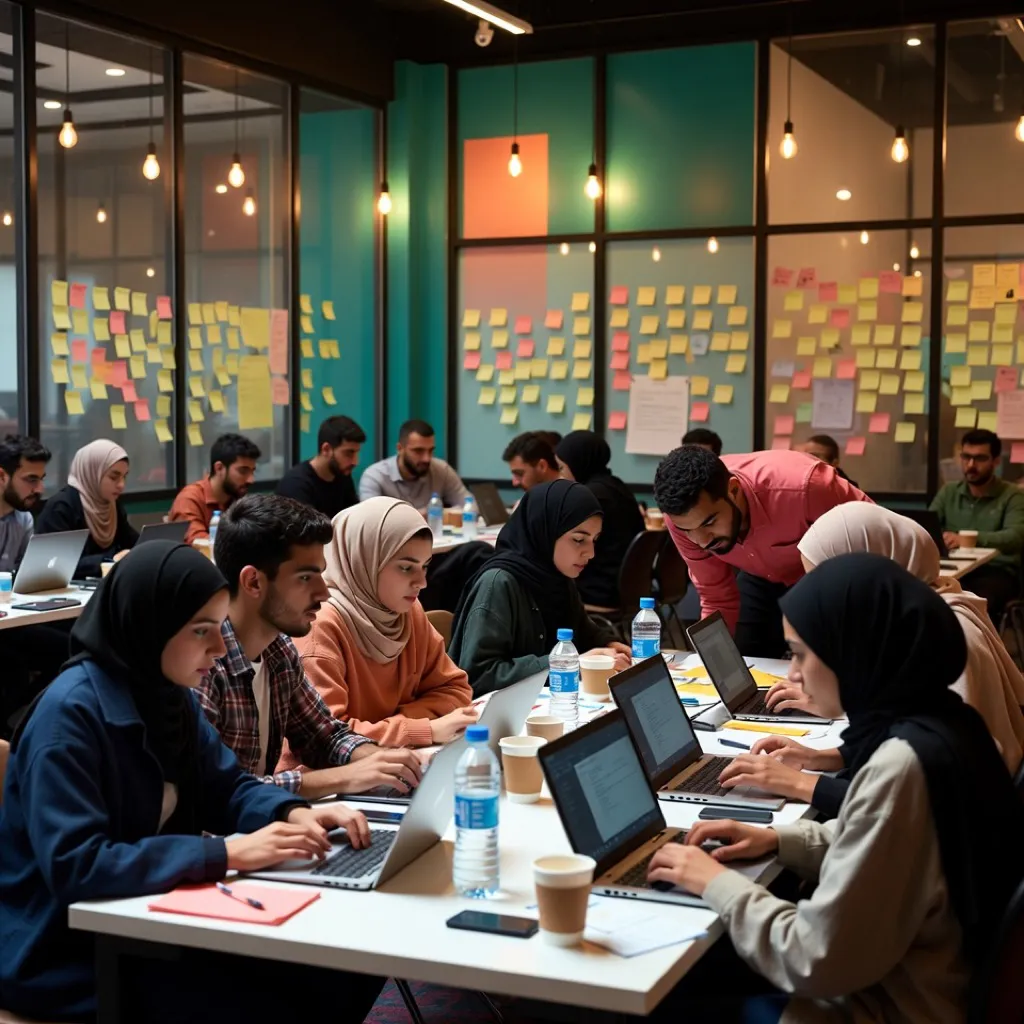
Every weekend in Algeria, somewhere between Algiers, Oran, and Constantine, a hackathon is happening. University-organized coding marathons, corporate innovation challenges by Djezzy, the national Algeria Startup Challenge (now in its 7th edition), the Fintech & Insurtech Open Innovation Challenge, themed competitions around AI, smart cities, and agritech. By conservative estimates, Algeria hosts hundreds of innovation events annually, engaging tens of thousands of participants.
But here is the question nobody asks: what happens on Monday?
After the trophies are handed out, the LinkedIn posts are published, and the corporate sponsors collect their branding footage — how many hackathon projects become actual startups? How many corporate challenges lead to real procurement contracts? How many university competitions produce technologies that reach the market?
The answer reveals a fundamental gap in Algeria’s open innovation ecosystem.
The Hackathon Landscape: A Taxonomy
Algeria’s innovation events fall into four distinct categories, each with different potential for real open innovation:
1. Corporate Innovation Challenges
Examples: Djezzy TECH INNOV hackathon (November 2025, focused on 5G, AI, IoT), Djezzy Impact Challenge (digital inclusion, in partnership with ASC), Fintech & Insurtech Open Innovation Challenge (organized by DZ Hadina Tech, backed by the Ministers of Finance and Knowledge Economy)
These are the most promising vehicles for open innovation because they connect participants directly with corporate resources. When Djezzy runs a hackathon around 5G and emerging technologies or the Fintech Challenge seeks digital payment solutions, the winners theoretically gain access to real customers, real infrastructure, and real budgets. Corporate Accelerator Programs examines how structured corporate programs are attempting to formalize this pipeline beyond one-off events. For a broader view, see Corporate Open Innovation in Algeria.
The reality: Most corporate challenges end at the demo day. The Djezzy TECH INNOV awarded prizes ranging from 200,000 to 700,000 DZD (roughly $1,500 to $5,000) to nine teams — meaningful recognition but not company-building capital. The challenges are typically organized with communications and PR objectives, not R&D or procurement budgets behind them.
2. National Competitions
Examples: Algeria Startup Challenge (ASC, 7th edition in 2025), Injaz El Djazair Young Entrepreneurs Competition, the National Vocational Formation Hackathon
National competitions carry prestige and sometimes cash prizes. The ASC, under the patronage of the Ministry of Knowledge Economy, Startups and Micro-Enterprises, is the flagship event — its 7th edition drew participants from 39 wilayas across 5 open innovation programs, selecting 16 winners. Injaz El Djazair, established in 2019, runs its Young Entrepreneurs Competition (YEC) where the winner represents Algeria at the INJAZ Al-Arab regional celebration.
The reality: Cash prizes are often consumed as personal income, not invested in company building. There is limited structured post-competition support — no systematic follow-on funding pipeline, no mentorship continuity beyond the event, no fast-track connection to NESDA for formal company creation.
3. University Hackathons
Examples: USTHB coding marathons, ESI events, university-organized AI and cybersecurity challenges, Societe Generale Algeria Hackathon (at ENP)
The volume here is significant. Nearly every engineering school in Algeria runs at least 2-3 hackathons per year. Students form teams, build prototypes in 24-48 hours, and present to juries of professors and occasional industry guests.
The reality: University hackathons are skills development events disguised as innovation events. They teach teamwork, rapid prototyping, and presentation skills — all valuable — but the projects are abandoned within days. No university in Algeria has a structured pathway from hackathon winner to incubator to startup.
4. Themed and International Events
Examples: NASA Space Apps Challenge (Algiers node), Google Developer Student Clubs events, Algeria 2.0 (11th edition in 2024 at Cyberparc Sidi Abdellah)
International franchise events bring global methodologies but often lack local follow-through. Algeria 2.0, which gathered innovators for five days of conferences, workshops, and panels in November 2024, is one of the country’s most established tech events. The National Vocational Formation Hackathon, launched in February 2026, drew 447 registered participants across 41 teams from 37 wilayas — showing that the model is extending beyond traditional university settings.
The reality: These events build community and expose participants to entrepreneurial methodology, but sustaining momentum after the event depends entirely on volunteer energy and whatever local ecosystem infrastructure exists.
The Numbers: From Hundreds of Events to How Many Startups?
Tracking outcomes across Algeria’s innovation ecosystem reveals a stark pipeline narrowing:
For context, Algeria currently has over 7,800 startups registered on the official startup.dz platform, with approximately 2,300 holding the official startup label. The hackathon ecosystem is contributing only a fraction of these, suggesting that most Algerian startups form through pathways other than innovation competitions.
Advertisement
Why the Conversion Rate Is So Low
No Post-Event Infrastructure
The hackathon ends, and there is nothing structured waiting. No warm introduction to investors. No office space offer. No mentor assignment. No follow-up meeting scheduled. Winners get a trophy, a check (maybe), and a handshake.
Corporate Challenge Theater
Most corporate sponsors treat innovation challenges as marketing events, not R&D pipelines. The budget comes from the communications department. The jury is composed of executives who have no procurement authority. Even when a winning solution fits the company’s needs, there is no internal champion to push it through procurement.
Skills Gap: From Prototype to Product
A 48-hour hackathon prototype is not a product. It is a demo. The gap between demo and MVP requires 3-6 months of full-time work, user testing, iteration, and often a complete rebuild. Hackathon participants — mostly students — do not have the resources, time, or business knowledge to cross this valley.
Regulatory Friction
Creating a company through NESDA involves a multi-step process — application, committee review, feasibility assessment — that can take weeks to months depending on the financing method. By the time the formalities are completed, the hackathon energy has dissipated and team members have moved on to exams, jobs, or the next hackathon.
The Missing Middle
Algeria has hackathons (idea stage) and some later-stage support (Cyberparc Sidi Abdellah, select accelerators). But the critical middle — the 3-12 month period where a hackathon project becomes a real company — has almost no support infrastructure.
What Good Looks Like: Models That Work
Station F (France): Scale Through Programs
Station F in Paris, the world’s largest startup campus, hosts over 1,000 startups at any given time through 30+ programs, with 8,000 startups having passed through since its founding. Alumni include companies like Hugging Face (valued at $4.5 billion). The key is not a single hackathon but a continuous pipeline: multiple entry points, structured residency programs of 6-12 months, and direct access to 600+ investors on campus. Winning a program competition leads to a structured residency, not just a trophy.
Plug and Play (Global): Corporate Challenge as Procurement
Plug and Play’s innovation platform runs 60+ industry-specific programs across 35+ global locations, connecting 550+ corporate partners with startups. The model works because corporate challenges are explicitly tied to pilot and proof-of-concept opportunities. Winners do not get trophies — they get meetings with named decision-makers at the sponsoring corporation, leading to paid pilot engagements. The platform has invested in 2,000+ startups, with 30+ becoming unicorns.
Singapore: Government as Innovation Buyer
Singapore’s Smart Nation initiative, backed by $2.4 billion in government investment, treats the government itself as an innovation customer. Rather than running standalone hackathons, the approach integrates startup solutions directly into government procurement. Pilot projects are test-bedded in real districts, with named agency champions responsible for implementation outcomes. The model turns innovation challenges into procurement pipelines rather than PR events.
A Framework for Fixing Algeria’s Hackathon Ecosystem
For Corporate Sponsors
- Move budget from marketing to R&D. If the challenge is not connected to a real business problem with real procurement budget, do not run it.
- Mandate pilot contracts for top winners (minimum 3-month paid engagement)
- Assign an internal champion — a product manager or R&D lead who will shepherd the winning solution through procurement
- Report outcomes publicly — how many winners got contracts, revenue generated, solutions deployed
For Universities
- Create hackathon-to-incubator pipelines — winning teams get automatic admission to the university’s incubator (create one if it does not exist)
- Assign faculty mentors to top projects for 6 months post-event
- Offer academic credit for students who continue developing their hackathon project
- Partner with NESDA for fast-track company creation for hackathon winners
For Government
- Condition hackathon funding on outcome reporting — no more grants without measuring what happened after
- Create a national bridge program — a 6-month package with stipend, workspace, and mentorship for top hackathon teams nationally
- Tax incentives for corporations that convert hackathon winners into suppliers
- Track national metrics — the Ministry of Knowledge Economy should publish annual data on hackathon-to-startup conversion rates
For Organizers
- Track and publish conversion rates — how many teams from your last event are still active?
- Build alumni networks — the community value of hackathons is enormous if maintained
- Partner across events — winning teams from university hackathons should be fast-tracked to corporate challenges and then to ASC
Frequently Asked Questions
What is hackathons as open innovation?
Hackathons as Open Innovation: Are Algeria’s Hundreds of Annual Events Producing Real covers the essential aspects of this topic, examining current trends, key players, and practical implications for professionals and organizations in 2026.
Why does hackathons as open innovation matter?
This topic matters because it directly impacts how organizations plan their technology strategy, allocate resources, and position themselves in a rapidly evolving landscape. The article provides actionable analysis to help decision-makers navigate these changes.
How does the hackathon landscape: a taxonomy work?
The article examines this through the lens of the hackathon landscape: a taxonomy, providing detailed analysis of the mechanisms, trade-offs, and practical implications for stakeholders.
Sources & Further Reading
- Algeria Startup Challenge — Official Platform
- Djezzy TECH INNOV National Innovation Hackathon
- Djezzy Impact Challenge 2025 — TechAfrica News
- Fintech & Insurtech Open Innovation Challenge 2024
- Injaz El Djazair — Entrepreneur League
- Station F — World’s Biggest Startup Campus
- Plug and Play — Corporate Innovation Platform
- Algeria First National Vocational Hackathon — TechAfrica News
- NESDA Startup Funding Schemes — WAYA Media
- Smart Hackathon Algeria Platform