A Gigawatt-Scale Campus Built Around Its Own Power Plant
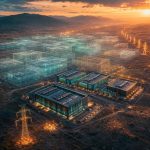
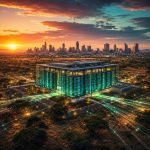
The defining constraint on AI data centers in 2026 is no longer chips or land — it is electricity, and how fast you can get it. The Matrix Data Center Campus is a direct answer to that constraint. It is a $18.7 billion hyperscale AI development in Sulphur Springs, Texas, about 90 minutes east of Dallas, being built by MSB Global Services. The plan calls for 3 gigawatts of capacity delivered across 30 high-density buildings on a 1,677-acre site, phased in over roughly five years.
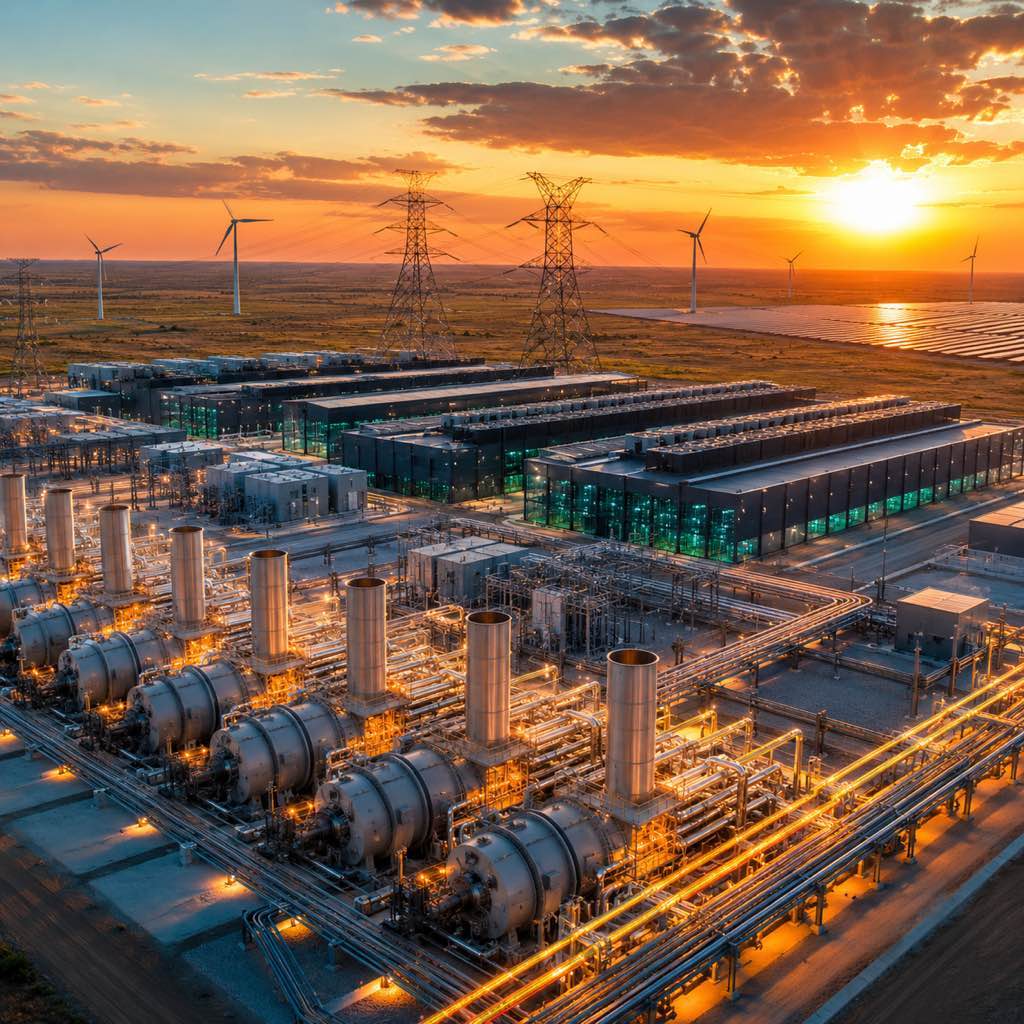
The scale figures are large, but the more consequential detail is how the campus intends to power itself. According to MSB Global’s own project materials, Phase I is anchored by a Bloom Energy fuel-cell microgrid, with the first 100MW building targeted for delivery and later phases adding a geothermal microgrid. The company frames the campus around a net-zero-emissions goal, using on-site zero-carbon generation rather than relying primarily on grid power drawn from the regional utility.
This is a deliberate architectural choice, not a green-marketing footnote. Across the United States, the wait to connect a large new load to the electricity grid now routinely runs into years, and that interconnection queue has become the single biggest bottleneck on bringing AI capacity online. By generating power on-site from the first building, a campus can begin operating while a grid-dependent competitor is still waiting in line for a substation upgrade. The Matrix campus treats its power plant as a core part of the data center, not an external dependency — and that is the part of the story worth studying.
Why On-Site Generation Is Becoming the Default for AI Campuses
The economics of the AI buildout make the power question unavoidable. Global data-center capacity is on a steep growth curve: BloombergNEF reports that JLL projects it could roughly double from about 103 gigawatts today to around 200 gigawatts by 2030, an expansion that analysts estimate could require as much as $3 trillion in new infrastructure spending. A single campus targeting 3GW is a meaningful slice of that projected growth, and every gigawatt of it needs firm, always-on power that intermittent renewables alone cannot guarantee.
That is why the fuel-cell-plus-geothermal approach matters beyond this one site. Fuel cells can be deployed on the data center’s own land on a timeline the operator controls, sidestepping the multi-year utility interconnection queue entirely for the early phases. Geothermal, added in later phases, provides firm baseload generation that runs regardless of weather or time of day — the opposite of solar and wind, whose intermittency makes them a poor sole match for a load that must run 24 hours a day. Together they let a campus scale its power in step with its buildings rather than being gated by a grid upgrade it does not control.
The Cooling Problem That Comes With the Power Problem
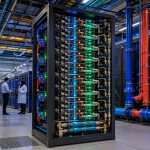
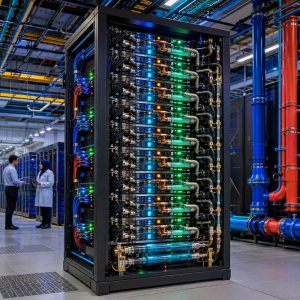
Dense AI hardware creates a second constraint that arrives with the first: heat. The Matrix campus is built for the latest generation of AI accelerators, and its cooling reflects that. MSB’s materials describe direct-to-chip liquid cooling for high-density GPU deployments alongside immersion-cooled tanks — the two cooling techniques that have become standard for racks drawing far more power per unit than the air-cooled servers of a few years ago.
The reason air cooling no longer suffices is straightforward physics. A rack packed with modern AI accelerators can draw an order of magnitude more power than a traditional server rack, and all of that power turns into heat that has to be removed before the chips throttle or fail. Direct-to-chip cooling pipes liquid coolant straight to the hottest components; immersion cooling submerges hardware in a dielectric fluid. Both move far more heat than moving air can, which is why campuses designed in 2026 treat liquid cooling as the baseline rather than an upgrade. The MSB campus notably pairs this with a stated zero-water-use design for its cooling — a meaningful choice in a Texas region where water availability is itself a planning constraint.
Advertisement
What This Means for Infrastructure Buyers and Planners
1. Evaluate power availability before location, not after
When assessing where to place or procure AI capacity, treat firm power availability as the first filter, ahead of land cost or fibre proximity. The Matrix campus is sited and structured around its ability to generate power on-site precisely because grid access, not real estate, is the scarce input. Ask any prospective data-center partner how their power is sourced and how quickly it scales — a site dependent on a distant grid upgrade carries a schedule risk that on-site generation removes.
2. Treat cooling architecture as a capacity decision, not a facilities detail
Whether a facility supports direct-to-chip or immersion cooling determines what density of AI hardware it can actually host. A data center still designed around air cooling caps out at a power density that modern accelerators exceed, which limits the AI workloads it can run at all. When procuring capacity, confirm the cooling architecture matches the hardware generation you intend to deploy — it is a throughput ceiling, not a comfort feature.
3. Read net-zero claims as schedule strategy, not just sustainability
On-site zero-carbon generation like fuel cells and geothermal is often framed as an environmental commitment, but its harder value is schedule certainty and independence from the interconnection queue. When a campus advertises a net-zero microgrid, read it also as a claim about how fast it can come online without waiting for the utility. Weigh that operational advantage alongside the environmental one — for a load that must run continuously, it may be the more decisive factor.
Where This Fits in 2026’s Infrastructure Race
The Matrix campus is one data point in a much larger buildout, but it captures the shift cleanly: the AI infrastructure race has become a power-generation race. The industry is committing enormous sums — hyperscalers alone are on track to spend well into the hundreds of billions of dollars on AI infrastructure this year — and the projects that move fastest are increasingly the ones that solve their own power rather than queuing for someone else’s. A $18.7 billion campus that brings its own fuel cells and geothermal to a rural Texas county is a bet that this pattern holds: that the operators who control generation will out-build those who depend on the grid.
The counter-case is worth keeping in view. On-site generation is capital-intensive and operationally complex; fuel cells and geothermal add engineering and fuel-supply risks that a simple grid connection avoids, and a 3GW campus phased over five years is exposed to shifts in AI demand that could leave later phases stranded if the buildout cools. But for now the direction is clear, and it reframes what an AI data center even is. The building is no longer just a hall full of servers — it is a power plant with a compute load attached, and the competitive edge is moving to whoever can generate firm, clean electricity on their own schedule.
Frequently Asked Questions
What is the Matrix Data Center Campus and who is building it?
The Matrix Data Center Campus is a $18.7 billion hyperscale AI data-center development in Sulphur Springs, Texas, about 90 minutes east of Dallas, being built by MSB Global Services. It targets 3 gigawatts of capacity across 30 high-density buildings on a 1,677-acre site, phased over roughly five years, with Phase I anchored by a Bloom Energy fuel-cell microgrid and later phases adding geothermal generation.
Why does the campus generate its own power instead of using the grid?
Across the United States, connecting a large new load to the electricity grid now routinely takes years, and that interconnection queue has become the biggest bottleneck on bringing AI capacity online. By generating power on-site with fuel cells from the first building and adding geothermal later, the campus can begin operating on a timeline it controls rather than waiting for a utility upgrade — turning power from an external dependency into a core part of the facility.
Why do AI data centers need liquid and immersion cooling?
A rack packed with modern AI accelerators can draw roughly an order of magnitude more power than a traditional server rack, and all that power becomes heat that must be removed before chips throttle or fail. Air cooling cannot move heat fast enough at those densities, so direct-to-chip liquid cooling and immersion cooling — which the Matrix campus uses — have become the baseline for high-density AI hardware rather than an optional upgrade.
Sources & Further Reading
🔗 Related Intelligence

Texas Responsible AI Governance Act: Enforcement Starts in 2026
Texas vs. Virginia: The Data Center Capital of the World Is Shifting

3M and Microsoft: The Fiber Connector Deal Quietly Unclogging AI Data Centers
AI Racks at 1 MW: How AI Is Forcing a Complete Rethink of Data Center Design