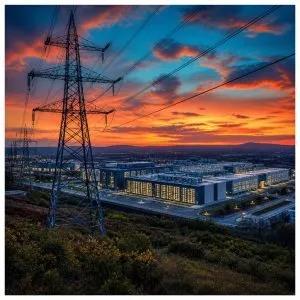
A Queue Five Times Bigger Than the Grid Itself
Texas has spent the past three years marketing itself as the friendliest state in the country for data center construction — cheap land, deregulated power markets, and a governor eager to court hyperscalers. That posture shifted abruptly on August 3, 2026, when Governor Greg Abbott directed ERCOT and the PUCT to pause new data center interconnection approvals until both agencies complete a statewide audit of energy and water use.
The trigger is scale. ERCOT’s interconnection queue has swollen to more than 1,800 projects requesting a combined 474 gigawatts of electricity — more than five times ERCOT’s record peak demand. According to the Texas Tribune, roughly 90% of that new-power demand comes from data center projects, and the state already has 335 data centers operating with another 248 planned, putting Texas in second place nationally behind Virginia and on track to take the top spot.
Abbott framed the move as protective rather than punitive: “Our top priority is to protect Texans’ safety and quality of life,” he wrote, warning that unchecked data center growth “could endanger the reliability and stability of the Texas electric grid,” according to Utility Dive’s reporting on his letter.
What the Audit Actually Demands
Abbott’s directive is narrower than a blanket moratorium — it requires data center developers to document specifics before ERCOT will process their interconnection requests. Per Houston Public Media and the Texas Tribune, operators must disclose:
- Projected annual and peak power consumption, and how much of it will come from self-generation versus the grid
- Projected water consumption and where that water will be sourced, including reuse practices
- Cooling technologies in use
- Tax breaks and public incentives received
- Facility ownership structure
- Plans to mitigate community impact
Projects that fail to verify this information face denial. The immediate operational fallout: ERCOT has suspended its “Batch Zero” transmission planning study — the first tranche of projects moving through the state’s new large-load interconnection process — and will ask the PUCT for a good-cause exemption to delay related notifications at the commission’s August 20, 2026 open meeting, per Utility Dive.
The audit isn’t happening in a vacuum. A prior PUCT survey asking data center operators to disclose water and power usage drew responses from just 28 of 377 companies contacted — a 7.4% response rate that state Rep. Brad Buckley called “pretty pathetic,” underscoring why regulators felt they were flying blind on the scale of committed demand.
Industry Pushback and Political Crosscurrents
Reaction split along predictable lines. The Data Center Coalition’s Dan Diorio argued the audit could ultimately help the industry, saying it could “showcase the good actors in the data center industry rather than delaying them unnecessarily,” per the Texas Tribune.
Critics came from both directions. Texas Agriculture Commissioner Sid Miller argued the governor’s directive lacks the force of law without legislative backing, while environmental groups, including Environment Texas, called for a special legislative session to codify stronger rules rather than relying on an executive order that could be reversed. State Rep. Gina Hinojosa said the move didn’t go far enough to protect ratepayers and residents near proposed sites.
Texas isn’t acting alone. New York implemented a similar move in July 2026, pausing new data center approvals for up to a year while it drafts development guidelines — a sign that state-level circuit breakers on AI infrastructure buildout are becoming a pattern, not an isolated Texas reaction, Utility Dive reports.
What makes the Texas case distinct is that it’s happening in the state that most aggressively courted this growth. ERCOT’s deregulated, single-grid design and Texas’s light-touch permitting were the specific selling points hyperscalers cited when siting campuses in the Dallas-Fort Worth and Houston metros over the past three years. A governor who has spent that period welcoming data center announcements as economic-development wins is now the one ordering the pause — a reversal that carries more signal for the industry than a similar move from a state that was never a top destination to begin with.
Advertisement
The Water Question Nobody Had Numbers For
The disclosure gap is arguably the more consequential part of Abbott’s order than the interconnection freeze itself. Texas regulators had been trying to get a basic inventory of data center water and power demand since well before August, and the 7.4% survey response rate meant the PUCT was setting policy on a sector it could not actually measure. Water is the sharper edge of that gap: much of Texas is under recurring drought stress, and large liquid-cooled AI campuses can consume water at a scale comparable to a small city, yet operators had faced no mandatory, verified reporting requirement tying a specific project to a specific water source. Abbott’s directive converts that from a voluntary survey question into a precondition for grid access — a shift from “please tell us” to “we will not connect you until you do.”
What This Means for Data Center Operators and Investors
1. Budget for disclosure compliance as a new gating cost, not paperwork
Before Abbott’s order, developers could submit interconnection requests with minimal public disclosure of water and power sourcing. Now, incomplete or unverifiable filings risk outright denial. Operators active in ERCOT territory should build a standing compliance function — water audits, cooling-technology documentation, ownership disclosure — into pre-construction budgets rather than treating it as a late-stage formality.
2. Prioritize self-generation and co-located power deals
Abbott’s audit explicitly asks how much of a project’s power will come from self-generation versus grid draw. Projects that already pair with dedicated gas, solar, or battery capacity — the model NextEra and Brookfield used for their Kentucky campus (see below) — will clear scrutiny faster than projects relying entirely on ERCOT capacity that doesn’t yet exist.
3. Expect the pause to ripple into financing timelines
With Batch Zero transmission studies suspended and no fixed end date on the audit, lenders and equity partners on Texas-sited projects should model multi-month delays into their construction schedules. The PUCT’s August 20 meeting is the first checkpoint to watch for how long the freeze extends.
4. Track parallel state actions, not just Texas
New York’s twelve-month pause shows this is a multi-state trend. Developers with multi-site pipelines should assume other states — particularly those with concentrated interconnection queues — may follow with their own audits or moratoria before a project reaches financial close.
The Bigger Picture
Texas built its data center boom on the promise of a fast, deregulated grid that could say yes faster than anywhere else. A queue at 474 gigawatts — a number no single state grid can physically absorb — turned that speed advantage into a liability regulators could no longer ignore. The pause doesn’t kill Texas’s data center pipeline; ERCOT and the PUCT have given no end date, and the state’s underlying advantages in land and market structure remain intact. But it does mark a shift in the negotiating leverage between hyperscalers and host states: for the first time in the current AI buildout cycle, a top-two data center state is asking operators to prove their numbers before it will guarantee power, not after.
Frequently Asked Questions
What exactly did Texas pause, and why?
On 3 August 2026, Governor Greg Abbott directed ERCOT and the Public Utility Commission of Texas to audit every data center in the interconnection queue before approving new grid connections. The trigger was scale: the queue had swollen past 1,800 projects requesting a combined 474 gigawatts — more than five times ERCOT’s record peak demand — with roughly 90% of that demand coming from data centres. It is a pause pending a statewide audit of energy and water use, not a blanket moratorium.
What must data centre operators now disclose?
Operators must document projected annual and peak power consumption and how much comes from self-generation versus the grid, projected water consumption and its source including reuse practices, cooling technologies in use, tax breaks and public incentives received, facility ownership structure, and plans to mitigate community impact. Projects that fail to verify this face denial, and ERCOT has suspended its “Batch Zero” transmission planning study in the meantime.
Is this only happening in Texas?
No. New York implemented a similar move in July 2026, pausing new data centre approvals for up to a year while it drafts development guidelines — which Utility Dive reads as a sign that state-level circuit breakers on AI infrastructure buildout are becoming a pattern rather than an isolated Texas reaction.
Sources & Further Reading
🔗 Related Intelligence

Texas vs. Virginia: The Data Center Capital of the World Is Shifting

The $18.7 Billion Matrix Campus: How a 3GW AI Data Center Rethinks Power in Texas
The Flexibility Bargain: How Data Centers Trade Curtailment for Faster Power

The Data Center Capacity Mirage: Why Committed Gigawatts Aren’t Getting Built