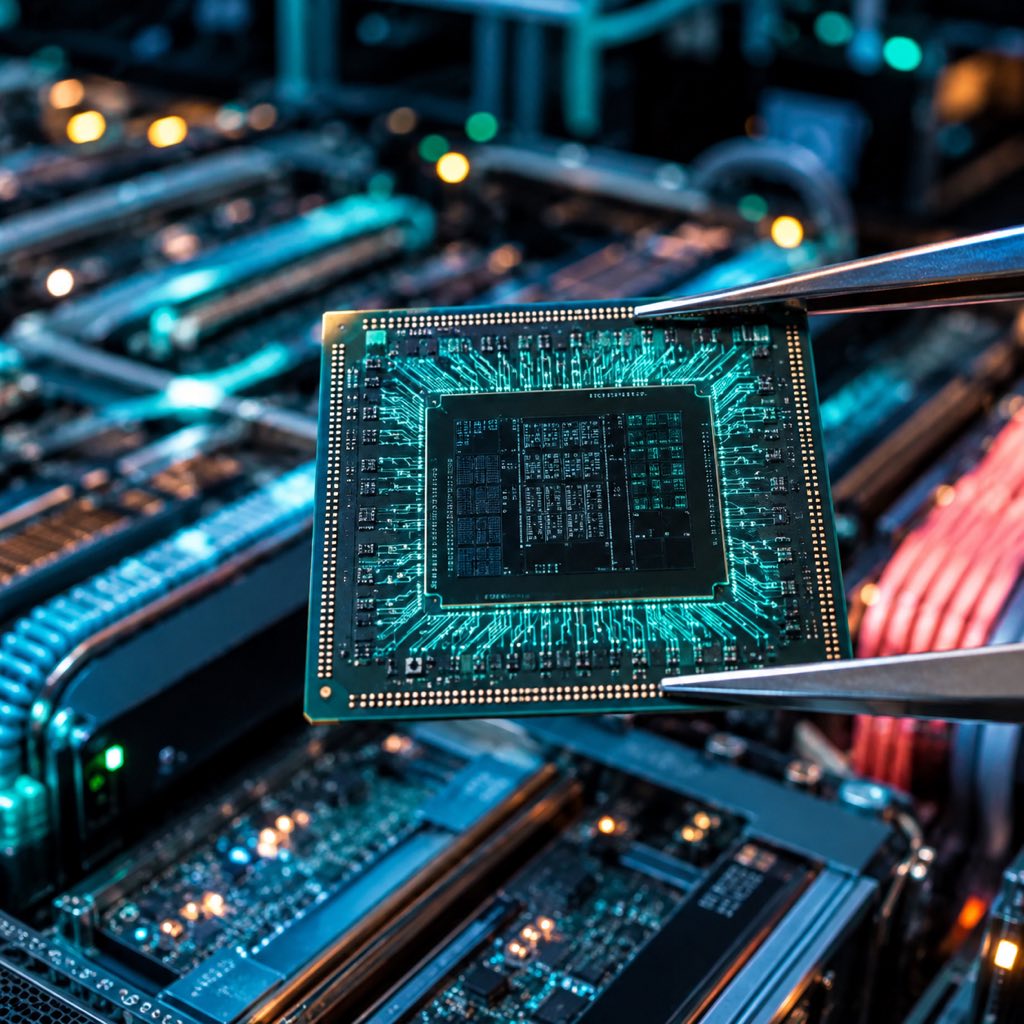
The Specs: 320 Billion Transistors and a Generational Memory Jump
AMD unveiled the Instinct MI455X at its Advancing AI 2026 event on July 23, 2026, with ServeTheHome’s detailed technical breakdown putting the chip’s transistor count at 320 billion — a 72% increase over the prior generation — manufactured on TSMC’s N2 (2nm) process. The headline number is memory: 12 stacks of HBM4 at 36GB per stack deliver 432GB of total memory capacity, backed by 23.3 TB/second of memory bandwidth — 2.9 times the bandwidth of the MI355X it replaces.
On raw compute, ServeTheHome reports peak FP4 performance of roughly 40 PFLOPS, with FP8 performance at approximately half that figure. Tensor performance specifically improves up to 4x over the MI355X in peak MXFP8 and MXFP4 workloads — a figure corroborated by Phoronix’s coverage of the launch, which also notes the chip carries 50% more HBM capacity than its predecessor. Vector operations in FP32/FP16 roughly double versus the prior generation, according to ServeTheHome’s breakdown, while chip-to-chip interconnect bandwidth via AMD’s Ultra Accelerator Link reaches 3.6 TB/second — more than 4x the aggregate link bandwidth of the MI355X generation.
That combination — near-tripled memory bandwidth, quadrupled tensor throughput on key AI workloads, and 50% more onboard memory — targets the specific bottleneck that constrains large language model inference and training today: moving enormous parameter sets and activation data between memory and compute fast enough to keep the compute units fed. AMD’s architecture bet with CDNA 5 is that memory bandwidth, not raw FLOPS, is increasingly the limiting factor for frontier AI workloads.
Helios: The Rack-Scale System Built Around MI455X
The MI455X doesn’t ship as a standalone chip for most customers — it ships inside Helios, AMD’s rack-scale AI system that pairs the new GPUs with AMD’s EPYC Venice CPUs and Pensando networking. Phoronix reports Helios is now in full production, with each rack delivering 4,600 CPU cores and 18,000 GPU compute units. Those figures translate to a shared-memory pod design intended to scale up to 72 GPUs working together on a single workload, according to ServeTheHome’s architecture analysis.
Power draw is substantial: ServeTheHome estimates each MI455X GPU consumes north of 2 kW, with total Helios rack power climbing upwards of 245 kW — a figure that underscores how thoroughly the AI infrastructure buildout has shifted the data center conversation from compute density alone to power delivery and cooling capacity as the primary deployment constraint. A rack drawing a quarter-megawatt is not something most existing data center facilities can simply retrofit into an available rack slot; it requires purpose-built power and liquid-cooling infrastructure from the ground up.
Phoronix quotes a firsthand account from AMD’s San Francisco demonstration describing Helios as “mighty impressive” in person, and reports shipments are happening later in the current quarter, ramping into the fourth quarter of 2026 and continuing into the first half of the following year — a staged rollout typical of rack-scale AI systems where component supply, cooling infrastructure, and customer data center readiness all need to align before volume deployment.
Advertisement
AMD’s Executive Framing: Three Distinct AI Infrastructure Markets
AMD Senior Vice President of AI Vamsi Boppana positioned the MI455X launch within a broader portfolio strategy, stating: “The next generation of AI will span frontier AI, sovereign AI and scientific computing, and each requires infrastructure optimized for its unique demands.” That framing explains why AMD launched the MI455X alongside a second chip, the Instinct MI430X, which AMD’s own announcement specifies delivers up to 288 TFLOPS of hardware-based FP64 performance for scientific computing and sovereign AI workloads — a different performance profile than the MI455X’s AI-training-optimized FP4/FP8 focus.
Security features also featured prominently in AMD’s own announcement, which highlighted secure boot, encrypted GPU-to-GPU links, and additional hardware-level protections built into the MI400 series — a detail relevant to sovereign AI deployments, where government and defense customers typically require verifiable hardware security guarantees beyond what commercial cloud AI deployments demand.
What This Means for Enterprises Planning AI Infrastructure
1. Factor power and cooling infrastructure into MI455X deployment planning before compute capacity
With individual GPUs drawing more than 2 kW and full Helios racks approaching 245 kW, enterprises evaluating MI455X deployments need to validate facility power delivery and liquid-cooling capacity as the first planning constraint, not compute budget. Many existing colocation facilities will need dedicated high-density zones or new-build capacity to host Helios racks at scale.
2. Treat AMD’s staged late-2026 shipping window as a planning horizon, not an immediate procurement option
Since Phoronix reports shipments ramping into the fourth quarter of 2026 and continuing into the following year, enterprises should treat MI455X and Helios as a mid-to-late-2026 planning horizon for production deployment, using the intervening months to finalize data center readiness, software stack validation on AMD’s ROCm platform, and procurement contracts rather than expecting near-term delivery.
3. Evaluate MI430X separately for scientific computing and sovereign AI use cases
Because AMD explicitly split its MI400-series lineup between the AI-training-optimized MI455X and the FP64-focused MI430X for scientific and sovereign workloads, organizations with HPC or government-security requirements should evaluate the MI430X’s specific FP64 performance profile rather than defaulting to the MI455X spec sheet, which is optimized for a different computational profile entirely.
The Real Contest: Memory Bandwidth as the New Battleground
AMD’s MI455X launch reflects where the AI chip competition has actually moved: not toward ever-higher peak FLOPS figures alone, but toward memory capacity and bandwidth, since modern large language models are frequently bottlenecked by how fast parameter and activation data can move between memory and compute rather than by raw arithmetic throughput. By pairing a 2.9x bandwidth increase with 50% more HBM4 capacity, AMD is betting that this specific dimension — not peak FLOPS on a spec sheet — is what will differentiate real-world AI training and inference performance against Nvidia’s upcoming Rubin architecture. Whether that bet pays off depends on how Rubin’s own memory specifications compare when Nvidia’s chip ships, and on how quickly AMD’s ROCm software ecosystem can close the maturity gap that has historically made Nvidia’s proprietary software platform the default choice for AI infrastructure buyers regardless of underlying hardware specifications.
The security features AMD built into the MI400 series also deserve attention beyond the raw performance numbers, because they signal AMD’s ambition to compete for a category of AI infrastructure spending that pure performance specs don’t capture: government and defense procurement, where secure boot chains and encrypted GPU-to-GPU interconnects are often contractual requirements rather than nice-to-have features. Nvidia has historically dominated even security-conscious government AI deployments simply because its software ecosystem is more mature, but a chip with comparable or superior memory bandwidth, hardware-level security guarantees, and a growing ROCm developer base changes the calculus for procurement officers who previously defaulted to Nvidia by habit rather than by a documented technical requirement that only Nvidia’s hardware could satisfy.
Frequently Asked Questions
What are the key specs of AMD’s Instinct MI455X?
The MI455X packs 432GB of HBM4 memory across 12 stacks, delivering 23.3 TB/second of memory bandwidth, with 320 billion transistors built on TSMC’s 2nm process and up to 40 PFLOPS of peak FP4 AI compute — up to 4x the tensor performance of AMD’s prior-generation MI355X.
When will the MI455X and Helios rack systems be available?
Phoronix reports shipments are happening later in the current quarter, ramping into the fourth quarter of 2026 and continuing into the first half of the following year, with the Helios rack platform already in full production as of the announcement.
How does the MI455X differ from AMD’s MI430X, also announced at the same event?
AMD’s own announcement specifies the MI430X targets sovereign AI and scientific computing with up to 288 TFLOPS of hardware-based FP64 performance, a different computational profile than the MI455X’s FP4/FP8-optimized design for frontier AI training and inference workloads.
Sources & Further Reading
🔗 Related Intelligence
SK hynix’s HBM4 Gambit: Two-Thirds of Nvidia’s Rubin Memory and a 48GB Stack

The AI Chip Wars: Nvidia’s Dominance, AMD’s Challenge, and the Rise of Custom Silicon
NVIDIA GB300 NVL72: The 72-GPU Rack Redefining AI Infrastructure
OpenAI’s Jalapeño: A First-Gen Inference Chip That Actually Competes With Nvidia