The Gap Between Announced and Built
The data center industry has a forecasting problem, and it isn’t about demand. Demand is real and growing — the global data center infrastructure market is on track to expand from $297.07 billion in 2025 to $752.12 billion by 2034, a 10.9% compound annual growth rate driven mainly by AI and high-performance computing workloads. The problem is timing: the gap between what gets announced and what actually gets energized has widened into a chasm that is now reshaping how enterprises plan cloud capacity.
The clearest evidence comes from a mid-2026 tracking exercise by Currence, an energy intelligence firm that followed 777 announced AI facilities and large data centers above 50 megawatts. Of a 190 GW total announced pipeline, roughly 16 GW was slated to begin operations in 2026 — but as Network World reported, only about 5 GW of that was physically under construction, leaving 11 GW still sitting in the announced-but-unbuilt stage. Currence’s data shows the pattern is not new: during 2025, more than a quarter of expected capacity missed its completion date outright, and another 10% quietly pushed its operational date back. Between 30% and 50% of the capacity expected to land in 2026 is now projected to be delayed or canceled for the same reasons.
Independent industry analysis backs this up from a different angle. A 2026 trends review from DC Byte, covered by Cloud Computing News, found that in several major markets, committed capacity — deals signed, land bought, power negotiated — now exceeds actively under-construction volume by more than 100%. In plain terms: for every megawatt physically being poured into concrete and steel, there is more than one additional megawatt that exists only on paper. The same analysis notes that grid congestion has pushed power-connection timelines for large projects toward the end of the decade in several regions, meaning a deal signed today may not deliver usable power until 2029 or later.
Where the Bottleneck Actually Sits
The instinctive assumption — that AI chip supply is the constraint — is outdated. The binding constraint has moved downstream, to the physical systems that get power from a substation into a server hall. Three chokepoints dominate.
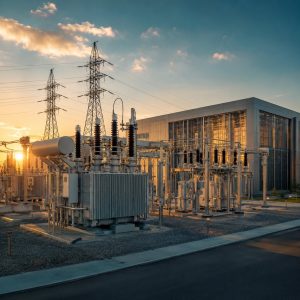
The first is grid interconnection. Utilities across major U.S. markets are sitting on queues that were sized for a pre-AI world, and large commercial load requests now compete with a wave of new generation and storage projects trying to connect to the same grid. The second is equipment. Power transformers — the unglamorous boxes that step voltage down from transmission to usable levels — have gone from a commodity part to a scarce one. Standard catalog units that once shipped in weeks now carry 12-to-26-week lead times even for off-the-shelf models, while custom units built for constrained sites run 40 weeks or more, and specialized transformers from legacy manufacturers can take over a year — driven by shortages of grain-oriented electrical steel, copper, and skilled assembly labor, not by any single company’s mismanagement. The third is permitting and community pushback: environmental review, water-use approvals, and increasingly organized local opposition to the electricity-cost and land impact of hyperscale campuses.
These constraints don’t hit every project the same way, which is why the newest wave of announcements pairs capacity directly with dedicated power. Digital Realty’s Kansas City campus, built on 1,440 acres, is targeting 600 MW near-term by early 2028 en route to a 2 GW full build — a deliberately staged timeline that assumes the power won’t arrive all at once. SoftBank’s Northern France campus is structured the same way: a 5 GW total ambition, but only a 3.1 GW first phase, backed by a €75 billion ($85 billion) commitment, because even a company writing an $85 billion check can’t will a grid connection into existence faster than the interconnection queue allows. And in the Middle East and Africa, Damac Digital’s plan for 6,000 MW across 13 countries is explicit about sequencing — the company has broken ground on 10 new sites in five months but expects only 8 of them operational by the end of 2026, effectively admitting up front that 20% of even its near-term pipeline will slip.
Cloud buyers are already adjusting. On Google’s most recent earnings call, CFO Anat Ashkenazi cited “capacity constraints” as a direct driver behind a $205 billion capital expenditure commitment — not discretionary growth spending, but a response to the fact that demand is outrunning deliverable supply. A separate Information Services Group survey found that growing AI compute demand, cost pressure, and data-sovereignty requirements are pushing more enterprises toward hybrid cloud architectures rather than single-vendor commitments, and that over 70% of enterprise leaders now describe switching their primary AI provider as “challenging” — a lock-in risk that gets worse, not better, when capacity is scarce and providers hold the negotiating leverage.
Advertisement
What Enterprise Cloud Leaders Should Do About It
1. Treat 2026-2027 capacity commitments as options, not guarantees
A signed capacity agreement today is not the same asset it was in 2022. With committed capacity outpacing under-construction volume by more than 100% in several markets, per Cloud Computing News’ analysis of DC Byte’s data, a contract for capacity in a congested market is a bet on a provider’s ability to clear its own permitting and interconnection backlog, not a delivery date. Negotiate contractual delay penalties and staged fallback capacity into every multi-year agreement, rather than assuming the megawatts show up on schedule.
2. Lock in regional capacity 18-24 months earlier than you think you need it
Given that the median wait for large-scale grid connections has stretched well past the two-year mark in constrained U.S. markets, and that transformer lead times alone can run 40 weeks to over a year, per gigaenergy.com’s lead-time data, any capacity planning cycle built around a 6-to-12-month runway is now obsolete. Push regional capacity reservations into the planning cycle a full budget year earlier than legacy procurement calendars assume, and treat the reservation itself — not the deployment — as the scarce resource.
3. Diversify across providers and geographies rather than concentrating on one hyperscaler
The ISG finding that over 70% of enterprise leaders see switching AI providers as “challenging” is a warning, not a footnote — it describes exactly the lock-in dynamic that worsens when one vendor’s capacity queue backs up. Split new AI workloads across at least two cloud providers and two geographic regions where compliance allows, so a single grid-interconnection delay or transformer shortfall at one vendor’s site doesn’t stall the whole roadmap. Neocloud and colocation providers, which are less exposed to hyperscaler-scale grid queues, are a legitimate overflow option for latency-tolerant workloads.
4. Build a delay-risk line item into every AI infrastructure roadmap, not just the budget
Executives are already doing this at the top: Google’s own CFO cited capacity constraints, not chip supply, as a driver of a $205 billion capex increase, per CIO Dive’s coverage. Enterprise IT leaders should mirror that discipline internally — attach an explicit probability-weighted delay estimate (using the 30-50% delay rate documented across the 2026 pipeline as a baseline) to every AI infrastructure milestone that depends on new data center capacity, and communicate that risk to the business stakeholders who are planning product launches around it.
Where This Fits in the 2026 Infrastructure Race
The uncomfortable truth is that the data center industry’s capacity problem is not a temporary supply hiccup that resolves once a few transformer factories ramp up. Grid interconnection queues, permitting cycles, and skilled-labor pipelines all move on multi-year timelines that don’t compress just because AI demand accelerated faster than anyone modeled. That mismatch means the 30-50% delay rate documented in the 2026 pipeline is closer to a new baseline than an anomaly — and the projects that are staging their builds deliberately, like Digital Realty’s Kansas City campus or SoftBank’s French megasite, are implicitly conceding that point rather than fighting it.
For enterprise cloud buyers, the strategic shift this demands is a move away from treating data center capacity as a commodity that scales linearly with a purchase order, and toward treating it as a constrained physical resource with its own multi-year supply chain — power, transformers, land, and community consent — that has to be reserved and hedged well before it’s needed. The winners in this environment won’t be the companies that signed the biggest capacity deals; they’ll be the ones that planned for the gap between what got announced and what actually got built.
Frequently Asked Questions
Why is data center capacity being delayed in 2026?
The primary causes are power grid interconnection backlogs, a global shortage of power transformers with lead times of 40 weeks to over a year, and permitting or community-opposition delays. Currence’s tracking of 777 announced AI facilities found only about 5 GW of a 16 GW 2026 pipeline is physically under construction, with 30-50% of that capacity projected to be delayed or canceled.
What is causing the power transformer shortage?
Shortages of raw materials such as grain-oriented electrical steel, copper, and aluminum, combined with limited skilled assembly and testing labor, have pushed standard transformer lead times to 12-26 weeks and custom units to 40 weeks or more, with specialized units from legacy manufacturers sometimes exceeding a year.
How should enterprises adjust their cloud strategy given these delays?
Enterprises should treat signed capacity agreements as options rather than guarantees, reserve regional capacity 18-24 months ahead of need, diversify workloads across multiple providers and regions, and build an explicit delay-risk estimate into AI infrastructure roadmaps rather than assuming committed megawatts will arrive on schedule.
Sources & Further Reading
- Data centre delivery constraints: implications for enterprise cloud strategy in 2026 — Cloud Computing News
- Up to 50% of data center capacity slated for 2026 could be delayed — Network World
- Data Center Infrastructure Market Expected to Reach US$ 752.12 Billion by 2034 — GlobeNewswire
- New Data Center Developments, July 2026 — Data Center Knowledge
- Transformer Lead Times: What to Expect and How to Get Faster Delivery — Giga Energy
- Cloud topic coverage — CIO Dive
🔗 Related Intelligence

The Hidden Bottleneck Halting the AI Data Center Boom: Transformer and Switchgear Shortages

Phantom Power: Why Two-Thirds of AI Data Center Demand Will Never Get Built
AI Racks at 1 MW: How AI Is Forcing a Complete Rethink of Data Center Design
Grid Transformer Shortage: The 5-Year Bottleneck Stalling AI Data Centers in 2026