
The Atom Whisperers Solving AI’s Invisible Supply Chain Problem
When people talk about the bottlenecks holding back AI infrastructure build-out, the conversation usually lands on the same three topics: GPU supply, power capacity, and fibre. Materials science rarely comes up — and that is precisely the gap that a London-and-San-Francisco-based startup called Orbital Industries has moved to fill.
Orbital — founded in 2022 and formerly known as Orbital Materials before a recent rebrand — closed a $50 million Series B in May 2026. Plural led the round. NVIDIA’s venture arm NVentures joined alongside Radical Ventures, Compound, and Fly Ventures. For a 50-person team that has yet to put a product on the market, the round represents an unusually high-conviction bet, and the presence of NVentures is the most telling signal: NVIDIA has a direct commercial interest in seeing data center cooling become cheaper, faster, and cleaner.
The company’s pitch is that the periodic table contains roughly 100 million theoretically stable compounds, but humans have only ever characterised a few hundred thousand of them. Most of that unexplored space contains materials with exotic properties — superconductivity at higher temperatures, thermal conductivity far beyond today’s coolants, dielectric constants that could transform chip packaging. The problem has always been the time it takes to explore that space experimentally. Orbital argues AI can collapse that timeline from decades to months.
What Orbital Industries’ Orb Model Actually Does
At the centre of Orbital Industries’ technology is a foundation AI model named Orb. CEO Jonathan Godwin describes the company as “vertically integrated” — meaning Orb is not a general-purpose research tool licensed to third parties but a proprietary model that Orbital uses to design, simulate, and ultimately commercialise new compounds internally.
According to Fortune’s reporting on the Series B, Orb can predict and simulate the quantum mechanical behaviour of atoms, handling simulations of 100,000 atoms on a single GPU — a scale that would require a small supercomputer cluster using conventional density functional theory calculations. The model runs roughly 10 times faster than alternatives at equivalent accuracy. That combination of scale and speed is what allows Orbital to actually close the loop: generate a candidate compound, simulate its behaviour in the target application, reject or refine, and iterate — all within a computational budget a startup can afford.
The first output from that pipeline is a liquid coolant designed specifically for GPU data centers. Traditional cooling fluids require strict regulatory scrutiny because the most effective historical options relied on PFAS — per- and polyfluoroalkyl substances, the “forever chemicals” that persist in the environment and face tightening bans across the EU and US. Designing a PFAS-free alternative with comparable thermal performance would normally take a decade and cost in the range of $100 million in laboratory trials and regulatory testing. Orbital completed that work in a matter of months. Commercial deployment is expected in 2027, which would make it — in the company’s own framing — the first AI-designed molecule to hit the commercial market.
Alongside the coolant, Orbital is developing a modular data center system that can be deployed in six months, compared to the three-year timeline that conventional hyperscale builds require. The combination positions Orbital not merely as a materials supplier but as a vertically integrated infrastructure enabler: designing the compounds that go into the facility, and helping customers get the facility built faster.
Advertisement
Why VCs Are Betting on Deep Tech Materials Now
The timing of this round is not accidental. Global venture funding hit $56 billion in April 2026, a 100% year-over-year increase from April 2025’s $26 billion, with AI capturing 66% of total global investment. Within that AI slice, infrastructure-focused bets — semiconductors, data centers, and supporting physical systems — attracted $1.8 billion in April alone. The broader appetite for picks-and-shovels AI plays is clear.
But what makes Orbital’s raise distinct is the materials-science angle. Through 2024, the overwhelming majority of AI venture dollars went to model companies, application layer software, and GPU-adjacent infrastructure. The Qubit Capital AI fundraising tracker puts AI’s share of global VC at roughly one-third of all 2024 venture investment, with US private AI spending at $109.1 billion — vastly outpacing the UK’s $4.5 billion and China’s $9.3 billion. Yet within that enormous pool, materials science has been a rounding error.
That is now changing for a structural reason: the physical constraints of scaling AI compute are becoming undeniable. Power delivery, thermal management, and facility construction timelines are the three most cited friction points in hyperscale expansion. Each of them has a materials-science dimension — from the dielectrics in power distribution hardware to the thermal interface materials between chip and heatsink to the structural compounds in prefabricated modular builds. NVIDIA’s decision to back Orbital through NVentures signals an explicit acknowledgement that the GPU roadmap is only as fast as the materials supply chain behind it.
Radical Ventures, another Orbital backer, has been one of the more consistent voices arguing that “AI for science” is the next major investment wave after generative AI for software. The logic is straightforward: AI that designs better materials, better drugs, and better manufacturing processes can unlock productivity gains an order of magnitude larger than AI that writes marketing copy or summarises documents. Orbital is one of the earliest funded examples of that thesis graduating from academic spin-out to commercially oriented Series B company.
What Founders and Tech Leaders Should Watch
1. Track AI-designed materials as an emerging investment category with its own signal layer
The Orbital raise is not a one-off. It is the leading edge of a category that will attract growing capital over the next 24-36 months as hyperscalers run into the physical limits of existing material options. Founders and CTOs who understand this category early will spot partnership, procurement, and competitive opportunities before they become obvious.
Specifically, watch for raises in three adjacent sub-sectors: thermal management compounds (the space Orbital is entering), advanced dielectrics for power electronics (directly relevant to EV charging infrastructure and AI server power supplies), and structural composites for modular construction (the six-month deployment timeline Orbital is targeting requires new prefab panel materials). Each of these sub-sectors has its own set of academic labs, European deep-tech investors (Plural, Fly Ventures, and Balderton are all active here), and US strategics (NVIDIA, AMD, and Micron all have corporate venture arms with materials mandates). When you see two or more of those investors in the same cap table, the thesis is reaching consensus.
The AI-for-science wave also creates an indirect opportunity for SaaS founders: the simulation and experiment-management software stack for materials labs is largely legacy. As AI models like Orb prove out, the workflow tools around them — experiment tracking, regulatory dossier automation, scale-up process modelling — become viable B2B product categories.
2. Understand the supply chain implications for hardware procurement and facility timelines
If Orbital’s coolant reaches commercial deployment in 2027 as planned, it will arrive at exactly the moment when many mid-tier enterprise data center builds are crossing the planning-to-construction threshold. Procurement teams that are not already tracking alternative cooling chemistries will be caught in a binary choice between the legacy PFAS-adjacent fluids they know and an unfamiliar new entrant with limited field history.
The practical advice is to begin monitoring the regulatory trajectory of PFAS cooling fluids now. The EU’s PFAS restriction proposal covers a broad class of fluorinated compounds used in immersion cooling; the US EPA has been tightening reporting thresholds under CERCLA. Facilities locking in long-term cooling contracts in 2026 and 2027 may find themselves renegotiating within a few years if the regulatory floor shifts. Building flexibility into procurement contracts — specifically, clauses that allow substitution to equivalent-performance alternatives without penalty — is a near-term action with asymmetric value.
On the six-month modular deployment timeline, the implication for enterprise planning is equally concrete. If Orbital or a competitor can reliably deliver a certified, operational data center module in six months, the traditional 36-month build timeline becomes a negotiating disadvantage in RFPs. Any organisation currently scoping a new on-premises facility for 2027-2028 occupancy should model both the conventional-build and modular scenarios, including the materials and certification risk profile of each.
3. Identify where deep tech and materials science intersects with your own product roadmap
Most technology company roadmaps treat hardware as a given. The CPU, the memory, the interconnect, the cooling loop — these are assumed constants, procurement variables to be optimised on price and availability rather than inputs that could themselves be redesigned. Orbital’s thesis challenges that assumption directly: if AI can design new materials in months rather than decades, then the properties of the physical substrate your product runs on are no longer fixed.
For founders building hardware-adjacent products — robotics, autonomous systems, edge computing devices, industrial IoT — this is an opening. A thermal interface material with 30% better conductivity changes the heat envelope for a robot actuator. A dielectric with lower loss characteristics changes the antenna design for a 5G module. A structural composite with higher stiffness-to-weight ratio changes what an autonomous delivery vehicle can carry. None of these second-order effects are speculative; they are direct consequences of the kind of material improvements Orbital’s model is designed to find.
The actionable step for technical leaders is to add “materials supply chain” to the standard horizon-scanning brief that feeds product strategy. This does not mean hiring a materials scientist; it means designating one member of the engineering leadership team to follow the AI-for-science funding news and translate it into product-relevant briefings quarterly. The gap between a materials breakthrough and its commercial availability is typically 18-36 months — short enough that watching now means being positioned when supply actually opens up.
The New Infrastructure Bottleneck Era
The narrative around AI infrastructure has been dominated by a handful of highly visible constraints: NVIDIA’s GPU allocation queues, the megawatt-scale power agreements that hyperscalers are signing with utilities, and the fibre capacity gaps in emerging markets. These are all real. But they are all also relatively legible — the market knows about them, investors are funding solutions, and the policy conversation has caught up.
Materials science sits in a different category: a constraint so embedded in the physical layer of the stack that it has been essentially invisible to the technology investment community. Cooling chemistry is decided by facilities engineers working from ASHRAE standards documents, not by CTOs or VCs. Structural composites are specified by architects and general contractors, not by product managers. The lack of visibility has meant a lack of urgency — until the PFAS regulatory wave and the compressed data center timeline pressure combined to make the status quo untenable.
Orbital Industries’ $50 million Series B, backed by both a generalist deep-tech European firm (Plural) and NVIDIA’s own venture capital arm, is the clearest signal yet that the technology investment community is beginning to treat materials as a first-class infrastructure problem. If their coolant reaches the market in 2027 as the first commercially deployed AI-designed molecule, it will mark a phase transition — from AI as a tool for designing software to AI as a tool for designing the physical world that software runs on. The startups, procurement teams, and policy frameworks that take that transition seriously now will be significantly better positioned than those who treat it as a curiosity for later.
Frequently Asked Questions
What does Orbital Industries’ AI model Orb actually do?
Orb is a foundation AI model that predicts and simulates the quantum mechanical behaviour of atoms. It can model 100,000 atoms on a single GPU and runs approximately 10 times faster than conventional alternatives such as density functional theory codes. Orbital uses Orb internally to rapidly screen candidate compounds and identify those with the properties needed for specific applications — starting with a PFAS-free coolant fluid for GPU data centers.
Why is NVIDIA’s NVentures investing in a materials science startup?
NVIDIA’s commercial roadmap depends on continued improvements in data center thermal management and construction speed. A more thermally efficient, regulatory-compliant cooling fluid directly reduces the operating cost and compliance risk of data centers running NVIDIA GPUs. By investing through NVentures, NVIDIA gets early visibility into a technology that could become a strategic input to its ecosystem — and signals to the broader market that materials science is now a relevant layer of the AI infrastructure stack.
When will Orbital’s AI-designed coolant be commercially available?
Orbital Industries is targeting commercial deployment of its PFAS-free liquid coolant in 2027. If it reaches market on that timeline, the company says it would represent the first time an AI-designed molecule has been commercially deployed, marking a significant milestone for the broader AI-for-science field.
Sources & Further Reading
🔗 Related Intelligence

Orbital Computing: The Startups Bringing Data Centers to Space

47 Seed-Stage Unicorns in Q1 2026: When AI Mints Billions Before Launch
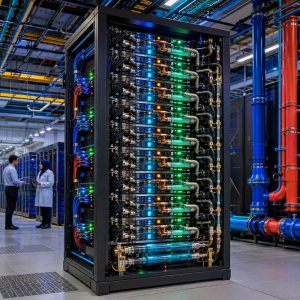
AI Racks at 1 MW: How AI Is Forcing a Complete Rethink of Data Center Design

AI in Construction: Physical Automation Hits the Tipping Point in 2026